E20 Petrol May Slightly Reduce Mileage, Says Centre; Government Dismisses Rumours Over Engine Safety and Insurance
E20 Petrol May Slightly Reduce Mileage, Says Centre; Government Dismisses Rumours Over Engine Safety and Insurance
Union Petroleum Minister Hardeep Singh Puri says E20 fuel may cause a slight drop in mileage but improves engine performance, while assuring motorists that the ethanol-blending programme is scientifically tested and safe.
By Vidhi Lalla
The Central Government has acknowledged that vehicles running on E20 petrol may experience a slight reduction in mileage. However, Union Petroleum and Natural Gas Minister Hardeep Singh Puri clarified that the impact is minimal and should not be viewed negatively, as ethanol-blended fuel also offers several performance and environmental benefits.


Speaking at a press conference in New Delhi, Puri said the reduced fuel efficiency cannot be attributed solely to ethanol blending. He explained that several other factors, including vehicle technology, engine condition and driving habits, also influence mileage.
Responding to criticism over the nationwide rollout of E20 petrol, the minister rejected allegations that the government was experimenting on motorists. He described many of the claims circulating on social media about engine damage and poor performance as a “make-believe narrative.”
Puri said ethanol is already used in high-performance racing cars because it improves vehicle acceleration and helps reduce engine knocking. According to him, while mileage may decline marginally, the overall driving experience and engine performance can improve with ethanol-blended fuel.
The minister also addressed concerns over vehicle insurance. He clarified that insurance companies have confirmed there is no issue with claims or policy coverage for vehicles using E20 petrol. He urged motorists not to rely on misinformation being circulated online.
The government further stressed that the E20 programme was introduced only after detailed consultations with stakeholders, including the Society of Indian Automobile Manufacturers (SIAM) and the Automotive Research Association of India (ARAI). Officials said the rollout follows extensive scientific testing and industry recommendations.
Looking ahead, Puri said the government is exploring higher ethanol-blending levels in the future. However, he clarified that any move beyond the current 20 per cent blend, such as E25 petrol, will only be considered after rigorous technical evaluations, scientific testing and consultations with industry experts.
The Centre has been promoting ethanol blending as part of its strategy to reduce crude oil imports, support domestic sugarcane farmers, lower carbon emissions and strengthen India’s energy security.
Frequently Asked Questions (FAQs)
Q. What is E20 petrol?
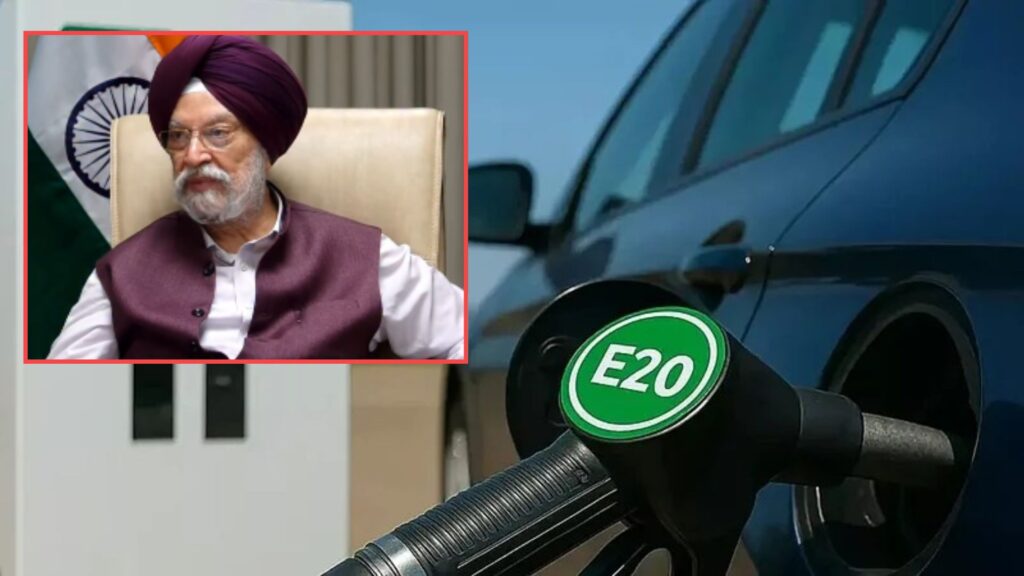
E20 petrol is fuel that contains 20 per cent ethanol blended with 80 per cent petrol. Ethanol is a renewable biofuel produced mainly from sugarcane and other agricultural feedstocks.
Q. Does E20 petrol reduce vehicle mileage?
Yes. According to the Union Petroleum Minister, E20 petrol may slightly reduce mileage. However, the reduction is expected to be minimal and depends on factors such as vehicle condition, engine technology and driving style.
Q. Can E20 petrol damage my engine?
The government says there is no evidence that E20 petrol damages compatible vehicles. It maintains that the fuel has undergone extensive testing before nationwide implementation.
Q. Will using E20 petrol affect vehicle insurance claims?
No. The government has clarified that insurance companies have confirmed there is no impact on vehicle insurance coverage or claim settlement due to the use of E20 petrol.
Q. Why is the government promoting ethanol-blended fuel?
The ethanol blending programme aims to reduce India’s dependence on imported crude oil, cut carbon emissions, improve energy security and provide additional income opportunities for farmers by increasing demand for ethanol feedstock.
Disclaimer: Fuel efficiency may vary depending on the vehicle model, engine condition, maintenance, driving habits and road conditions. Vehicle owners are advised to follow the fuel recommendations provided by their vehicle manufacturer.