Rising School Fees Push Parents Toward Loans: Financial Relief or Risky Gamble?
Rising School Fees Push Parents Toward Loans: Financial Relief or Risky Gamble?
With education costs surging across India, parents are turning to short-term school fee loans. But are they a blessing or a financial trap?
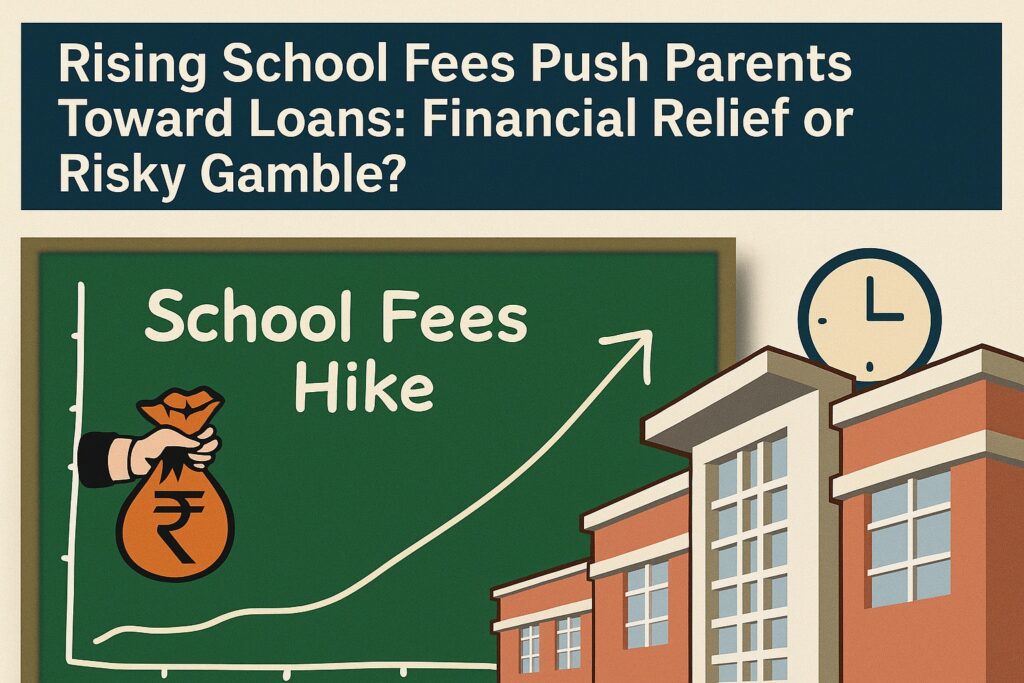
As school fees in India continue to soar, more parents are finding themselves under financial strain. A LocalCircles survey conducted in May 2025 revealed that 44% of parents reported facing fee hikes between 50% and 80% over the past three years. Education, whether in big cities or small towns, is rapidly becoming more expensive and increasingly unaffordable.
To address this, several schools have partnered with banks and fintech lenders to offer short-term loans specifically for paying school fees. Schools have tied up with companies such as GrayQuest, Eduvanz, and EduFin to provide parents with the option to pay school fees through monthly instalments. Parents can apply online through the school’s portal or approach lenders like IDFC First Bank and Bank of Baroda directly.

These loans typically cover tuition and admission fees, along with library, laboratory, and examination charges. Some plans also include hostel costs, as well as the purchase of books, uniforms, and laptops. However, they do not include expenses like external coaching or extracurricular tuition. Once the loan is approved, the amount is paid directly to the school or vendors, while parents repay the amount to the lender in equated monthly instalments, or EMIs.
Some fintech firms offer no-cost EMI options, which means parents can break up a large annual fee say ₹2.4 lakh into ₹20,000 monthly payments without added interest. This can ease the immediate burden of lump-sum payments and improve cash flow management. For parents with a stable income, this can be a convenient way to manage rising education costs.
However, these loans are not without risk. They are formal credit agreements, and missed or delayed payments can negatively affect a parent’s credit score. Some lenders may also charge processing or administrative fees. If EMIs are not paid on time, schools can withhold report cards or access to digital platforms as per their policies, which can affect the child’s academic continuity.
The emotional and financial impact can also be significant. Taking a loan every academic year may push families into a continuous debt cycle, especially if other financial obligations already exist. In such cases, the short-term relief of EMIs may be outweighed by the stress of long-term repayment pressure.
A school fee loan should be considered only if the borrower has a predictable, stable income and is confident in repaying the monthly instalments without compromising other financial responsibilities. It is advisable to avoid these loans if the family already has high EMIs, unstable earnings, or other ongoing debts.
In summary, bridge loans for school fees can provide timely support for many households, but they should be used wisely. Understanding the fine print and evaluating one’s financial capacity before opting in is essential. Education is a priority, but financial peace should not be the price.