Pune: 44-Year-Old Woman Undergoes Complex Fibroid Surgery at Inamdar Hospital After Ignoring Symptoms for Months

Pune: 44-Year-Old Woman Undergoes Complex Fibroid Surgery at Inamdar Hospital After Ignoring Symptoms for Months
When Pain Isn’t “Just Age”: A 44-Year-Old Woman’s Journey Through Complex Fibroid Surgery
When Meera (name changed), 44, came to Inamdar Multispeciality Hospital on 1 November, she walked in thinking she would get “some medicines” and go back to her routine.
For months, she had lived with:
- Nagging lower abdominal pain
- Heavy, irregular bleeding
- Constant tiredness and disturbed sleep
Like many women in their 40s, she kept telling herself, “Yeh toh age ka effect hai… it’s normal.”
The diagnosis behind the symptoms
Clinical examination and scans showed that Meera had:
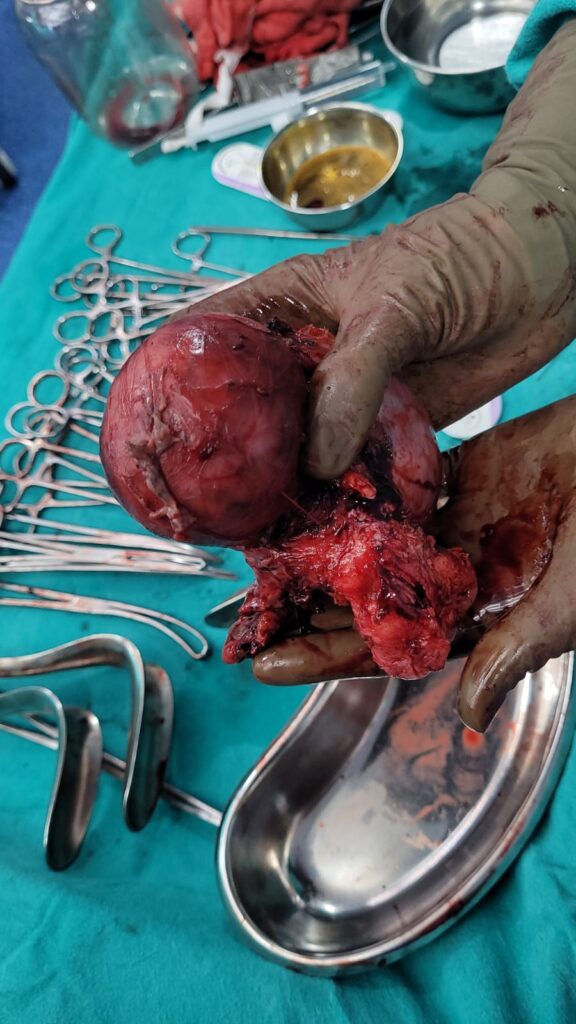
- A large fibroid uterus with an 8 cm anterolateral wall fibroid
- Cystocoele and rectocoele – weakening of the pelvic floor, causing the bladder and rectum to bulge into the vagina
- An umbilical hernia
These findings explained her heavy bleeding, pain and discomfort. They also meant that she needed more than just tablets and rest.
“Any woman over 40 who finds her bleeding getting heavier, longer, more painful or irregular must treat it as a health alert, not a phase to ‘adjust’ to,” says Dr Charu Sud, MBBS, MD (Obstetrics & Gynaecology), Consultant – Obstetrics & Gynaecology, Inamdar Multispeciality Hospital, Pune. “Your body is talking to you. Please don’t mute it with painkillers and excuses.”
Given her condition, the team advised a Laparoscopically Assisted Vaginal Hysterectomy (LAVH) with cystocoele and rectocoele repair, and in the same sitting, laparoscopic umbilical hernia repair.
A technically demanding surgery
In the operation theatre, one more factor became crucial: Meera’s weight was around 100 kg. Obesity changes how surgeons and anaesthetists plan a procedure—it can reduce visibility, narrow working space and increase anaesthesia and recovery risks.
The gynaecological surgery was led by Dr Charu Sud, Consultant – Obstetrics & Gynaecology, along with
Dr Sucheta Talele, MBBS, DGO, DNB (Obstetrics & Gynaecology), Consultant High Risk Obstetrician and Gynaecologist and Laparoscopic Surgeon, Inamdar Multispeciality Hospital, Pune.
Her umbilical hernia was repaired laparoscopically by Dr Abhijit B. Gotkhinde, MBBS, DNB (General Surgery), Consultant Laparoscopic, Robotic & Laser (Minimal Access) Surgeon, Inamdar Multispeciality Hospital, Pune. The major OT and anaesthesia team, including Dr Nelson Bardeskar, MS (General Surgery), Consultant General, Laparoscopic & Laser Surgeon, Inamdar Multispeciality Hospital, Pune, and Dr Akshaya, provided critical support and monitoring throughout.
The most challenging part was delivering the enlarged uterus vaginally. The 8 cm fibroid kept getting stuck behind the pubic bone (pubic symphysis). The team changed their angle of approach, worked carefully from the back, held the uterine fundus and very gently guided the uterus down before clamping, cutting and ligating the cornua in a slow, controlled sequence.
“In such cases, you need patience, planning and a very calm OT,” explains Dr Sucheta Talele. “The aim is not just to finish a difficult surgery, but to do it safely so that the woman recovers well and returns to her daily life with confidence.”
Meera had her surgery the same day as admission, was discharged on 5 November, and came for follow-up on 12 November with no abnormal bleeding, less pain and much better comfort in walking and daily activities.

“My body had been warning me for a long time”
“I used to say, ‘after 40, every woman has these issues’. I pushed my check-ups, ignored my cycles and just kept going,” Meera says.
“When the doctors showed me what was happening inside, I realised how long I had been ignoring my own body. This surgery has given me relief—and a big reality check. I cannot treat my health as the last item on my to-do list anymore.”
She has now started regular walks, is working with a diet counsellor and has decided to keep yearly gynaecology visits.
A message for every woman crossing 40
Dr Charu Sud sums it up simply:
“After 40, any change in your periods, any new pelvic pain, or any persistent discomfort deserves a proper check-up. Early action usually means more options and smoother treatment. Late action often means complex surgery.”
What Meera’s case teaches every woman:
- Don’t normalise heavy or irregular bleeding.
- Don’t ignore pelvic pain, pressure, urinary or bowel changes.
- Don’t push your own health to the bottom of the family priority list.
Her journey is a quiet reminder to women everywhere: listen early, act early—and treat your health as non-negotiable.