How The Shivarkar Legacy Transformed Wanawadi Into A Modern, Progressive Neighbourhood
How The Shivarkar Legacy Transformed Wanawadi Into A Modern, Progressive Neighbourhood
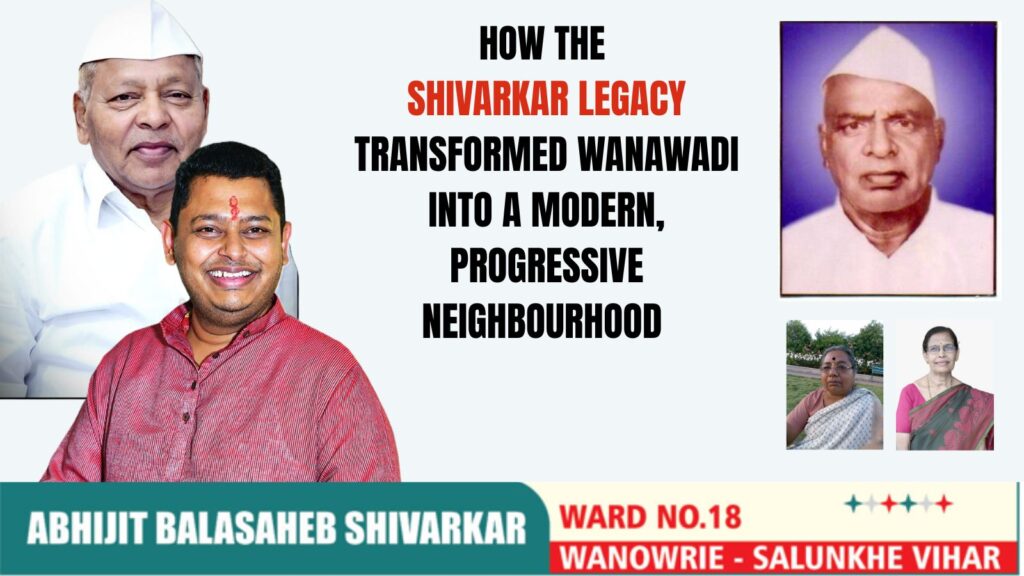
Wanawadi’s transformation from a small agrarian village into one of Pune’s most developed, connected and sought-after neighbourhoods is deeply rooted in the legacy of two visionary leaders—late Viththalrao Shivarkar and senior Congress leader Balasaheb Shivarkar.
Their decades-long commitment to civic development, education and social upliftment laid the foundation for the modern Wanawadi residents know today.Late Viththalrao Shivarkar arrived in Wanawadi as a farm labourer but soon became a central figure in the locality’s evolution. With limited formal education but immense determination, he worked alongside prominent leaders like Kisan Veer and Ratnappa Kumbhar. His public life began dramatically when he confronted and punished a British soldier who was harassing women in Wanawadi, earning him deep respect among villagers.
He went on to become one of Pune’s first corporators (1952–57) and later MLA from the Pune Cantonment constituency.Viththalrao actively participated in the freedom struggle, remained underground during crucial phases, and later joined the Samyukta Maharashtra Movement, for which he served a jail term in Yerwada. His efforts in the movement helped bring together opposition MLAs to support Yashwantrao Chavan, a contribution acknowledged by Chavan in his autobiography Krishnakath.

His developmental work reshaped Wanawadi. He introduced the first underground drainage line, internal roads, streetlights, and improved water and sanitation facilities. He pushed for the establishment of three PMC primary schools, initiated the first sewage treatment project, and built the first bridge connecting Wanawadi village.
Committed to education, he founded the Mahatma Phule Education Society and started Bhairavnath School in his own home. He later established Lokmanya Education Society in Nathachi Wadi, Daund.Viththalrao secured 250 acres of land for 45 landless families in Alegav Paga, pioneered Maharashtra’s first community wedding ceremony, and donated 25,000 sq ft of his own land for a municipal hospital in Wanawadi. His legislative career was equally impactful, raising maximum questions in the Assembly despite limited schooling.Carrying this legacy forward, Balasaheb Shivarkar emerged as one of Pune’s most influential leaders—three-time corporator, three-time MLA, mayor and minister of state. He accelerated eastern Pune’s growth by ensuring the transfer and expansion of the Cantonment Water Works to PMC, ensuring reliable water supply for Wanawadi, Kondhwa and Undri.
He played a vital role in releasing key defence-land reservations, enabling large townships and housing societies to develop. Under his tenure, nearly 50 roads, drainage lines, pipelines, parks and schools were built. He also initiated the construction of the Shaheed Pandurang Salunke Memorial in Salunke Vihar, honouring the Param Vir Chakra awardee of the 1971 war.
Together, Viththalrao and Balasaheb Shivarkar created the backbone of modern Wanawadi—a neighbourhood shaped by vision, service and unwavering dedication to public welfare.