Third Mumbai–Pune Expressway: A To Z Of The New 130 Km Greenfield Corridor
Third Mumbai–Pune Expressway: A To Z Of The New 130 Km Greenfield Corridor
DPR approved, land acquisition underway, and work on key sections set to begin from March 2026
The long-discussed Third Mumbai–Pune Expressway is now officially moving from planning to execution, with the National Highways Authority of India (NHAI) approving the Detailed Project Report (DPR) and revealing timelines for construction. Designed as a high-capacity greenfield corridor, the new expressway aims to drastically cut travel time between Mumbai and Pune while easing pressure on the existing Mumbai–Pune Expressway.
Why Is It Called The ‘Third’ Expressway?
The project is being called the third Mumbai–Pune expressway because it will act as a third alternative route between the two cities. Currently, commuters rely on the Yashwantrao Chavan Mumbai–Pune Expressway and the old NH-48 Pune–Mumbai highway. The new corridor will run parallel to both, offering a modern, faster, and safer option.
This expressway is also part of the larger Mumbai–Pune–Bengaluru Express Corridor, with the Pune–Bengaluru stretch already under construction. The Mumbai extension of this route is what forms the third expressway.

Route, Length And Design
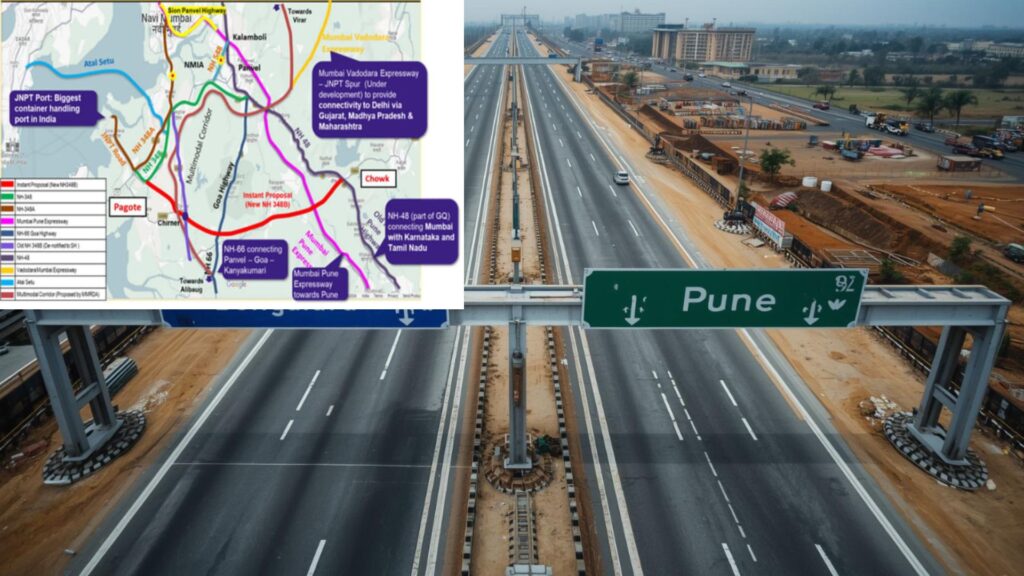
The proposed expressway will be a 130-km, six-lane greenfield highway running from Atal Setu in Mumbai to Shivare Junction near Pune. It will pass through the Sahyadri mountain range using a network of tunnels and elevated bridges, a design aimed at maintaining high speeds while ensuring safety in hilly terrain.
The route has been strategically planned to connect Navi Mumbai International Airport and Jawaharlal Nehru Port Trust (JNPT), making it crucial for both passenger movement and heavy commercial logistics. It will also link with Pune’s Ring Road, allowing traffic headed towards Satara, Kolhapur, and Bengaluru to bypass Pune city entirely.
Cost, Capacity And Travel Time
While early estimates for certain sections place costs around ₹3,500 crore, the overall project cost is expected to be around ₹15,000 crore. Once operational, the expressway is designed to handle up to three lakh vehicles per day.
The biggest impact will be on travel time. The Mumbai–Pune journey, which often stretches well beyond three hours due to congestion, is expected to be completed in around 90 minutes under normal traffic conditions.
What NHAI Officials Say
Sanjay Kadam, Project Director, NHAI Pune, said the new expressway has become essential due to rising traffic volumes on the existing route.
“The existing Pune–Mumbai e-way has reached saturation due to a sharp rise in traffic volume, leading to congestion, delays, and safety concerns. This new expressway is being planned as a high-capacity alternative that will ensure smoother, faster and safer travel,” he said.
Explaining the alignment, Kadam added, “The expressway will start near Atal Setu, connect Navi Mumbai International Airport and Jawaharlal Nehru Port Trust (JNPT) and pass through the Sahyadri range using a network of tunnels and elevated bridges before terminating at Shivare in Bhor taluka.”
When Will Work Start?
NHAI has completed around 70% land acquisition for the crucial Pagote–Chowk (30 km) section. The bidding process for this stretch is in its final stages, with contractors expected to be appointed soon. Construction on this section is slated to begin in March 2026.
Officials have indicated that once construction starts, the targeted completion timeline is around three years.
What This Means For Commuters
For daily and frequent commuters, the announcement comes as a relief. Persistent congestion, accidents, and unpredictable delays on the existing expressway have long been a concern. Once operational, the third Mumbai–Pune expressway is expected to transform intercity travel, boost logistics efficiency, and significantly improve regional connectivity across western Maharashtra.