Eight Hours of Pretending: Intern’s Experience Highlights the Rise of ‘Task Masking’ in Offices
Eight Hours of Pretending: Intern’s Experience Highlights the Rise of ‘Task Masking’ in Offices
For one young intern, the reality of office life was far different from what he expected. The first two weeks of his internship were hands-on and engaging: he worked at a pharmaceutical plant, fixing machinery, moving materials, and learning on the floor alongside experienced staff. But once he was moved to an office desk, the situation changed dramatically.
“Now, I sit at my desk for eight hours and just pretend to be busy,” he wrote in a candid Reddit post. His days are filled with opening files, scrolling through spreadsheets, and waiting for tasks to come his way. When managers notice him idle, he is given trivial jobs no one else wants. The monotony is so intense that he finds himself counting the minutes, yet leaving is not an option because he relies on the paycheck.
What frustrates him the most isn’t the lack of work—it’s the constant performance of looking productive. He wonders whether to discuss his situation with his manager or the staffing agency that technically employs him, or simply endure another month of the same routine.

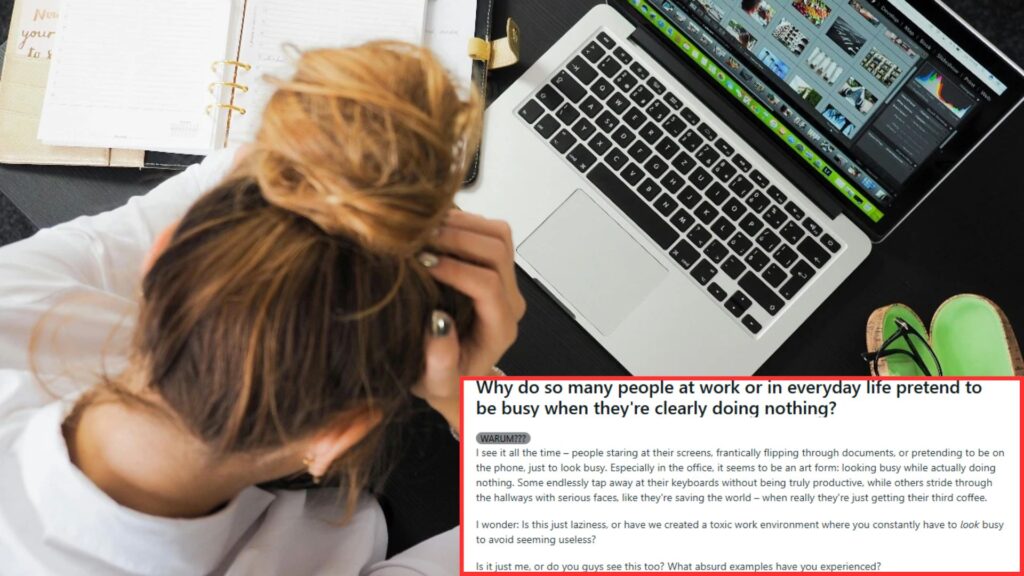
Other employees have shared similar experiences online. Office corridors, they note, are often full of people appearing busy but producing little: frantically typing, flipping through documents, walking briskly with serious expressions, or pretending to take calls. This raises a difficult question: is this sheer laziness, or a workplace culture that values appearances over actual results?
This phenomenon now has a name: task masking. It refers to the act of looking productive while accomplishing very little. At first glance, it may seem harmless—attending unnecessary meetings, opening and closing documents, carrying laptops around—but its widespread presence points to a systemic issue rather than personal failings.
Even senior leaders are not immune. Zerodha founder Nikhil Kamath admitted on the WTF podcast that much of what he does can feel like “pretending to work.” A former CXO revealed that he only appeared busy while his own bosses were around, with meaningful output taking up just a fraction of his day.
Task masking thrives in modern office culture because visibility has become a proxy for value. With return-to-office mandates, sitting at a desk for long hours signals commitment, while leaving early is perceived as disengagement—regardless of actual work completed. Employees naturally adapt, focusing on appearances rather than results.
The implications are serious. Efficiency declines, trust erodes, and employees learn to inflate effort while hiding true productivity. Psychologically, it is exhausting. Long hours of performing busyness drain energy and create anxiety, leaving workers tired yet unfulfilled.
This is not a problem of laziness or lack of discipline. Task masking often arises because employees do not have clear benchmarks for success, do not believe genuine effort will be recognized, or sense that visibility matters more than results. Admitting that work is complete can even backfire, with “extra” assignments handed out as punishment. The Reddit intern’s experience highlights this perfectly: finishing work early invites more meaningless tasks.
Over time, this pattern teaches employees to slow down, stretch tasks, and replace real progress with the illusion of activity. Work becomes louder but less meaningful, while managers lose sight of actual capacity and productivity.
Solving task masking doesn’t require employees to work harder. It requires clarity from management: defining what constitutes success, identifying key outputs, and setting expectations for task completion. Until organizations provide these answers, office spaces will remain filled with motion that accomplishes little. Employees like the Reddit intern will continue to spend their days sitting, counting minutes, and performing busyness—quietly hoping no one notices.