Rare Eyeless Common Trinket Snake in Pune Documented in International Journal
Rare Eyeless Common Trinket Snake in Pune Documented in International Journal
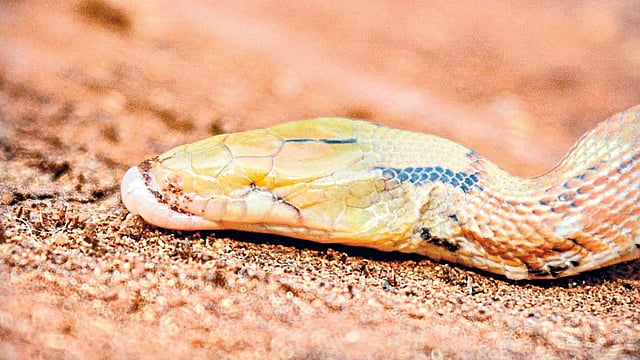
Discoveries in wildlife continue to astonish, and one such exceptional case emerged in Pune’s Pashan when a Common Trinket Snake (Coelognathus helena) was found completely without eyes. This unusual specimen has now been scientifically studied and published in the international journal Reptiles & Amphibians (USA), thanks to the efforts of Solapur-based ophiologist Rahul Shinde and Pune snake rescuer Anil Kanaskar. The documentation highlights a rare congenital condition with significant scientific value.
The Common Trinket Snake is a non-venomous species that is primarily terrestrial and can be active during both day and night. It is commonly found in gardens, old buildings, and forests throughout South Asia. While these snakes are widely encountered, cases like this—where the snake is born without eyes—are extremely rare, making this discovery especially noteworthy.
Kanaskar recalled, “On Dec 19, 2024, I received a call from the Sutarwadi area in Pashan where I came across an unusual specimen of the Common Trinket Snake.” Upon closer examination, he observed that the ocular regions were completely covered with smooth scales, with no visible pupils, and slight jaw deformities were also evident. Recognizing it as a rare congenital abnormality, he immediately contacted Shinde for expert guidance. “It is gratifying that this discovery has been scientifically studied and documented,” Kanaskar added.

Shinde confirmed that the snake displayed bilateral anophthalmia, a congenital condition in which both eyes fail to develop. “Such abnormalities are extremely rare in snakes, and this is believed to be the first recorded instance of bilateral anophthalmia in the Common Trinket Snake,” he said. The researchers emphasized that documenting such anomalies at an international level significantly contributes to reptile biology and developmental studies.
Anophthalmia occurs during early embryonic development when the eye structures fail to form or regress prematurely. While genetic and environmental factors may play a role, the exact cause in this case is unknown. Remarkably, despite these deformities, the snake appeared healthy. After careful observation and scientific documentation, it was safely released back into its natural habitat.
Shinde highlighted the broader relevance of the finding for herpetology and developmental biology. “Documenting such rare conditions enhances our understanding of embryological development in reptiles and reinforces the importance of recording unusual wildlife occurrences,” he noted. Experts say this discovery underscores the need for systematic documentation of rare anomalies, which can provide valuable insights for future research into congenital deformities in reptiles.