Supreme Court Focuses on Gender- Segregated Toilets and Menstrual Hygiene in Schools
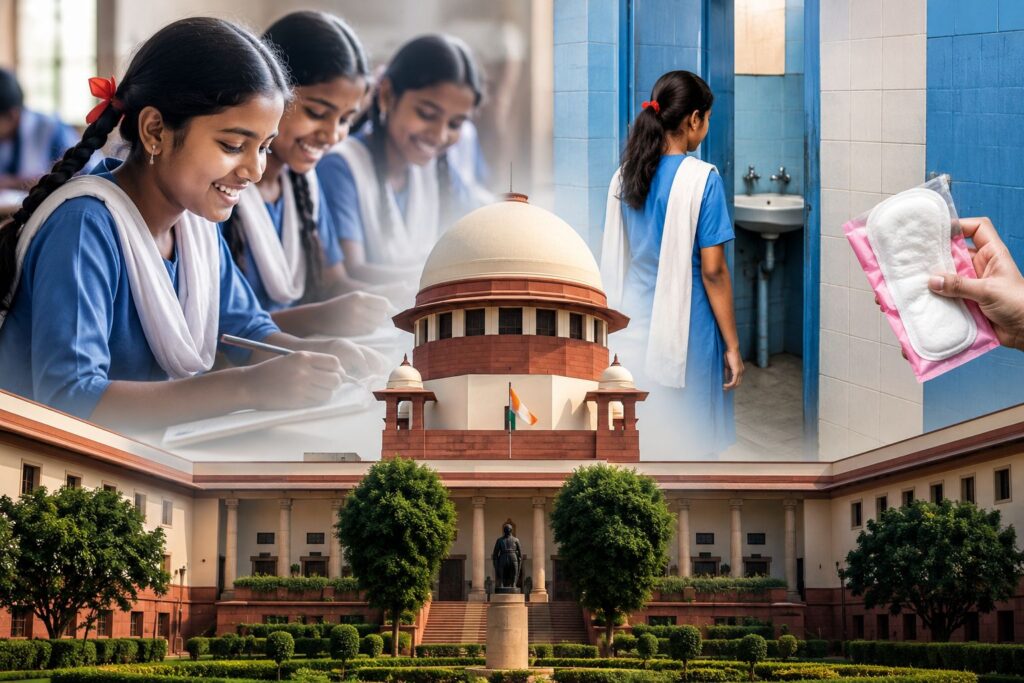
Supreme Court Focuses on Gender- Segregated Toilets and Menstrual Hygiene in Schools
In a significant observation aimed at protecting the educational rights and dignity of girl students, the Supreme Court on Monday stressed that girls should never be forced to discontinue their education due to the absence of sanitary napkins and functional gender-segregated toilets in schools. The apex court directed the Centre and state authorities to ensure strict implementation of earlier directions regarding menstrual hygiene and sanitation facilities across educational institutions.
The remarks came during the hearing of a matter related to menstrual hygiene management in schools, where the Centre informed the court that efforts are being made nationwide to improve facilities for girl students. The bench noted that the lack of proper sanitation remains one of the major reasons behind absenteeism and school dropouts among adolescent girls, especially in rural and economically weaker regions.

A bench comprising Justices J B Pardiwala and R Mahadevan observed that education is a fundamental right and no girl should be compelled to stay at home because schools fail to provide the necessities required during menstruation. The court emphasised that menstrual hygiene is directly linked to health, dignity, equality, and access to education.

The Supreme Court also referred to its January 30 judgment, in which authorities were directed to ensure free sanitary napkins for girl students and the availability of separate, hygienic, and functional toilets for girls in schools. According to the Centre, the judgment has accelerated efforts across states and Union Territories, leading to increased coordination between education departments, health departments, and local administrations.
The court highlighted that inadequate sanitation facilities often create unsafe and uncomfortable environments for female students. In many schools, girls reportedly avoid attending classes during menstruation due to fear of embarrassment, lack of privacy, and unhygienic conditions. Experts and activists have long argued that this issue contributes significantly to educational inequality in India.
STORY | Girls shouldn't give up education due to lack of sanitary napkins, gender-segregated toilets:
— Press Trust of India (@PTI_News) May 25, 2026
SC to Centre
The Supreme Court on Monday stressed that girls should not give up education only for the reason that sanitary napkins and functional, gender-segregated toilets are… pic.twitter.com/M3fU1MyGpj
According to various surveys conducted in the past, a considerable number of girls in India miss school during menstruation, while many eventually drop out altogether after reaching puberty. Lack of awareness, social stigma surrounding menstruation, poor access to sanitary products, and absence of clean toilets continue to affect the academic journey of thousands of students.
The apex court stated that providing sanitary napkins and proper washroom facilities should not be treated as welfare measures alone, but as essential requirements for ensuring equal educational opportunities. It further underlined that schools must become safe and inclusive spaces where girls can study without discomfort or discrimination.
The Centre informed the court that multiple schemes and awareness drives are being implemented in collaboration with state governments to improve menstrual hygiene among school-going girls. Authorities are also reportedly working on strengthening monitoring systems to ensure schools comply with sanitation norms.
Education and child rights activists welcomed the court’s observations, calling them a crucial step towards addressing period poverty and gender disparity in education. They believe the intervention could encourage stronger policy implementation and improve school attendance rates among girls, particularly in remote and underprivileged areas.
The issue has once again drawn national attention to the broader challenges surrounding menstrual health awareness in India. Experts argue that alongside infrastructure development, there is a need for comprehensive awareness campaigns to break social taboos associated with menstruation and create a supportive environment for young girls.
The Supreme Court’s remarks are being seen as an important reminder that access to education cannot be separated from access to dignity, hygiene, and basic healthcare facilities.