Maharashtra Housing Society Rules Overhauled: Changes Every Flat Owner Must Know
Maharashtra Housing Society Rules Overhauled: Changes Every Flat Owner Must Know
From capped maintenance charges to parking decided by members, the state government’s June 30 amendments directly affect millions of residents across Maharashtra
By Vidhi
Pune: If you live in a co-operative housing society in Maharashtra, the rules governing how your society collects money, manages funds, and makes decisions changed on June 30, 2026. The Government of Maharashtra amended the Maharashtra Co-operative Societies Rules, 1961, with the stated aim of bringing transparency, uniformity, and accountable management to housing societies across the state. The notification came into effect on the same day it was published.


Here is what changed and what it means for residents.
- Charges That Are Now Capped or Standardised
The most immediate changes affect how societies collect money from members.
Service charges must now be levied uniformly across all flats in a society, regardless of floor, size, or usage, closing a gap that had allowed some societies to impose unequal charges. Water charges will be calculated based on the number of taps provided to each flat rather than a flat per-unit rate, making the billing more proportional to actual supply.
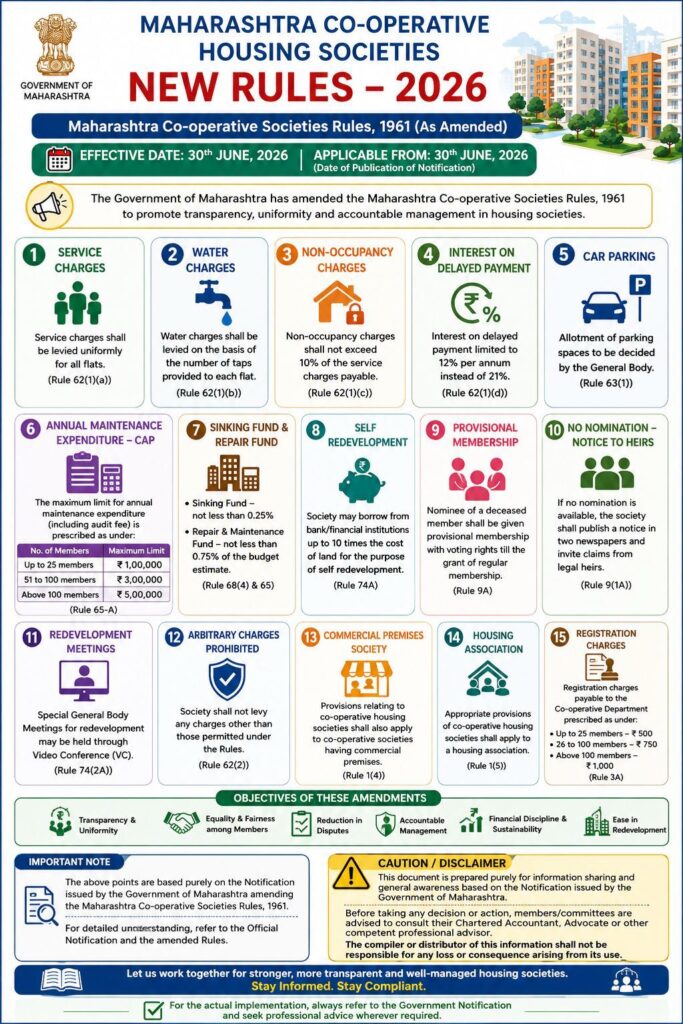
Non-occupancy charges, which are levied on flats that are rented out rather than owner-occupied, have been capped at 10 percent of the service charges payable. This is a significant protection for members who had previously faced much higher non-occupancy levies. Societies are also now prohibited from levying any charge not specifically permitted under the rules, directly addressing the problem of arbitrary fees that many residents have faced.
The interest rate on delayed maintenance payments has been reduced from 21 percent per annum to 12 percent per annum. This brings the rate closer to standard lending norms and eases the financial burden on members who fall behind.
- Annual Maintenance Caps by Society Size
For the first time, the government has set a maximum cap on annual maintenance expenditure including audit fees, scaled by society size. Societies with up to 25 members can spend a maximum of ₹1 lakh annually on maintenance. Those with 51 to 100 members are capped at ₹3 lakh. Societies with more than 100 members have a ceiling of ₹5 lakh. This rule is designed to prevent societies from inflating maintenance budgets at the expense of members.
- Sinking Fund and Repair Fund Made Mandatory
Societies are now required to maintain a Sinking Fund of not less than 0.25 percent, and a Repair and Maintenance Fund of not less than 0.75 percent of the budget estimate. Making these contributions mandatory addresses a long-standing problem where societies deferred structural repairs for years due to absent or underfunded reserves, leaving buildings in poor condition and members exposed to sudden large levies.
- Parking, Redevelopment, and Membership
Car parking allotment is now to be decided by the General Body of the society, removing discretion from individual committee members and ensuring the decision is collective. This directly addresses one of the most common sources of conflict in housing societies.
For self-redevelopment, societies may now borrow from banks and financial institutions up to ten times the cost of land. This significantly expands the financial capacity of societies that wish to undertake redevelopment independently rather than through a developer.
Special General Body Meetings for redevelopment can now be held through video conference, a practical update that removes the logistical barrier of assembling all members in person for what are often lengthy or contentious proceedings.
- Protections for Members and Heirs
The nominee of a deceased society member will now receive provisional membership with full voting rights until regular membership is formally granted, ensuring continuity of representation for families navigating the paperwork after a loss.
Where no nomination exists, the society is required to publish a notice in two newspapers inviting claims from legal heirs, replacing the informal and often inconsistent practices that previously left property disputes unresolved.
- Registration Charges and Broader Applicability
Registration charges payable to the Co-operative Department have also been standardised: ₹500 for societies with up to 25 members, ₹750 for 26 to 100 members, and ₹1,000 for societies above 100 members.
The amended rules now apply not only to residential co-operative housing societies but also to co-operative societies with commercial premises and to housing associations, broadening the reach of the protections significantly.
The government has stated that the objectives of the amendments are transparency and uniformity, equality and fairness among members, reduction in disputes, accountable management, financial discipline, and ease in redevelopment. The notification advises all members and committees to refer to the official government notification for complete details and to consult a chartered accountant, advocate, or professional advisor before acting on any of the new provisions.
Disclaimer:This article is based on the Government of Maharashtra’s notification amending the Maharashtra Co-operative Societies Rules, 1961, effective June 30, 2026. For legal or financial decisions, always refer to the official notification and seek professional advice.