Smart Meters Not Responsible for Higher Power Bills, Heatwave Drove Surge in Consumption: CM Fadnavis
10 July, 2026: Maharashtra Chief Minister Devendra Fadnavis on Friday said that smart meters are not responsible for the recent increase in electricity bills, attributing the higher bills to the prolonged heatwave and increased power consumption during the summer.
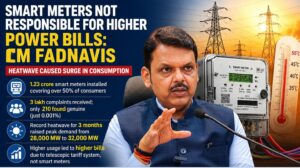
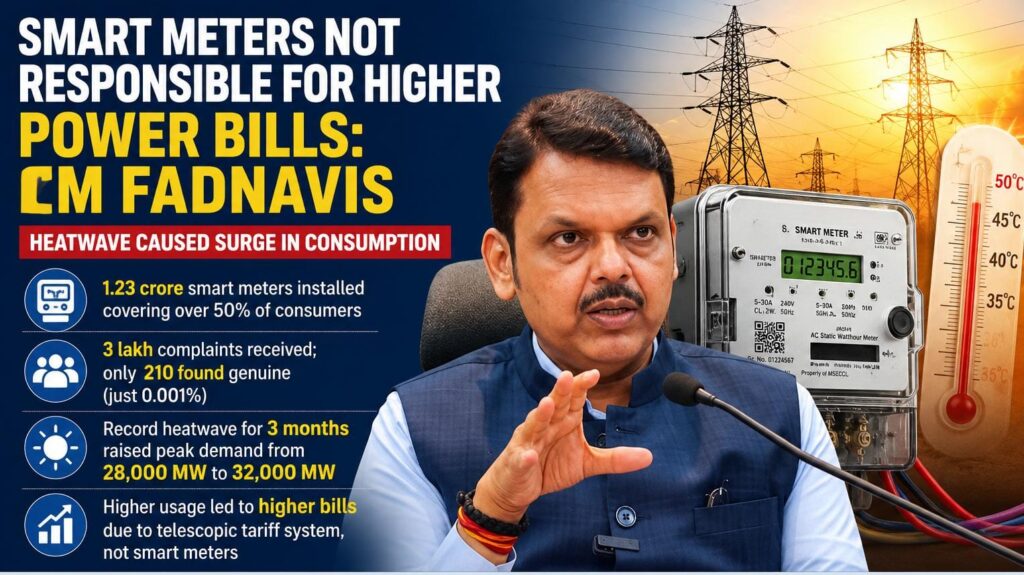
Replying to the final week motion in the Maharashtra Legislative Assembly, Fadnavis said the Centre has made smart meters mandatory across the country and Maharashtra has already installed 1.23 crore smart meters, covering more than 50% of the targeted consumers.
Addressing concerns over higher electricity bills, the Chief Minister said that while nearly 3 lakh consumers had lodged complaints regarding smart meters, detailed inspections found only 210 complaints to be genuine. He said this accounts for just 0.001% of the total complaints, indicating that the vast majority of smart meters were functioning correctly.

Fadnavis said consumers using smart meters also receive benefits such as lower daytime electricity tariffs. However, he acknowledged that many people had reported higher bills and clarified that the increase was due to unusually high electricity usage during the intense summer rather than the installation of smart meters.
He said Maharashtra experienced a heatwave for nearly three months this year, causing electricity demand to rise sharply. The state’s peak power demand increased from the usual 28,000 MW to nearly 32,000 MW, with the higher demand continuing for three consecutive months.
To support his argument, Fadnavis cited a study conducted in Badlapur, where the maximum temperature rose from 38°C in May 2025 to 43°C in May 2026. He also noted that the monsoon arrived nearly a month late, leading to increased use of air conditioners, coolers and fans.
According to the study, electricity consumption in a typical one-bedroom household increased from around 270 units to 415 units, while homes that usually consumed 400 units saw their usage rise to nearly 600 units.
Explaining the billing structure, the Chief Minister said Maharashtra follows a telescopic tariff system, where electricity rates increase after certain consumption levels. Consumers using more than 300 units pay a higher rate, while those crossing 500 units are charged an additional increase. As a result, higher electricity consumption during the heatwave automatically led to higher bills.
Fadnavis reiterated that similar increases in electricity bills were reported even in areas where smart meters have not yet been installed, further indicating that the rise in bills was linked to increased power usage rather than the metering system.
No Load Shedding Across Maharashtra
The Chief Minister also said Maharashtra successfully met the record summer power demand of 32,000 MW. He admitted there was a temporary shortage of around 500 MW for two days after some power generation units went offline, but maintained that there has been no statewide load shedding.
Responding to complaints from rural areas, Fadnavis explained that many consumers confuse scheduled power supply under the feeder separation scheme with load shedding. He said 76% of agricultural feeders in the state now receive daytime electricity, and work is underway to shift more consumers to village feeders to ensure a more reliable supply.
He also referred to the recent flooding in Vasai-Virar, where electricity supply had to be suspended for three days as a safety measure. The government, he said, is working to relocate power infrastructure in low-lying and flood-prone areas to prevent similar disruptions in the future.