Nalanda University: From Ancient Glory Through Destruction To Modern Revival

Nalanda University: From Ancient Glory Through Destruction To Modern Revival
More than 1,500 years after its establishment as the world’s first residential university, Nalanda rises again with a new campus inaugurated in 2024, rekindling India’s tradition of world-class education
Bihar’s Nalanda University stood as the beating heart of knowledge more than 1,500 years ago, attracting the brightest minds from across Asia. At its peak, the ancient institution housed over 10,000 students and 2,000 teachers, specializing in subjects ranging from astronomy and mathematics to medicine and philosophy. Today, after centuries of obscurity, Nalanda has been revived with a modern campus that honors its glorious past while looking toward the future.
The Ancient Marvel
Nalanda Mahavihara, established during the Gupta Empire in 427 AD near present-day Rajgir in Bihar, functioned as a Buddhist university for 800 years. It predates the University of Oxford and Europe’s oldest university, Bologna, by more than 500 years. Regarded as the second-oldest university in the world after Takshashila, it served as a residential campus spread over 14 hectares.

The university campus featured over 300 rooms, seven large halls, and its legendary library named Dharmagunj, which spanned nine stories. Chinese traveler Xuanzang, who studied there in the 7th century for nearly 15 years, described its vast libraries where monks handwrote and preserved manuscripts. The library contained nine million handwritten palm-leaf manuscripts, making it the richest repository of Buddhist wisdom in the world.
Admission proved as rigorous as modern elite institutions. Students faced demanding oral interviews, and only about 20 percent of applicants gained entry. Those admitted received mentorship from esteemed Buddhist masters like Dharmapala and Silabhadra. Historian William Dalrymple calls it the Harvard, Oxford, and NASA of its time, a place where ideas flourished, science advanced, and debates shaped the world.
Nalanda University, a UNESCO World Heritage Site, was one of the oldest and greatest universities that attracted scholars from all over. Plan a visit at this historic site which offers a glimpse into our glorious past. #ruinsofnalandauniversity #nalandauniversity #nalanda… pic.twitter.com/1u3Z9HhziC
— Bihar Tourism (@TourismBiharGov) September 19, 2023
Academic Excellence And Global Reach
The ancient university offered a diverse curriculum including theology, grammar, logic, astronomy, metaphysics, medicine, and philosophy. It gained particular renown for Buddhist studies, but also played a key role in developing Indian philosophy, religion, and various sciences.
Aryabhata, the renowned mathematician and astronomer believed to have invented zero, is speculated to have headed the university in the 6th century. His works laid the foundation for significant mathematical concepts used today. The ancient Indian medical system of Ayurveda received extensive teaching at Nalanda before spreading to other parts of India through alumni.

Nalanda attracted scholars from across Asia, including China, Korea, Japan, Tibet, Mongolia, Sri Lanka, and Southeast Asia. Notable scholars such as Chinese pilgrim Xuanzang and Korean pilgrim Hyecho studied there. The campus design of open courtyards enclosed by prayer halls and lecture rooms inspired other Buddhist institutions, while artistic traditions developed at Nalanda influenced ecclesiastical art in Thailand and metal work in Tibet and the Malayan peninsula.
Destruction And Rediscovery
Nalanda faced attacks before its final destruction. The Huns under Mihirkula struck in the 5th century, and the Gauda king of Bengal invaded in the 8th century. On both occasions, imperial patronage from rulers helped restore and expand the facilities.
In the 12th century, the devastating final blow came when invader Bakhtiyar Khilji, a Turko-Afghan military general, set fire to the university’s magnificent libraries. The fire raged for three months, destroying the priceless collection of Buddhist wisdom. Only a handful of palm-leaf volumes and painted wooden folios survived, carried away by fleeing monks. These manuscripts are now preserved in the Los Angeles County Museum of Art and the Yarlung Museum in Tibet.
After six centuries of obscurity, Scottish surveyor Francis Buchanan-Hamilton rediscovered the university in 1812. Sir Alexander Cunningham officially identified it as the ancient university in 1861. UNESCO designated the archaeological site as a World Heritage Site in 2016.
The Modern Revival
Former President APJ Abdul Kalam first proposed reviving Nalanda University in 2006 during his address to the Bihar Legislative Assembly. The proposal gained international support at the 2007 East Asia Summit, with endorsement from sixteen member countries.
The Indian Parliament passed the Nalanda University Bill in 2010, officially establishing the institution on November 25, 2010. The university opened its doors for the first batch of students in September 2014, operating from a temporary location near Rajgir with just 14 students.
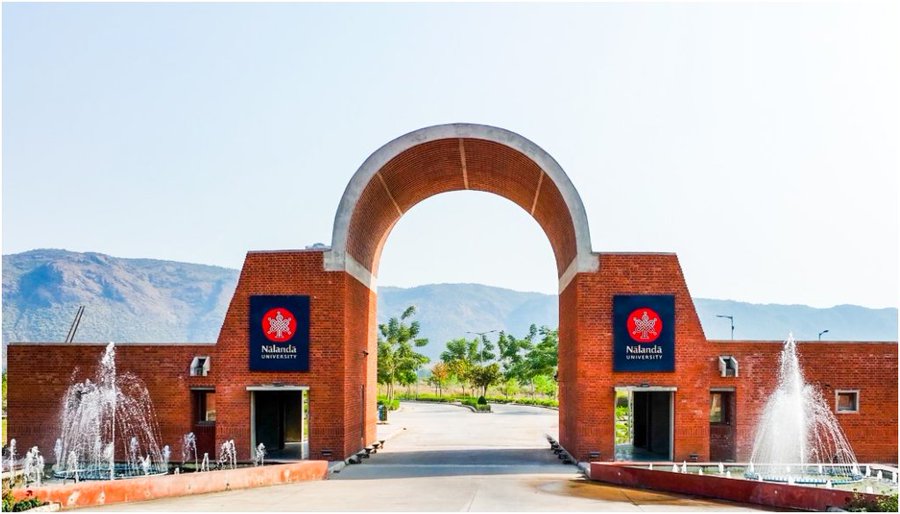
Former President Pranab Mukherjee laid the foundation stone for the permanent campus in 2016 at Pilkhi village, Rajgir. Construction commenced in 2017, and Prime Minister Narendra Modi inaugurated the new campus on June 19, 2024, in the presence of External Affairs Minister S Jaishankar and ambassadors from 17 partner countries.
A State-Of-The-Art Campus
Built at a cost of Rs 1,749 crore, the new 455-acre campus represents a collaborative effort between India and East Asia Summit countries, including Australia, Bangladesh, Bhutan, China, Singapore, South Korea, Thailand, and Vietnam. Designed by Pritzker Prize laureate BV Doshi’s firm Vastu Shilpa Consultants, the campus draws architectural inspiration from the original monasteries and buildings at ancient Nalanda Mahavihara.
The campus features two academic buildings with 40 classrooms serving about 1,900 students, two auditoriums seating 300 people each, student hostels accommodating 550 students, and an amphitheater for 2,000 students. It includes a state-of-the-art library, an archival center, a 250-capacity yoga center, and a fully equipped sports complex.
As India’s first Net Zero green campus, it incorporates over 100 acres of water bodies, an on-grid solar plant, water treatment and recycling facilities, and more than 100 acres of green cover. The campus deliberately uses only eight percent of total area for building construction to match the architectural setting the ancient university would have provided. It operates as a no-vehicle zone, with students and faculty using bicycles or walking within the campus.

Academic Programs Today
The revived Nalanda University functions exclusively as a graduate school, offering master’s and doctoral programs. It comprises five schools: Historical Studies, Ecology and Environment Studies, Buddhist Studies, Philosophy and Comparative Religions, and Languages and Literature. The School of Management Studies and additional programs in Information Sciences, International Relations, and Public Policy are planned for phased implementation.
For the 2023-24 academic year, the university enrolled 1,038 students, including 187 international students. Students from more than 20 countries currently study at Nalanda, exemplifying the principle of Vasudhaiva Kutumbakam (the world is one family). The university has been recognized as an Institute of National Importance by the Government of India.
Nalanda’s legacy reminds us that India’s tradition of world-class education is not new but deeply rooted in history. As Prime Minister Modi stated during the inauguration, Nalanda is not just a name but an identity, an honor, a value, and a proclamation that knowledge cannot be destroyed even though books may burn.