SC Directs Railways to Tackle Train Overcrowding, Orders ₹8 Lakh Compensation to Widow
SC Directs Railways to Tackle Train Overcrowding, Orders ₹8 Lakh Compensation to Widow
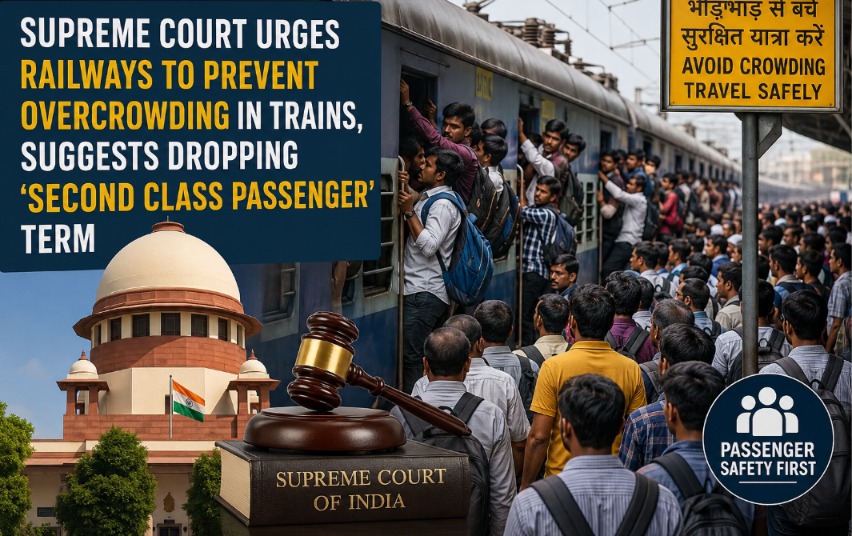
18 July, 2026: The Supreme Court has directed the Indian Railways to take stronger measures to curb overcrowding in trains, observing that overcrowded coaches frequently lead to passengers falling from moving trains and losing their lives. The Court also recommended that the Railways stop using the term “second class passenger” in its manuals, saying the classification should apply to the coach, not the passenger, in line with the spirit of the Constitution.
A Bench comprising Justice Sanjay Karol and Justice Nongmeikapam Kotiswar Singh made the observations while allowing an appeal filed by the widow of a man who died after falling from a moving train in 2015. The Court ordered the Railways to pay her ₹8 lakh in compensation, ruling that the absence of the deceased’s journey ticket alone cannot be a reason to reject a genuine compensation claim under the Railways Act.

The Bench noted that deaths caused by passengers falling from overcrowded trains are not isolated incidents. While such cases may appear small in comparison to the vast railway network, the Court said they have devastating consequences for the families of the victims.

The Court referred to recent incidents, including the Mumbai suburban train tragedy in June 2025 and the New Delhi railway station stampede during the Maha Kumbh rush, saying they underline the urgent need to improve passenger safety and crowd management.
Examining the Indian Railway Commercial Manual, the Bench observed that the Railways already has detailed guidelines for managing overcrowding. These include regulating passenger movement, distributing commuters across coaches, issuing warnings when trains become overcrowded, and adding extra coaches whenever required. However, the Court said the real concern lies in poor implementation of these measures.
The Bench further suggested that the Railways recruit more personnel to strengthen crowd management and improve passenger safety, stating that increased manpower would help save lives while also creating employment opportunities.
At the same time, the Court stressed that passengers also have a responsibility to travel safely and avoid taking unnecessary risks while boarding or travelling in overcrowded trains.
The Supreme Court also objected to the use of the phrase “second class passenger” in railway manuals. It observed that while coaches may be classified based on fare, describing people in such terms is inconsistent with constitutional values and dignity.
In the present case, the Court held that both the Railway Claims Tribunal and the Madhya Pradesh High Court had wrongly denied compensation because the deceased’s ticket could not be recovered after the accident. The widow had consistently stated that the ticket was kept in her husband’s travel bag, which went missing following the incident.
Referring to Section 124A of the Railways Act, the Bench said the law provides for a beneficial “no-fault liability” scheme. It ruled that the widow had fulfilled the initial burden of proof by filing an affidavit stating that her husband was travelling with a valid ticket. The loss of the ticket during the accident, the Court said, could not by itself negate his status as a bona fide passenger.
Setting aside the orders of the Tribunal and the High Court, the Supreme Court directed the Railways to pay ₹8 lakh in compensation within four weeks. The Court further ordered that if the amount is not paid within the stipulated period, it will attract interest at the rate of 8% per annum from the date the compensation claim was originally filed.