Nostradamus Predictions For 2026: Five Chilling Prophecies Fuel Global Anxiety
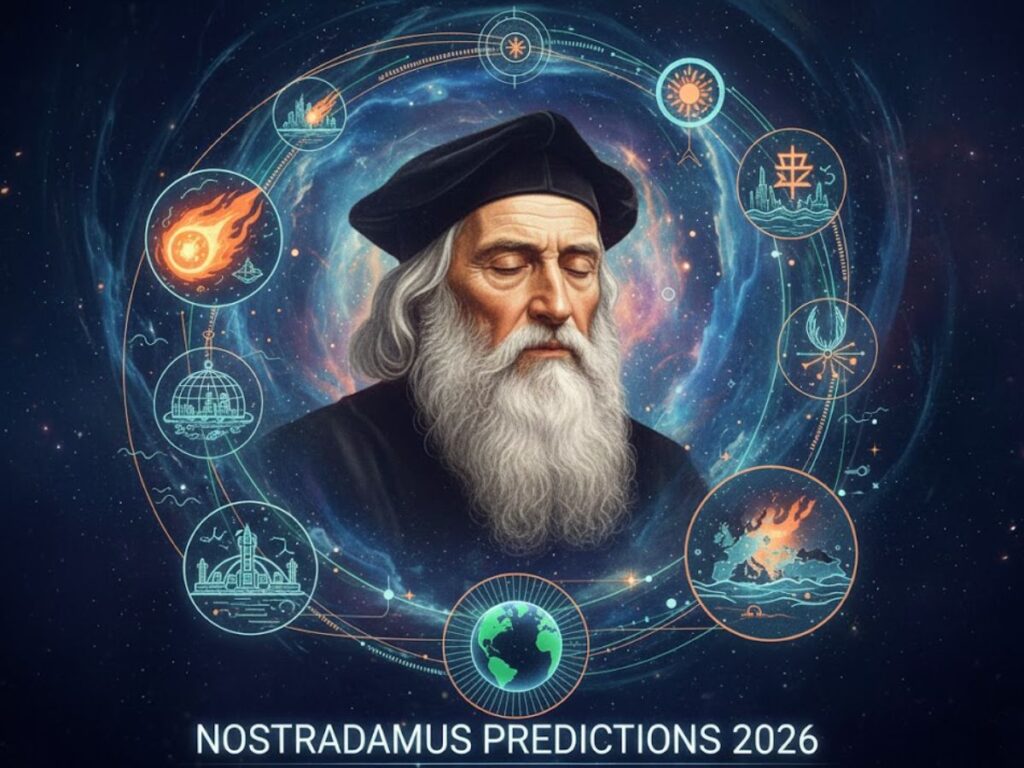
Nostradamus Predictions For 2026: Five Chilling Prophecies Fuel Global Anxiety (AI Image )
From fears of global war and AI dominance to economic collapse and ocean-linked disasters, centuries-old verses are being read anew in today’s tense world.
As the world steps into 2026, predictions attributed to the 16th-century seer Nostradamus have once again captured global attention. Written nearly 400 years ago in his cryptic work Les Prophéties (often referred to as The Centuries), several of his verses are being widely interpreted as warnings for the coming year. While historians continue to debate their accuracy, five particular prophecies are trending due to their unsettling parallels with current global developments.
The first and most alarming interpretation revolves around the possibility of a large-scale global war. Commentators link Nostradamus’s verses about prolonged conflict and powerful alliances to ongoing geopolitical tensions. The Russia-Ukraine war, now stretching over multiple years, remains unresolved, with the US and European nations backing Ukraine, while Russia shows little sign of retreat. Parallel flashpoints in the Middle East, especially rising tensions involving Israel, Iran, and regional allies, have added to fears of wider confrontation. China’s growing military and economic assertiveness in the Indo-Pacific region has further intensified speculation that global power rivalries could spiral into a broader conflict, possibly by mid-2026.
Another prediction frequently discussed is the warning of severe economic turmoil. Nostradamus is believed to have written about financial instability, scarcity, and societal unrest. In the present context, fears of recession, inflation pressures, disrupted supply chains, and widening inequality have led many to draw connections between these verses and modern economic uncertainty. While economists rely on data rather than prophecy, the unease around global financial systems has made these interpretations resonate strongly.

A third prophecy gaining traction concerns the rise of artificial intelligence. Nostradamus is said to have foreseen a time when human control would weaken and decision-making power would shift to non-human forces. With rapid advances in AI by major technology companies, including systems capable of autonomous learning, creative tasks, and strategic decision-making, this interpretation has sparked intense debate. While AI is transforming healthcare, education, and productivity, experts also warn about ethical risks, loss of human oversight, and unintended consequences—concerns that mirror the darker readings of Nostradamus’s writings.
Equally disturbing is the prediction of a major sea-based conflict or ocean-driven catastrophe. According to interpretations, Nostradamus foresaw a powerful event at sea that could alter global politics. This has been linked to rising naval tensions, contested maritime routes, and increasing militarisation of oceans. Scientists also point out that oceans play a critical role in climate stability, and any large-scale disturbance whether military or natural could have devastating consequences for coastal populations worldwide.
The fifth prophecy focuses on natural disasters, particularly those linked to water. Nostradamus’s verses are believed to describe extreme rainfall, flooding, earthquakes, and tsunamis. Recent years have already seen powerful earthquakes and climate-related disasters across Asia and the Pacific region, prompting speculation that even larger events could follow. While science explains these phenomena through tectonic and climatic processes, the alignment with ancient predictions continues to intrigue many.
Nostradamus himself remains an enigmatic figure. Born in 1503, he claimed to foresee events centuries into the future, even predicting his own death in 1566. Whether viewed as coincidence, symbolic poetry, or genuine foresight, his prophecies resurface whenever the world enters periods of uncertainty.
As 2026 approaches, these interpretations reflect less about destiny and more about humanity’s collective fears war, technology beyond control, economic fragility, and the growing power of nature. Whether prophecy or projection, they serve as a reminder of the importance of wisdom, restraint, and preparedness in an increasingly complex world.
Disclaimer: This article is based on interpretations of historical writings and current global events. Nostradamus’s predictions are symbolic and speculative in nature and should not be treated as factual forecasts.