Pune: ‘Temples Are Living Knowledge Systems, Not Mere Monuments,’ Says Expert Pankaj Saxena at Bharat Vimarsh
Pune: ‘Temples Are Living Knowledge Systems, Not Mere Monuments,’ Says Expert Pankaj Saxena at Bharat Vimarsh
The country’s social, historical, and cultural heritage was unveiled through the ‘Bharat Vimarsh’ initiative
Pune, January 14, 2026 – Our temples were not merely inanimate structures or just artifacts in a museum. They are living and vibrant components of our rich knowledge traditions, and of our cultural, social, literary, artistic, and economic experiences and exchanges. Do not limit such ancient heritage sites and temples to mere terms like ‘monuments’ or ‘museums,’ opined Pankaj Saxena, co-founder of the ‘Bodha’ think tank and an expert in Indian education and philosophy.
The ‘Bharat Vimarsh’ initiative was launched by Nation First and Chanakya Mandal Parivar in Pune with the aim of making the country’s social, historical, and cultural heritage known to the new generation and enabling them to understand the profound aspects of Indian knowledge systems. He was speaking at the first program organized under this initiative. The program was held in the auditorium of Buntara Bhavana in Baner, on the Bangalore-Mumbai highway. The event was open to all. The program began with the lighting of the lamp.
Present on the occasion were Pankaj Saxena, Prakash Dhoka, President of Pune Metropolitan Tribal Welfare Ashram & Managing Director of Industrial Metal Powders India, renowned orthopaedic surgeon and author Dr. Milind Modak, Colonel Nandu Koregaonkar, and educationist Dr. Vasudev Aital, Premanand Sharma (a founding member of the Azad Hind Force, Imphal Front, and a member of the National Committee appointed by the Prime Minister for Netaji Subhas Chandra Bose’s 125th birth anniversary year), Tamil literature scholar Jatayu, Founder of Nation First Sunil Bhosale, Amritanshu Pandey (Research Fellow of the Sir Jadunath Sarkar Fellowship for Indian History, and author of the book ‘Fractal Mandala – A History of Ancient India’ and a series of historical fiction novels), and others were present.

Also present were renowned iconographer Dr. G. B. Deglurkar, history researcher Pandurang Balkawade, retired Brigadier Sangram Dalvi, Nanded City Director Narsing Lagad, Anuradha Gokhale of the Ek Bharat Hum Bharat organization, dignitaries from the armed forces, medical profession, and business sector, and a large number of students.
Saxena emphasized the need for modern Hindu society to connect with its ancient, historically rich civilization. He stated that the fearless articulation of the term ‘Hindu’ has now begun, and a wave of Hindu consciousness is surging across the nation. This vibrant consciousness should not be limited to the political sphere alone. He stressed the need for collective efforts to ensure that Hindu consciousness thrives in our social, cultural, artistic, and literary fields, and flows through all aspects of life. ‘Bharat Vimarsh’ is the beginning of such efforts, said Saxena.
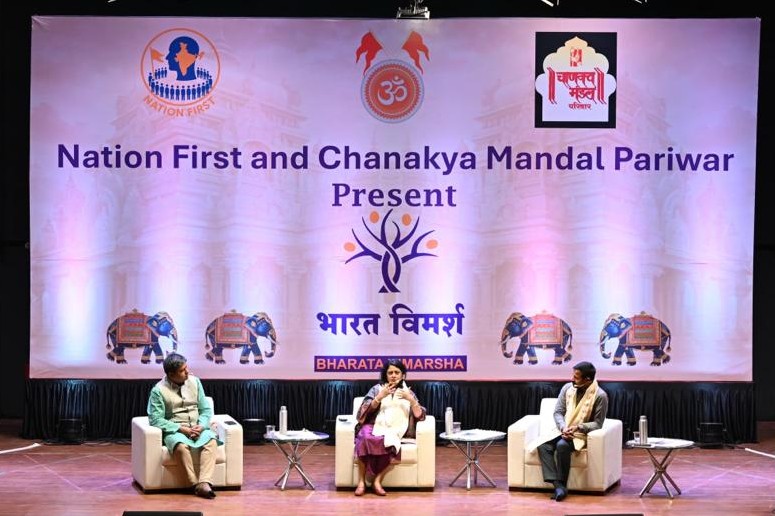
In the first session of ‘Bharat Vimarsh’, under the title ‘Devalaya’ (Temple), Pankaj Saxena, author, researcher, blogger and scholar of Hindu temples Monidipa Bose-De, and author and member of the Indian Knowledge System initiative Ramakrishna Kongalla, presented their views.
Temples were built for darshan (seeing/visiting), but the scope of this darshan is vast. It is not just the sight of the idol that is intended, but also the vision of our principles, life philosophies, moral values, loyalties, artistic perspective, and truth. Temples have created and developed a comprehensive ecosystem, expressed Saxena. He also said that the ecosystem created by the temples should be revived, and the temples should be rebuilt in their original form.
Monidipa Bose said, “Temples, gopurams, sculptures, paintings, and architectural designs – all these elements have documented our history. Every idol and sculpture here has a meaning, a message, and the architecture is based on scientific principles.”
Ramakrishna Kongalla mentioned that the heights achieved by our predecessors in the fields of temple architecture, sculpture, and iconography are astonishing. He said that out of approximately three and a half thousand structures under the Archaeological Survey of India, a staggering 3,000 are temples. This statistic itself underscores the all-encompassing importance of temples. Sanyukta Bhosle compered the program and introduced the speakers.
Photo captions:
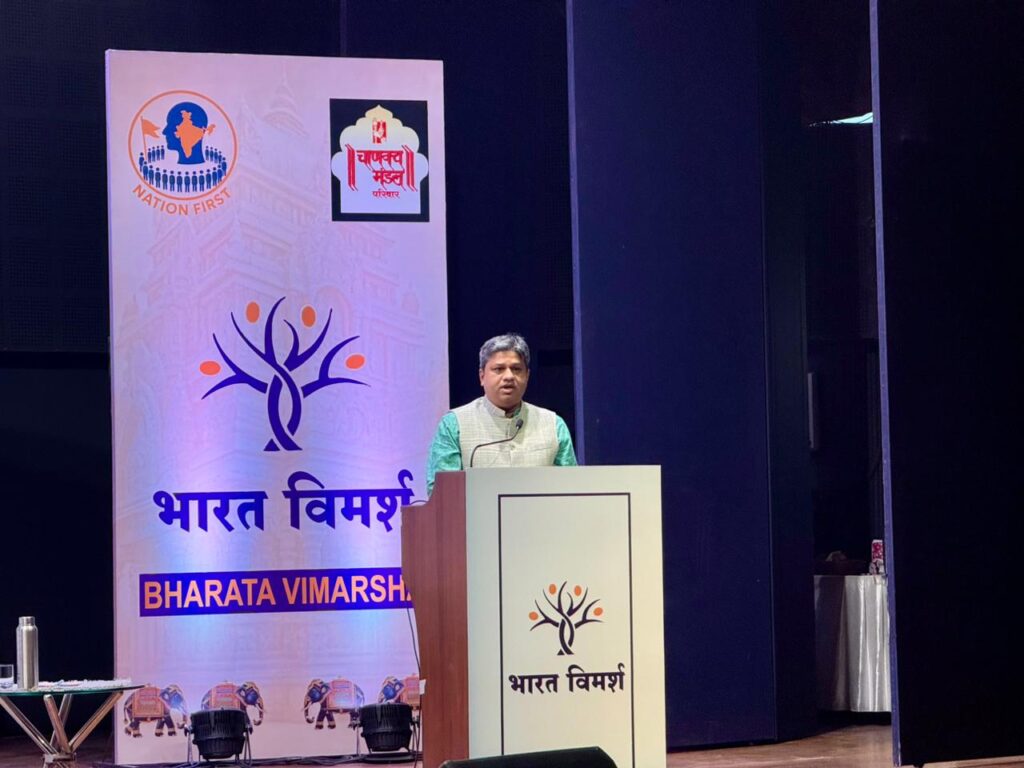
Photo 1 – The ‘Bharat Vimarsh’ initiative, launched by Nation First and Chanakya Mandal Parivar in Pune, held its first program today at the Buntara Bhavana auditorium in Baner, on the Bangalore-Mumbai highway. Pankaj Saxena delivering the inaugural address at the beginning of the program.
Photo 2 – The ‘Bharat Vimarsh’ initiative, launched by Nation First and Chanakya Mandal Parivar in Pune, held its first program today at the Buntara Bhavana auditorium in Baner, on the Bangalore-Mumbai highway. Pankaj Saxena, Monidipa Bose-De, and Ramakrishna Kongalla (from left to right) sharing their thoughts during the interactive session on the topic of ‘Devalaya’ (temple).