Holika Dahan 2026: Lunar Eclipse Sparks Confusion, Does Holi Date Remains Unchanged?
Holika Dahan 2026: Lunar Eclipse Sparks Confusion, Does Holi Date Remains Unchanged?
Rare ‘Blood Moon’ on March 3 coincides with Chhoti Holi, but rituals will be performed safely after the eclipse ends
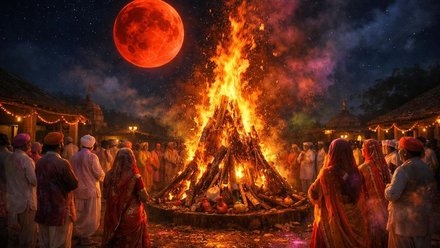
With Holi approaching in 2026, many people are confused because this year Holika Dahan coincides with a lunar eclipse. Since eclipses are traditionally considered inauspicious in Hindu belief, questions are being raised about whether the festival dates will change and whether the rituals of Holika Dahan should be performed at all.
According to the Hindu calendar, Holika Dahan, also known as Chhoti Holi, will be observed on Tuesday, March 3, 2026. On the same day, the first lunar eclipse of the year will take place. This rare celestial event has made the occasion even more significant, as a lunar eclipse falling on the night of Holika Dahan is considered uncommon.
As per Indian Standard Time, the lunar eclipse will begin at 3:21 pm and end at 6:46 pm. The Purnima tithi of the Phalgun month also starts and ends during this same time, making the eclipse and the full moon coincide exactly. However, an important detail is that the eclipse will end before moonrise in India. Because of this, it is being referred to as a ‘Grastodaya’ lunar eclipse.

Religious scholars and astrologers have clarified that Holika Dahan will not be affected, as the auspicious time for the ritual begins only after the eclipse ends. The Muhurat for Holika Dahan on March 3, 2026, is from 6:46 pm to 8:50 pm. Since this falls after the completion of the eclipse, all religious activities can be carried out without any restriction.
This means there is no change in the date of Holika Dahan and no postponement of the festival. Holi with colours will be celebrated the following day, on March 4, 2026, as per tradition.
The lunar eclipse occurring on Holika Dahan is also expected to attract astronomy enthusiasts. During the eclipse, the Moon may appear reddish in colour, which is why such an event is often referred to as a ‘Blood Moon’. The year 2026 will witness four eclipses in total, including two lunar and two solar eclipses, making it astrologically significant.
In Vedic astrology, eclipses are considered inauspicious, and activities like worship, cooking, and major rituals are usually avoided during the eclipse period. However, since this eclipse ends before the Holika Dahan Muhurat begins, there is no restriction on performing the ritual.
Holika Dahan symbolises the victory of good over evil and is associated with the story of Prahlad and Holika. On this day, people worship Holika before lighting the fire. Offerings such as coconut, wheat ears, gulal and water are made. After lighting the fire, devotees circumambulate it three, five or seven times while praying for happiness, prosperity and protection from negative energies.
Many were also concerned about the Sutak period, which begins before an eclipse and is considered inauspicious for religious activities. While Sutak will be observed before the eclipse, the actual ritual of Holika Dahan is scheduled only after the eclipse concludes, making it religiously valid.
Experts have reassured that there is no need for panic or changes in celebration plans. The festival will be celebrated on its traditional dates, and the presence of a lunar eclipse only adds a rare astronomical dimension to this year’s Holi.
In short:
Holika Dahan: March 3, 2026
Lunar eclipse time: 3:21 pm to 6:46 pm
Holika Dahan Muhurat: 6:46 pm to 8:50 pm
Holi with colours: March 4, 2026
Despite the coincidence of the lunar eclipse, Holi 2026 will be celebrated as usual, with rituals performed safely after the eclipse ends.