Marriage Certificates Alone Don’t Make a Hindu Marriage: Supreme Court Draws Clear Line
Marriage Certificates Alone Don’t Make a Hindu Marriage: Supreme Court Draws Clear Line
On April 19, 2024, the Supreme Court delivered a significant judgment that draws a firm legal boundary between paperwork and personal law. The Court made it unequivocally clear that under Hindu law, a marriage does not come into existence merely because a certificate has been issued or registered. Without the actual performance of essential Hindu rites and ceremonies, such a relationship has no legal standing, regardless of any documents claiming otherwise.
In this ruling, the Court emphasised that a marriage certificate cannot substitute the religious and customary ceremonies mandated under the Hindu Marriage Act, 1955. Registration, the Court held, is only a record of an already valid marriage—it cannot create one by itself.
The decision was pronounced by a Bench comprising Justice B.V. Nagarathna and Justice Augustine George Masih in Dolly Rani v. Manish Kumar Chanchal. Exercising its extraordinary powers under Article 142 of the Constitution, the Court declared that the parties were never legally married, even though they possessed both a private marriage certificate and a government-issued registration.

The petitioner (woman) and the respondent (man) were both trained commercial pilots. Their engagement took place on 7 March 2021. Instead of immediately solemnising their marriage according to Hindu customs, the couple obtained a marriage certificate dated 7 July 2021 from a private body known as Vadik Jankalyan Samiti (Regd.). Relying on this document, they later secured a marriage registration certificate from the authorities in Uttar Pradesh.
Notably, the actual Hindu wedding ceremony, as planned by both families, was scheduled much later—on 25 October 2022. However, before the ceremony could be conducted, serious disputes arose between the parties.
The petitioner alleged dowry-related harassment and, on 17 November 2022, lodged an FIR against the respondent and his family members under Sections 498A, 420, 506 and 509 of the IPC, along with provisions of the Dowry Prohibition Act.
Subsequently, in March 2023, the respondent filed a divorce petition before the Family Court in Muzaffarpur, Bihar, under Section 13(1)(ia) of the Hindu Marriage Act. Challenging this, the petitioner approached the Supreme Court seeking transfer of the divorce proceedings to Ranchi, where she was residing with her parents.
During the pendency of this transfer petition, both parties reconsidered their positions. They jointly approached the Supreme Court under Article 142, requesting a declaration that no valid marriage had ever taken place and seeking quashing of all matrimonial and criminal proceedings between them.
Counsel for the petitioner contended that since no Hindu marriage had ever been solemnised as required by law, the divorce petition itself was not maintainable. The respondent’s counsel conceded that no ceremonies contemplated under Section 7 of the Hindu Marriage Act had been performed. However, it was argued that the existence of a marriage registration certificate compelled the respondent to initiate divorce proceedings.
Both parties jointly admitted before the Court that they had never undergone any Hindu rituals, rites or customary ceremonies. They explained that the certificates were obtained due to external pressure and practical considerations, and that they now wished to free themselves from the legal consequences of a marriage that had never truly occurred.
Before granting relief, the Court undertook a detailed examination of Sections 7 and 8 of the Hindu Marriage Act, 1955, laying down important principles on what constitutes a valid Hindu marriage.
Meaning of “Solemnisation” Under Section 7
The Bench highlighted that Section 7 uses the word solemnised, which inherently implies the performance of ceremonies. The Court clarified:
“A marriage cannot be treated as having taken place unless it is performed in the proper manner and through recognised ceremonies.”
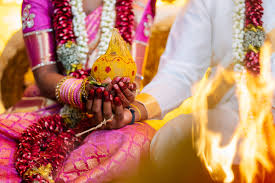
The judges reiterated that a Hindu marriage is not merely a civil contract but a samskara—a sacred sacrament. Ceremonies such as Saptapadi, involving seven steps taken in the presence of the sacred fire, form the core of a valid Hindu marriage.
“Without the solemn performance of rituals as mandated by law, a man and a woman cannot legally assume the status of husband and wife.”
It further held that any certificate issued without evidence of such rituals cannot establish marital status under Hindu law.
Addressing Section 8 of the Act, which deals with registration of marriages, the Court made it clear that registration does not bring a marriage into existence. Instead, it merely serves as proof of a marriage that has already been validly solemnised.
“If the foundational requirement of a marriage under Section 7 is missing, registration cannot cure that defect or grant legitimacy.”
Thus, registration is evidentiary in nature, not constitutive. Where no ceremony has taken place, registration loses all legal significance. The Bench expressed concern over an emerging trend where young couples obtain marriage certificates for convenience—such as visa applications—without actually performing marriage ceremonies.
The Court remarked, “Instances are increasing where couples, intending to marry at a later stage, register their marriage for practical reasons. Such registration does not amount to solemnisation of a Hindu marriage.”
It strongly criticised the practice, questioning its legal and social consequences, “If the ceremony never takes place later, what would be the legal status of such parties? Can they be regarded as husband and wife in law or in society?”
The Court clearly answered these concerns by holding that without solemnisation, no marital status can ever arise.
Reflecting on the deeper meaning of marriage under Hindu law, the Court underscored that marriage is neither a commercial transaction nor a casual event.
The Bench observed:
“A Hindu marriage is a sacred institution of immense value, forming the foundation of family and society. It is not merely an occasion for celebration, exchange of gifts or material demands.”
The judges urged young individuals to approach marriage with seriousness and respect, stressing that it carries both spiritual and social responsibilities.
The Court clarified that while the Special Marriage Act permits marriage through a statutory and registration-based procedure for persons of any faith, the Hindu Marriage Act is distinct. Under the Hindu Marriage Act, fulfilment of religious rites and ceremonies is indispensable.
“What may be sufficient for a valid marriage under the Special Marriage Act cannot automatically apply to marriages governed by the Hindu Marriage Act.”
The Act, the Court explained, consciously preserves the religious character of Hindu marriages by giving a central role to customary rituals.
After considering the joint request and the legal position, the Supreme Court declared, “The so-called marriage dated 07.07.2021 does not qualify as a Hindu marriage in terms of Section 7 of the Act.”
Consequently, the Court held both the private certificate and the government registration to be void and non-existent in law. It ruled that the parties had never acquired the legal status of husband and wife.
In light of this declaration, the Supreme Court quashed all pending proceedings between the parties, including the divorce case in Muzaffarpur, the maintenance proceedings in Ranchi, the criminal FIR and all related actions. The transfer petition was also disposed of as infructuous.
Through this judgment, the Supreme Court has sent a clear and cautionary message: under Hindu law, marriage cannot be reduced to a mere administrative formality. Rituals and ceremonies are not optional traditions but legal essentials. By firmly rejecting the notion that certificates alone can create marital status, the Court has reinforced the sanctity of Hindu marriage while also preventing misuse of registration processes for short-term convenience. This ruling is likely to have far-reaching implications for how marriages are approached, documented and understood in the future.