Blinkit Under Fire After Customer Alleges Receiving Partially Eaten Ice Cream
Blinkit Under Fire After Customer Alleges Receiving Partially Eaten Ice Cream
What should have been a simple ice cream delivery has now turned into a widely discussed controversy, raising fresh concerns about hygiene and reliability in quick-commerce services. A customer’s unsettling experience has triggered debate across social media platforms.
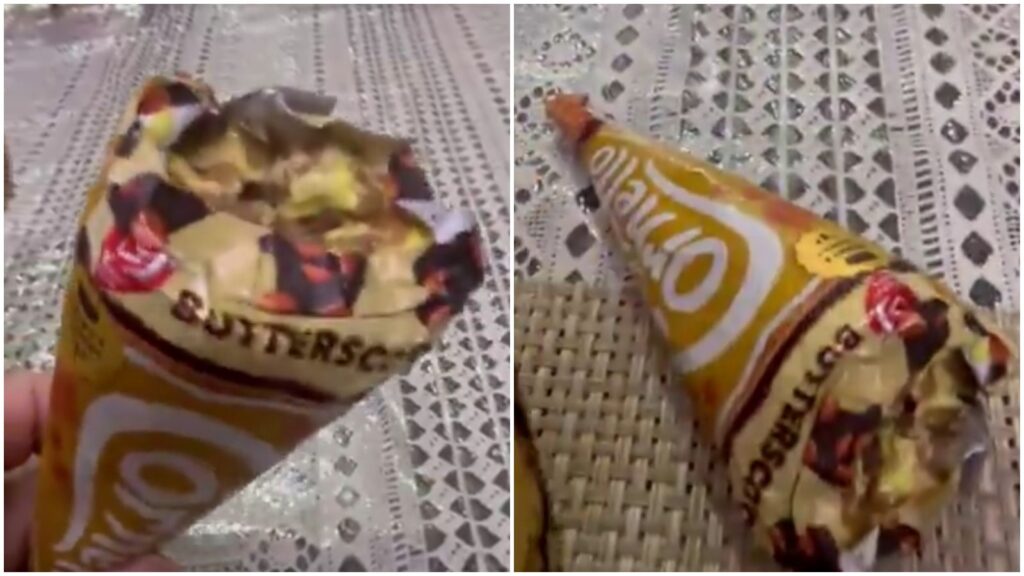
Tejinder Singh Sodhi, an X (formerly Twitter) user from Jammu, shared his experience after ordering ice creams through Blinkit. According to his post, the delivery arrived as expected and the items were stored properly. However, when he later opened the package, he claimed to have found that one of the ice creams had already been opened and partially eaten.
Videos shared by Sodhi show one ice cream appearing tampered with, while another remains sealed and untouched. He described the incident as more than just a simple mistake, calling it a serious health risk.

Blinkit reportedly offered a refund, but Sodhi declined it, emphasizing that the issue was about accountability rather than money. He stated that customers should not be treated as disposable and tagged authorities such as the Food Safety and Standards Authority of India and Jago Grahak Jago. He also mentioned plans to take the matter to consumer court.
The incident also had a personal impact, as Sodhi shared that his daughter was upset after seeing the condition of the product and said she would no longer trust the platform.
Ordered ice creams from @letsblinkit in Jammu. Stored them properly, opened the pack after dinner — and found a HALF-CONSUMED ice cream inside the Blinkit pack.
— Tejinder Singh Sodhi (@TejinderSsodhi) April 8, 2026
This is not negligence. This is a serious health risk.
Refund offered. Refused.
I will be taking this to consumer… pic.twitter.com/ujrWBfTnWo
Following the viral post, Blinkit responded by apologizing for the inconvenience and requested his order ID and registered mobile number via direct message to investigate the issue on priority.
Reactions online suggested that such experiences may not be isolated. Several users claimed they were not surprised, with some sharing similar incidents. One user mentioned receiving a partially consumed chocolate product in a previous order, though a refund was provided.
Others advised against ordering items like cones or kulfi, suggesting these are more vulnerable to tampering during delivery. Some also pointed out that missing items in orders are fairly common, and refunds do not always feel sufficient—especially when GST is charged on the full order amount.
Many users placed responsibility on the delivery process, calling for stricter monitoring and penalties for delivery agents involved in such cases. One commenter noted that perishable items could be among the riskiest products to order through such platforms.