Lenskart Dress Code Row: Viral ‘Bindi-Tilak Ban’ Document Sparks Debate, CEO Replies
Lenskart Dress Code Row: Viral ‘Bindi-Tilak Ban’ Document Sparks Debate, CEO Replies
Company clarifies commitment to inclusivity as old policy document triggers social media backlash
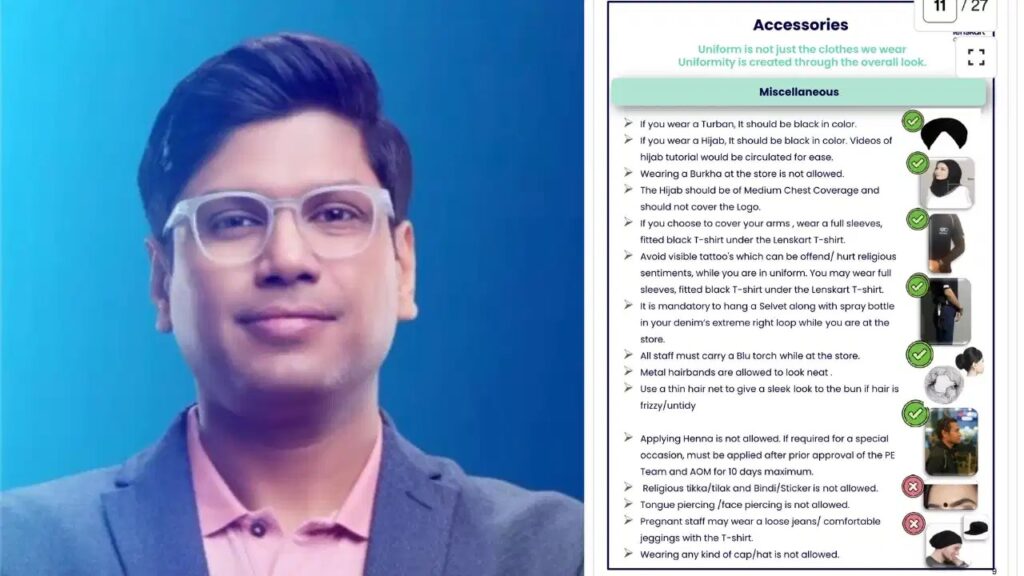
Lenskart has found itself at the centre of a controversy after an alleged internal dress code document went viral on social media, claiming restrictions on certain religious symbols while permitting others.
The viral document suggested that employees were not allowed to wear bindis, tilaks, or sacred threads (kalava), while items like hijabs and turbans were permitted under specific conditions. It also mentioned that hijabs should be black, of a certain length, and should not obstruct the company logo. Wearing a burqa inside stores was reportedly not allowed.
The issue gained traction after social media users and public figures questioned the apparent disparity in rules. Writer and activist Shefali Vaidya raised concerns online, asking why symbols of one religion were restricted while others were allowed, sparking widespread debate.

As the controversy escalated, Lenskart CEO Piyush Bansal stepped in to clarify the company’s stance. He stated that the document being circulated is “outdated and incorrect” and does not reflect the company’s current policies.
So I confirmed, this is genuine. This is what @peyushbansal tells his employees, hijab is okay, but bindi/tilak/Kalawa is not, for @Lenskart_com, a company that exists in Hindu majority Bharat, where most of the employees and consumers are Hindu! What do you say to this? This is… https://t.co/jQ2EPdWPJM pic.twitter.com/SWfOajOjpo
— Shefali Vaidya. 🇮🇳 (@ShefVaidya) April 15, 2026
Bansal emphasised that Lenskart is committed to maintaining an inclusive and respectful workplace. He added that employees across the organisation are free to express their cultural and religious identities, and the company does not discriminate based on such practices.
Despite the clarification, the incident has triggered a broader conversation around workplace dress codes and personal expression. While some argue that companies have the right to enforce uniform policies for a professional environment, others believe such rules should not interfere with individual identity and religious freedom.
The controversy highlights the challenges companies face in balancing brand consistency with inclusivity, especially in a diverse country like India where cultural expression is deeply personal.
As of now, Lenskart maintains that its current policies support equality and that the viral document does not represent its official or updated guidelines.