Atal Setu-Coastal Road Connector Nearly Complete; Connects Mumbai-Navi Mumbai Airport Directly But Work Stalled as Awaits Clearance
Atal Setu-Coastal Road Connector Nearly Complete; Connects Mumbai-Navi Mumbai Airport Directly But Work Stalled as Awaits Clearance
Uncertainty over the exact number of mangrove trees in the affected area has put the crucial connector project on hold, delaying direct road access between Mumbai, Navi Mumbai and the upcoming international airport.
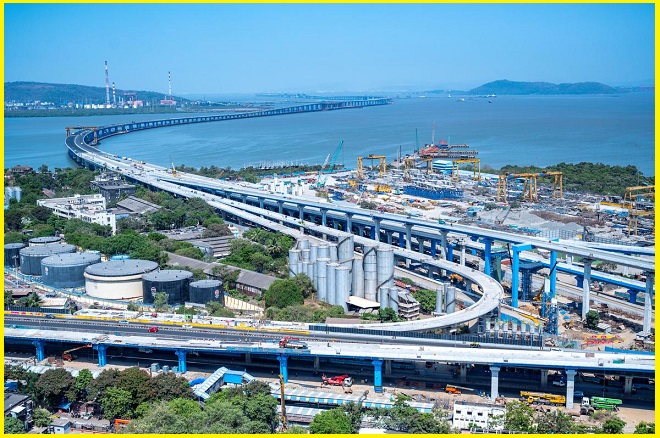
The much-awaited connection between the Atal Bihari Vajpayee Sewri–Nhava Sheva Atal Setu and the Navi Mumbai Coastal Road has hit a roadblock due to pending environmental clearance related to mangrove forests. Although the coastal road itself is almost complete, the final link that would allow seamless travel from Mumbai to Navi Mumbai and the new international airport remains stalled.
The delay is not due to construction issues but because of a technical and environmental hurdle. The proposed connector passes through a patch of mangrove land, and while the area affected has been identified, authorities have not yet determined the exact number of mangrove trees that would be impacted. This uncertainty has resulted in the rejection of Coastal Regulation Zone (CRZ) clearance for the project at this stage.

Mangroves are protected ecosystems under environmental laws because they act as natural barriers against floods, prevent coastal erosion, and support marine life. Any project that involves cutting or disturbing mangroves must go through strict scrutiny and detailed assessment. Even small inaccuracies in data can lead to rejection or postponement of approvals.
According to the project plan, around 4,510.81 square metres of mangrove area will be affected for the Atal Setu–Coastal Road connection. However, the Maharashtra Coastal Zone Management Authority has said that merely mentioning the area is not enough. The exact number of mangrove trees present in this land must be physically verified and documented before clearance can be granted.
The Mumbai Metropolitan Region Development Authority has proposed adding six ramps at the Shivajinagar (Gavan, Navi Mumbai) interchange to connect Atal Setu with the Navi Mumbai Coastal Road. For this, a total of 32,166.90 square metres of land is required. Out of this, about 4,424.57 square metres fall under mangrove coverage. Additionally, toll plazas are planned on these ramps, which will require another 4,383.16 square metres of land, including 86.24 square metres of mangrove area.
During the meeting of the Maharashtra Coastal Zone Management Authority, the Forest Department’s Mangrove Cell pointed out that while the extent of land is mentioned, the exact number of trees has not been verified through a site inspection. Without this data, environmental impact cannot be correctly assessed, and CRZ permission cannot be issued.
As a result, MMRDA has now been asked to carry out a physical survey of the site. This inspection must identify how many mangrove trees will be affected, the severity of impact, and what compensatory measures will be taken. Only after submitting this detailed report can the authority reconsider the application for clearance.
This delay has become a major concern because the Atal Setu–Coastal Road connector is a critical piece of Mumbai’s future transport network. Once operational, it will offer direct and faster road connectivity between Mumbai, Navi Mumbai, and the upcoming Navi Mumbai International Airport. It will also reduce travel time, decongest existing highways, and improve regional mobility.
The Navi Mumbai Coastal Road itself is already nearing completion. However, without this final link to Atal Setu, its full potential cannot be realised. Commuters who were expecting a smooth and uninterrupted drive from South Mumbai to Navi Mumbai will now have to wait longer.
Officials have clarified that the delay is purely procedural and environmentally driven, not due to construction failures. The government is trying to ensure that infrastructure development does not come at the cost of ecological damage, especially in sensitive coastal zones.
Once the physical verification is completed and the report is submitted, the CRZ authority will re-examine the proposal. If the impact is found to be manageable and proper compensatory plantation plans are approved, clearance could be granted.
Until then, the Atal Setu–Coastal Road connection remains stalled, highlighting how environmental compliance plays a decisive role in shaping large infrastructure projects in urban India.