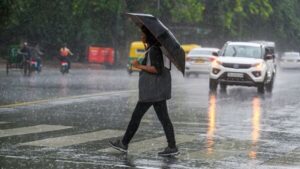
High Price For a Basic Necessity: Private Water Tanker Rates Jump From ₹700 To ₹1,500 In Pune As Alternate-Day Water Supply Deepens Dependence
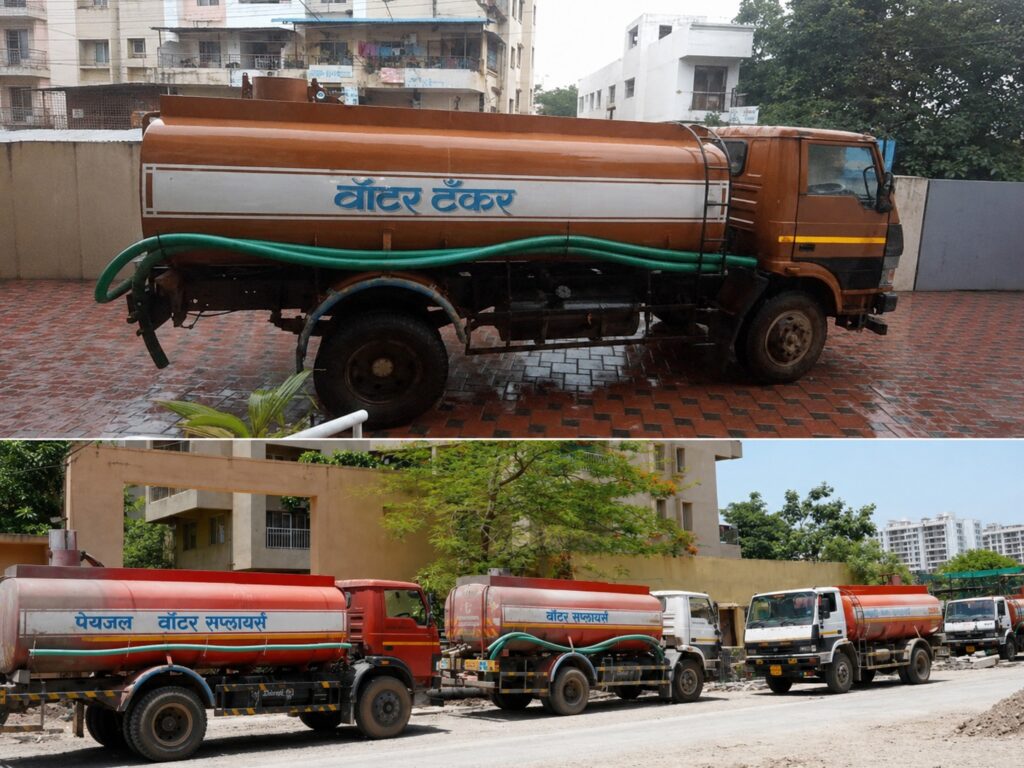
High Price For a Basic Necessity: Private Water Tanker Rates Jump From ₹700 To ₹1,500 In Pune As Alternate-Day Water Supply Deepens Dependence
Rising demand, limited civic infrastructure and shrinking water reserves have pushed Pune’s private tanker business into overdrive, leaving thousands of residents paying significantly higher prices for a basic necessity.
By Vidhi Lalla
Pune’s ongoing water shortage is rapidly transforming the city’s private water tanker sector into a booming business, with residents across several suburbs reporting steep price hikes after the Pune Municipal Corporation (PMC) introduced alternate-day water supply.

Housing societies that earlier paid around ₹600 – ₹700 per tanker are now being charged between ₹1,200 and ₹1,500, while in some high-demand localities residents claim prices have climbed to ₹2,000-₹2,500 per tanker, depending on availability, distance and demand.
The increase comes at a time when thousands of households are relying almost entirely on private tankers for drinking water and daily use.
Demand Outpaces Civic Infrastructure
The water crisis has exposed the widening gap between Pune’s rapid urban expansion and its civic infrastructure.
Neighbourhoods such as Wagholi, Kharadi, Lohegaon, Viman Nagar, Undri, Pisoli, Mohammadwadi-NIBM, Sus, Mhalunge, Baner, Balewadi and Hinjewadi have witnessed massive residential growth over the last few years. However, many housing societies remain partially connected or completely outside the municipal water pipeline network.
As municipal supply becomes less frequent, private tankers have emerged as the primary source of water for thousands of families.
Tanker Trips Cross Five Lakh Mark
Official PMC data highlights the city’s growing dependence on tanker water.
- FY 2023-24: 4,00,348 tanker trips
- FY 2024-25: 4,89,202 tanker trips
- FY 2025-26: 5,17,422 tanker trips
For the first time, annual tanker trips have crossed the five-lakh mark.
Over three years:
- Total tanker supply increased by 29.24%
- Private tanker operations grew by 81.73%
- Tendered tankers increased by 25.72%
- PMC-owned tanker operations rose by 21.30%
March demand has also surged dramatically, rising from 38,299 tanker trips in March 2024 to over 58,000 trips in March 2026, while more than 55,000 tanker trips were recorded in just the first 26 days of April 2026.
Limited Civic Fleet
Despite serving one of India’s fastest-growing cities, the PMC operates only a limited fleet.
The civic body owns 57 water tankers, of which 39 are used by the Water Supply Department for drinking water distribution and 17 are deployed for garden maintenance, with each carrying approximately 9,000 to 10,000 litres.
The city currently relies on three categories of water tankers:
- PMC-owned tankers supplied to residents
- Tendered private tankers contracted by PMC
- Commercial private tankers that purchase water from civic loading stations and sell it independently
No Cap On Private Selling Price
PMC charges ₹1,282 per municipal tanker supplied to individuals or housing societies.
Private operators, meanwhile, purchase a water loading pass from the civic body for ₹666 per tanker. However, there is currently no regulatory ceiling on the price at which these operators can sell water, leading to complaints of arbitrary pricing during periods of high demand.
Residents and civic observers have repeatedly called for stronger oversight and transparent pricing mechanisms.
Newly Merged Areas Bear The Brunt
The situation is particularly difficult in newly merged villages and peripheral suburbs where pipeline connectivity remains inadequate.
Residents report delayed deliveries, irregular supply and increasing dependence on private operators.
“Every summer we prepare an additional budget only for water. Tankers have become an unavoidable monthly expense for many societies,” said Gaurav Kulkarni, a resident of Mahalunge.
“Groundwater levels have fallen sharply and several borewells have stopped yielding water. For many families, tankers are now the only reliable source,” said Rohit Jadhav, a resident of Kirkatwadi.
Allegations Of Overcharging
Residents allege that tanker operators are capitalising on the water shortage by increasing prices without a transparent formula.
Some housing societies have also complained of long waiting periods for municipal tankers, while allegations of unofficial payments to secure faster deliveries continue to circulate. These claims have not been independently verified.
“Whenever demand spikes and supply remains limited, prices naturally rise. The long-term solution lies in expanding pipeline infrastructure rather than relying on emergency tanker supply,” said Dr. Meenal Patwardhan, an urban water policy researcher.
A Business Built On A Civic Gap
The city’s expanding skyline and rising population have significantly outpaced investment in water infrastructure.
The long-pending 24×7 equitable water supply project, launched in 2017, includes 82 water storage tanks, nearly 2.8 lakh water meters and 1,600 kilometres of pipelines. However, only about 30-35% of the planned storage infrastructure is currently operational, delaying the expected benefits.
Until permanent infrastructure catches up with urban growth, experts believe Pune’s dependence on private water tankers will continue to increase.
“Tankers were originally meant to be a temporary solution, but in many parts of Pune they have become an essential public utility. That highlights the urgent need for faster infrastructure development and better regulation,” said Prof. Anil Deshpande, an urban infrastructure analyst.