‘I Told Them Not To…’: Rishi Sunak Says His Daughters Thank AI Chatbots; Know the Hidden Cost of Saying “Please”
‘I Told Them Not To…’: Rishi Sunak Says His Daughters Thank AI Chatbots; Know the Hidden Cost of Saying “Please”
At the India AI Impact Summit, the former UK Prime Minister shared a light-hearted story that has sparked a wider debate on politeness, technology and hidden AI costs.
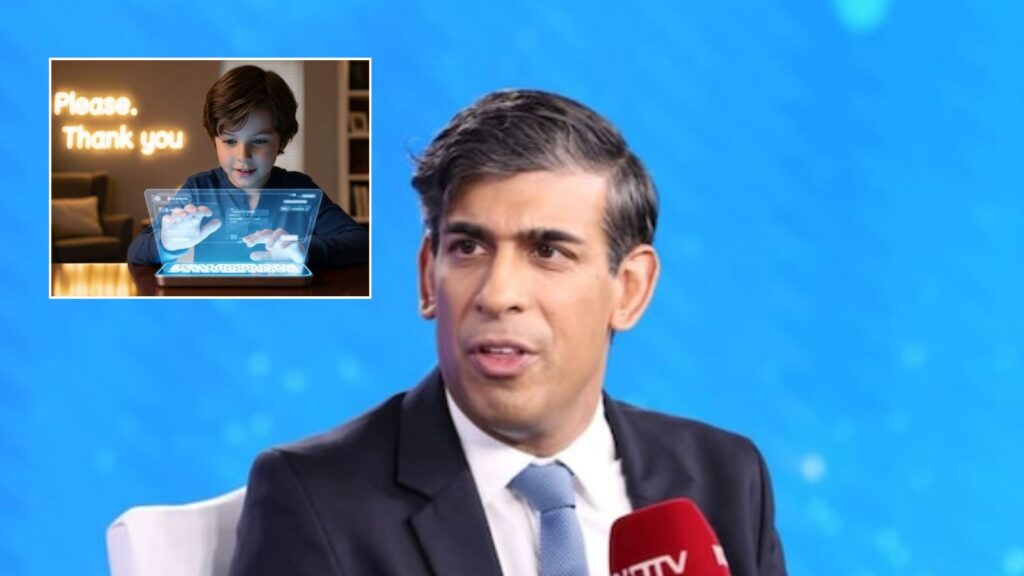
Former UK Prime Minister Rishi Sunak revealed that his two daughters always say “please” and “thank you” while interacting with AI chatbots — even though he advised them it wasn’t necessary.
Speaking at the India AI Impact Summit in New Delhi on February 18, Sunak shared the anecdote during a fireside chat.
“My two young girls, when they use these models and the chatbots… they’re very polite, and they always say please and thank you,” Sunak said.

He added that he told them, “You don’t need to say please and thank you. It’s polite, but it’s not a person. And by the way, it takes up a lot of compute power, so better if you don’t.”
However, his daughters disagreed.
“If AI takes over the world, we’ll want to be polite to AI,” they reportedly told him.
Sunak laughed and responded, “I thought it was a good system… I think it shows how important it is to make people trust technology.”
Sunak and his wife, Akshata Murthy, have two daughters, Krishna and Anoushka.
Does politeness matter to AI?
Artificial intelligence systems such as chatbots do not have emotions, consciousness or awareness. They do not feel gratitude, offence or appreciation.
However, several technology thinkers argue that politeness toward AI is less about the machine and more about the user.
OpenAI CEO Sam Altman has previously suggested that using polite language helps reinforce positive communication habits. The idea is that practising respectful language even with machines strengthens human-to-human behaviour.
Research reflects this growing habit. A Pew Research survey in 2019 found that 54 per cent of American smart speaker users said “please” to their devices. A 2025 survey indicated that 67 per cent of AI users in the US and 71 per cent in the UK use polite language with digital assistants.
Some experts also suggest polite prompts may produce better results. A Microsoft WorkLab note observed that generative AI often mirrors tone and clarity. A study by researchers at Waseda University and the RIKEN Center in Tokyo found that polite prompts can generate higher-quality responses — although excessive flattery may reduce effectiveness.
The hidden cost of saying “please”
Sunak’s remark about “compute power” also touches on a technical reality.
Every message sent to AI systems triggers high-powered servers that consume electricity and water for cooling. OpenAI’s Sam Altman once responded to a social media post questioning the cost of politeness by saying, “Tens of millions of dollars well spent, you never know.”
Even short responses require computational resources. Reports have indicated that generating small replies uses measurable amounts of electricity and water due to cooling requirements in data centres.
The bigger debate
Critics caution that being overly polite to AI could blur the line between humans and machines, potentially leading to over-humanising technology.
Others argue that politeness is a small but meaningful habit in a world increasingly shaped by digital interaction.
Sunak’s anecdote may have been light-hearted, but it has reignited a broader question: as AI becomes embedded in daily life, are we shaping technology or is it shaping us?
For now, many users seem content to type those extra words.