SC Signals Heavy Compensation For Dog Bites, Warns Feeders To Take Responsibility
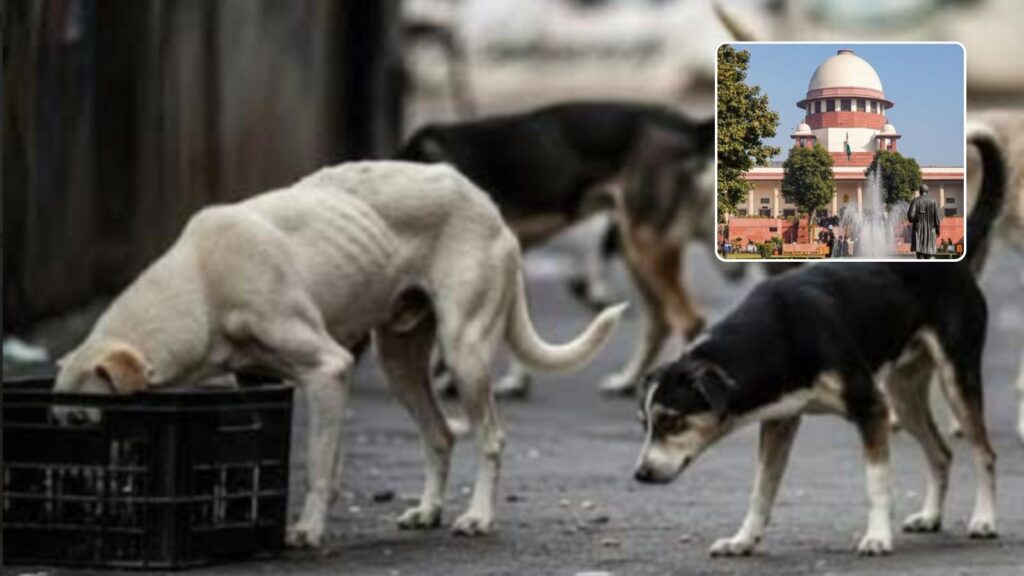
SC Signals Heavy Compensation For Dog Bites, Warns Feeders To Take Responsibility
Top court says states may face financial liability for attacks, questions free roaming of strays, and stresses accountability of both authorities and dog feeders
The Supreme Court has sent a strong signal that states and Union Territories could soon face “heavy compensation” for every dog bite incident and every death caused by stray dogs, as it expressed serious concern over the growing public safety threat posed by free-roaming animals. The court also warned that people who feed stray dogs cannot escape responsibility if those animals cause serious or lifelong harm to citizens.
A bench of Justices Vikram Nath, Sandeep Mehta and N.V. Anjaria observed that the stray dog problem has reached alarming proportions due to decades of inaction by governments. The judges said that failure to implement existing laws and rules has allowed the issue to grow “a thousand times, a zillion times,” creating a situation where public safety is now at serious risk.
The court questioned why stray dogs should be allowed to roam freely in all areas and stated that those feeding them must take accountability for their conduct. “Take the dogs home or take them inside your campus and houses. Why should they be everywhere?” the bench asked, making it clear that feeding without responsibility cannot be justified when attacks result in grave injuries or death.

The court clarified that it is not challenging the validity of the Animal Birth Control (ABC) Rules or the Prevention of Cruelty to Animals Act. Instead, it is deeply concerned about their chronic non-implementation. “We are not saying the ABC Rules are bad. We want implementation of statutory provisions,” the bench said, stressing that proper enforcement alone could have prevented the crisis from escalating to this level.

The judges expressed frustration that despite legal frameworks existing for decades, authorities have failed to act meaningfully. “There has been a failure in the last 75 years, and they have created a worse situation. Therefore, we want to pass effective orders,” the court remarked.
At the same time, the bench made it clear that it would not issue blanket directions regarding alleged harassment of dog feeders. On January 9, the court declined to entertain general complaints and held that such matters are law-and-order issues that must be addressed through FIRs and the criminal justice system. It said it could not function as a fact-finding forum for scattered incidents across the country.
The court is currently hearing petitions seeking modification of its November 7, 2025 order, which directed authorities to remove stray dogs from institutional areas such as schools, hospitals, and transport hubs after sterilisation and vaccination. It also made clear that dogs picked up from such locations should not be released back to the same places.
During the hearing, senior advocate Arvind Datar raised concerns about feral dogs in wildlife areas, particularly in Ladakh, where nearly 55,000 free-ranging dogs are said to be threatening critically endangered species. He urged the court to extend its directions to airports as well, noting that authorities often claim they cannot act because captured dogs must be released back.
The bench pointed out that the problem has now reached even judicial premises. Referring to a recent dog bite incident at the Gujarat High Court, the judges said, “The worst part is when municipal authorities went to capture dogs, they were attacked by lawyers — so-called dog lovers.”
Justice Mehta asked pointedly, “Who should be held accountable when dogs attack a 9-year-old? The organisation that is feeding them?” The court made it clear it is unwilling to “shut its eyes” when vulnerable groups such as children and the elderly are being injured or killed.
The judges reiterated that they have never ordered the killing of stray dogs. Their directions are strictly limited to removing strays from high-risk institutional and public areas in the interest of safety under Article 21 of the Constitution, which guarantees the right to life.
Reaffirming that the root problem lies in administrative failure, the court stressed the need for proper sterilisation, vaccination, shelter creation and scientific waste management. It warned that continued non-compliance may now lead to financial consequences and fixed accountability.
The bench said it would spend focused time with states and the Union government to examine whether they even have a workable plan of action. “Allow us to take the Union, the states and the authorities to task,” the judges said, emphasising that public safety can no longer be compromised by administrative inertia.
The matter is scheduled for further hearing on January 15, where the court is expected to consider stricter enforcement mechanisms and accountability measures.