Student Calls for OTP-Based Food Delivery After Zomato Order Goes Missing, Internet Backs Demand
Student Calls for OTP-Based Food Delivery After Zomato Order Goes Missing, Internet Backs Demand
Concerns around food delivery safety and verification have resurfaced after an engineering student shared his experience of a missing Zomato order on social media. The post, which has now gone viral on X with over seven lakh views, has sparked widespread discussion, with many users supporting his suggestion that food delivery platforms should introduce OTP-based confirmation before handing over orders.
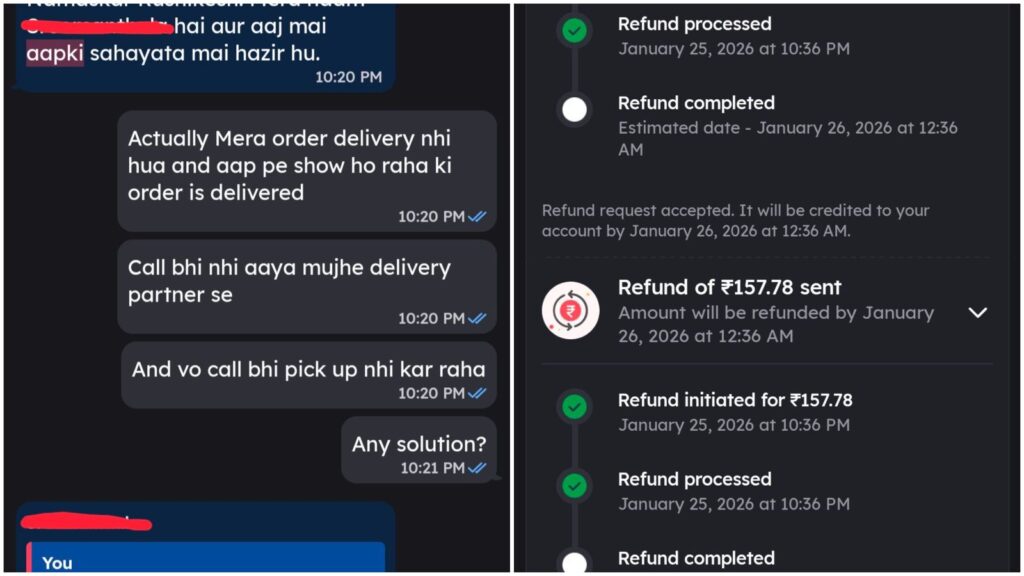
The student, Rushikesh Sapkal, explained that he had placed a Zomato order late on Sunday night. The delivery was delayed by nearly 30 minutes, something he initially found unusual. When he went downstairs to collect the food, he was surprised to receive a notification stating that the order had already been delivered — despite no delivery partner calling him or handing over the package.
In his post, Sapkal said he repeatedly tried calling the delivery partner, but his calls were not answered. He then contacted Zomato’s customer support, which arranged a conference call involving Sapkal, the delivery partner, and a customer care representative.

During the call, the delivery partner claimed that he had handed over the order to “a boy standing in the colony” who reportedly mentioned the correct order ID. Sapkal questioned this explanation, pointing out that order IDs are typically printed on delivery bags, making it easy for anyone to falsely claim an order without proper verification.
Zomato should introduce OTP based verification for food deliveries.
— SUPERBRO (@Rushu_Tushu) January 26, 2026
Yesterday, I ordered food from Zomato, and the delivery partner was unusually delayed, almost 30 minutes late, which already felt suspicious.
When I went downstairs to receive my order, I suddenly got a… pic.twitter.com/nnk1kHyoLh
Screenshots shared by Sapkal show him informing customer support that the order had not been delivered, while the support team responded that they would reach out to the delivery partner for clarification.
Zomato eventually issued a refund. However, Sapkal said the company also warned him that this would be the “first and last time” such a refund would be processed. He described the remark as unfair, especially since he had no role in the delivery error.
Reacting to the response, Sapkal questioned how the incident could be considered his fault and raised concerns about what would happen if a similar issue occurred again. He said the situation could have been easily avoided if Zomato required OTP verification at the time of delivery.
Expressing his frustration, he added that he has since deleted the Zomato app and decided to stop ordering food online. According to Sapkal, the entire episode resulted in wasted time and left him without food late at night.
Sapkal’s post led to a surge of responses from users who said they had faced similar problems with various quick-commerce and food delivery platforms. One user recounted an incident involving Blinkit, where items ordered for a house party were marked as delivered but were actually handed over to someone standing outside the wrong house. The delivery partner later returned, apologised, and took responsibility. While the items were recovered, the user questioned how deliveries could be completed without proper identity checks, noting that anyone nearby could accept an order.
Another user shared a more frustrating experience with Swiggy. Their order was delayed and later cancelled after the delivery partner claimed to have met with an accident. When Swiggy placed the order again, the second delivery partner also reported an accident. As it was treated as a repeat order, the user alleged that Swiggy refused to issue a refund, leaving them without food, money lost, and nearly two hours wasted.
A third user described tracking a Zomato delivery partner who continued moving farther away from the delivery location. According to the user, the rider travelled nearly 25 kilometres before disappearing, and the order never arrived.
The viral discussion has reignited questions about accountability and verification in app-based deliveries. Many users echoed Sapkal’s demand for OTP-based confirmation, arguing that such a system could help prevent incorrect handovers and protect customers from avoidable losses.