Supreme Court Pulls Up Samay Raina, Vipul Goyal, Nishant Tanwar and Others for Mocking Disabled People, Warns Against Violating Dignity in the Name of Free Speech
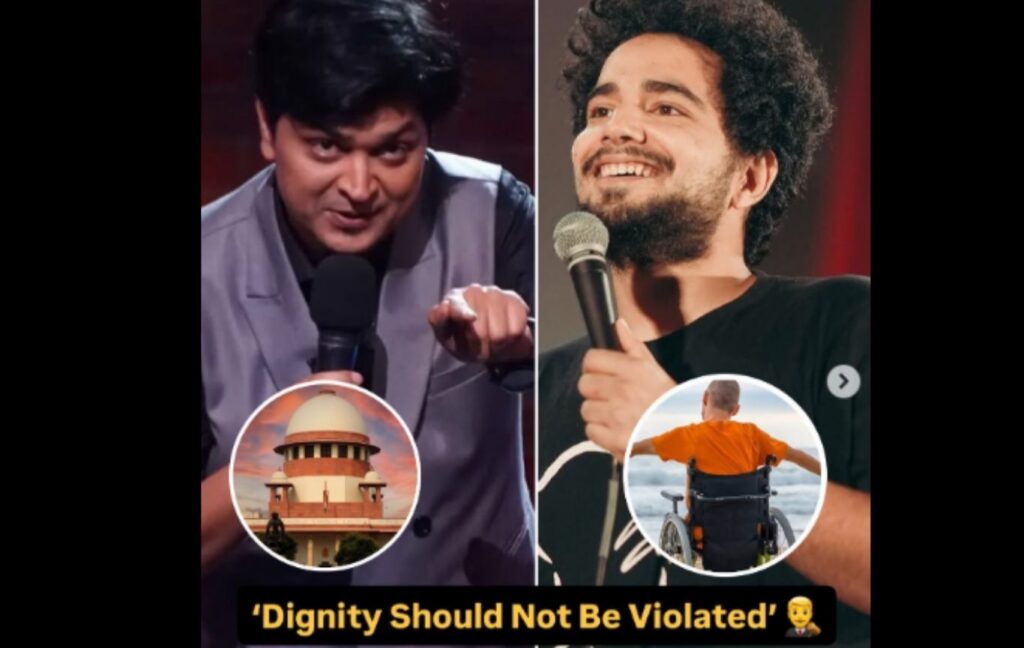
Supreme Court Pulls Up Samay Raina, Vipul Goyal, Nishant Tanwar and Others for Mocking Disabled People, Warns Against Violating Dignity in the Name of Free Speech
In a significant move addressing the intersection of comedy, digital content, and human dignity, the Supreme Court of India on Tuesday expressed strong concern over stand-up performances that allegedly mocked individuals with disabilities. Emphasizing the fundamental right to dignity, the court warned that freedom of speech must not come at the cost of dehumanising others—especially vulnerable communities.
The matter came up during a hearing of a petition filed by the SMA Cure Foundation, an NGO representing individuals affected by Spinal Muscular Atrophy (SMA), a rare genetic disorder. The petition alleged that several comedians, including Samay Raina, Nishant Jagdish Tanwar, Vipul Goyal, Balraj Paramjeet Singh Ghai, and Sonali Thakkar (also known as Sonali Aditya Desai), had made offensive and insensitive jokes about disabled individuals during their online performances and recorded events.
The bench, comprising Justices Surya Kant and Joymalya Bagchi, took a firm stance, underlining that the right to dignity, which falls under Article 21 of the Constitution, must take precedence over Article 19’s guarantee of free speech when the two come into conflict. The court observed, “Article 21 must prevail if any competition takes place,” reinforcing the idea that no form of expression should come at the cost of violating someone’s inherent dignity.

In a clear signal that it intends to establish a broader legal framework to address such concerns, the court invited inputs from both the public and legal professionals to help craft guidelines aimed at ensuring respectful and inclusive digital content. The goal, the bench explained, is to build a structure where comedy and expression thrive—without marginalising or hurting vulnerable sections of society.
Acknowledging the seriousness of the allegations, the court directed comedians Samay Raina, Vipul Goyal, Balraj Ghai, and Nishant Tanwar to be physically present at the next hearing. Comedian Sonali Thakkar was permitted to join the proceedings virtually. The court gave them two weeks to respond to the allegations made in the petition, cautioning that “no further extensions will be granted,” and warned that any failure to appear would be “viewed seriously.”
The petitioner NGO stressed that the content in question did not merely cross the line of bad taste but was actively “offensive, denigrating, and dehumanising.” According to the SMA Cure Foundation, such jokes not only mocked the lived realities of disabled individuals but also trivialised the enormous financial burden associated with their medical treatment. The NGO argued that this kind of representation violated multiple constitutional rights, including Articles 14 and 21, and should fall within the reasonable restrictions laid out under Article 19(2).
The Supreme Court also sought the assistance of Attorney General R Venkataramani in drafting a set of enforceable guidelines for digital platforms. The bench asked him to help devise a balanced regulatory framework that would protect freedom of expression while safeguarding the dignity of marginalised groups. Venkataramani requested more time to deliberate, noting that careful consideration would be needed to ensure both practicality and enforceability.
The justices underscored the importance of this initiative by stating, “What we are doing is for posterity. You have to ensure that not a single word is misused by anyone. You have to ensure balance. We have to protect citizens’ rights. A framework must be there so that the dignity of anyone is not violated.”
In addition to summoning the individual comedians, the court issued notices to key government bodies including the Ministry of Information and Broadcasting, Ministry of Electronics and Information Technology, and the Ministry of Social Justice and Empowerment. Notices were also sent to prominent industry associations such as the News Broadcasters and Digital Association and the Indian Broadcasting and Digital Foundation, indicating the court’s intent to involve all stakeholders in shaping the future of digital content moderation.
This case has stirred an important national conversation—raising questions not only about the limits of humour but also the responsibilities of content creators in a rapidly evolving digital space.