Which Ocean Holds the Maximum Number of Islands? Exploring Earth’s Most Island-Rich Waters
Which Ocean Holds the Maximum Number of Islands? Exploring Earth’s Most Island-Rich Waters
If you shift your gaze across the vast blue spaces that dominate our planet, one thing becomes clear: oceans are not just empty stretches of water. They are dotted with countless islands, each shaped by fire, movement, and time. From tiny coral rings barely rising above sea level to large, inhabited landmasses with deep cultural roots, islands have played a major role in Earth’s natural story, influencing biodiversity, climate, and human civilization. Among all the oceans, one stands far above the rest when it comes to the sheer number of islands it contains.
That distinction belongs to the Pacific Ocean, which has more islands than any other ocean on Earth. Scattered across its immense surface are tens of thousands of islands, far exceeding the island counts of the Atlantic, Indian, Southern, or Arctic Oceans. Its extraordinary size, combined with intense geological activity, has made it the most prolific region on the planet for island formation.
The Pacific Ocean is also the largest ocean on Earth, covering nearly one-third of the planet’s surface. It stretches from the icy waters of the Arctic in the north to the Southern Ocean near Antarctica in the south. In fact, its area is so vast that it is larger than all of Earth’s landmasses combined. This enormous expanse provides the perfect conditions for islands to form and remain widely distributed across the ocean basin.

Beyond its size, the Pacific stands out for having the highest level of marine biodiversity in the world. Its waters support massive coral reef systems, deep-sea ecosystems, and productive coastal habitats that are home to thousands of marine species. Many of these ecosystems are closely linked to island chains, making islands a central part of the ocean’s ecological richness and balance.
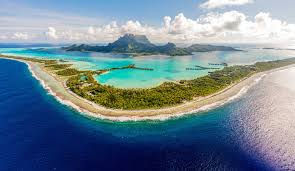
One of the main reasons the Pacific Ocean contains so many islands is its location along the Ring of Fire. This region is known for frequent earthquakes and intense volcanic activity. Over millions of years, repeated volcanic eruptions pushed molten rock up from the ocean floor, gradually forming islands above sea level. At the same time, tectonic plate movements lifted sections of the Earth’s crust, while coral reefs grew around submerged volcanoes, eventually creating coral islands and atolls.
The islands of the Pacific are traditionally grouped into three major regions, each with its own distinct characteristics. Polynesia covers an enormous area and includes well-known island groups such as Hawaii, Samoa, Tonga, and Tahiti. These islands are largely volcanic in origin and are famous for their strong cultural traditions and remarkable history of long-distance ocean navigation.
Micronesia, as the name suggests, consists of thousands of small islands and low-lying atolls, including the Marshall Islands, Palau, and Kiribati. Many of these islands are made of coral and sit just above sea level, which makes them especially vulnerable to rising seas and the impacts of climate change.
Melanesia is home to some of the Pacific’s largest and most mountainous islands, such as Papua New Guinea, Fiji, the Solomon Islands, and Vanuatu. These islands are known for dense forests, rich natural resources, and extraordinary linguistic and cultural diversity, making the region one of the most varied on Earth.
Most Pacific islands began their journey underwater, formed by volcanic eruptions on the ocean floor. As these volcanoes grew taller, they eventually emerged above sea level. Over time, coral reefs developed around them, sometimes forming ring-shaped atolls as volcanic centers sank. In other areas, tectonic forces pushed parts of the ocean floor upward, creating uplifted islands with steep landscapes.
The Pacific Ocean is also home to some of the most extreme features on the planet. It contains the Mariana Trench, the deepest known point in any ocean, underscoring the dramatic geological depth of the region. More than 75 percent of the world’s active volcanoes are found in and around the Pacific, continually reshaping the islands and seafloor.
Many island nations, including Fiji, Kiribati, and Tonga, depend heavily on the Pacific for food, transportation, and economic activity. The ocean also plays a critical role in global climate systems, with its currents influencing weather patterns, monsoons, and large-scale ocean-atmosphere events. Long before modern technology, Pacific islanders developed sophisticated navigation techniques using stars, wind, and wave patterns, allowing them to travel vast distances across open water.