Woman Says ‘100% Pure’ Coconut Oil Contains Vegetable Oil, Manufacturer Responds
Woman Says ‘100% Pure’ Coconut Oil Contains Vegetable Oil, Manufacturer Responds
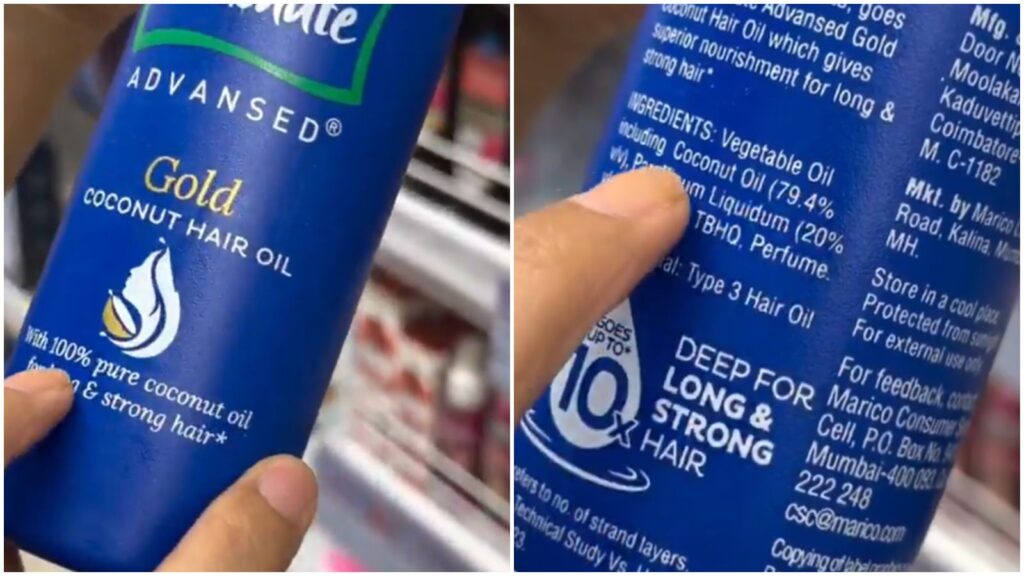
Coconut oil is a household essential across India, widely used for cooking, skincare, and haircare. However, a recent viral video has led many to question whether the oil they use every day is as pure as labels claim. In the video, a woman is seen inside a grocery store holding a bottle of coconut oil. On the front of the bottle, the label reads, “With 100% Pure Coconut Oil.” When she turns the bottle around, the ingredient list reveals the presence of not just coconut oil but also vegetable oil.
“Then how is it 100% pure coconut oil?” she asks, highlighting what she sees as a clear contradiction between the product’s branding and its ingredients. The video quickly spread online, with many users expressing frustration over misleading labeling practices.
The Manufacturer’s Response

Among the responses was a detailed explanation from a small-scale manufacturer who runs Sri Krishna Mills Co., a coconut oil production facility established over a century ago. He explained the economics of producing authentic, pure coconut oil and why smaller producers find it difficult to compete with larger brands that sell oil at significantly lower prices.
According to him, the current price of copra (the dried kernel used to extract coconut oil) is around ₹240 per kilogram. Given that roughly 1,000 kilograms of copra produce about 650 liters of oil, the basic cost of pure coconut oil works out to approximately ₹370 per liter. After adding production expenses, the total comes to ₹390–₹400 per liter before any profit. He pointed out that if any brand sells coconut oil for much less, it is likely blended with other, cheaper oils.
Parachute 100% pure coconut oil …
— Woke Eminent (@WokePandemic) November 10, 2025
but……….
Is she reading the labels wrong? or there is some technical truth in what the brand claims? pic.twitter.com/vgmVP5TK5J
The Other Side of the Debate
Some social media users, however, pointed out that the label in question did not actually claim “100% Pure Coconut Oil” but rather stated “With 100% Pure Coconut Oil.” This difference, they argued, could be significant. The phrase “With 100% Pure Coconut Oil” may imply that the coconut oil used in the blend is itself pure, even if the overall product includes other ingredients such as vegetable oil.
Supporters of this interpretation suggested that the wording might be technically accurate, though potentially misleading to consumers who might interpret it as indicating the product is made entirely of coconut oil. They also noted that the same brand sells another version of its coconut oil that clearly states “100% Pure Coconut Oil” on the front, and in that case, the ingredients list on the back mentions only “Coconut Oil,” indicating that it is indeed unblended.
Consumer Confusion and the Need for Clarity
The discussion has revealed how small differences in wording can lead to major misunderstandings among consumers. While one bottle might say “With 100% Pure Coconut Oil,” another might say “100% Pure Coconut Oil,” and the distinction is often lost on buyers who assume both mean the same thing.
Consumers are now calling for clearer labeling standards that leave no room for ambiguity, while ethical manufacturers continue to stress the importance of transparency and quality.