Cockroach Janta Party surpasses BJP on Instagram, has over 12 million followers
Cockroach Janta Party surpasses BJP on Instagram, has over 12 million followers
What began as a satirical online protest against remarks by the Chief Justice of India has quickly turned into a viral Gen Z political movement.
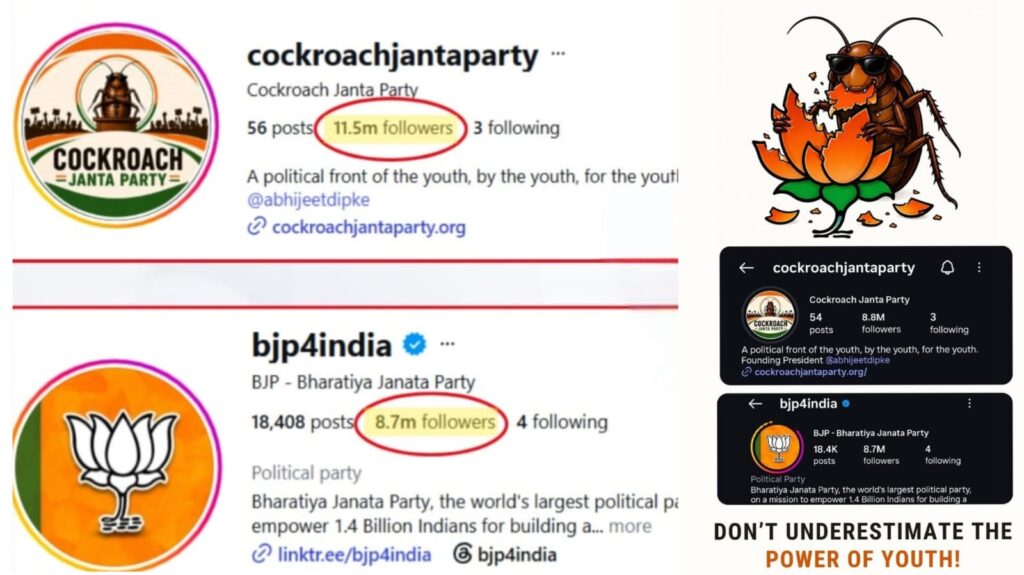
The satirical political campaign Cockroach Janta Party (CJP) has crossed 10 million followers on Instagram within just five days of its launch, overtaking the BJP’s official follower count on the platform.
Started by Abhijeet Dipke, the movement began as an online protest after remarks made by Chief Justice of India Surya Kant about unemployed youth sparked outrage on social media. The campaign, driven by memes, satire and viral reels, quickly gained massive support among young users.
The CJP’s Instagram handle @cockroachjantaparty crossed the 10-million mark on Thursday. In comparison, the BJP’s official Instagram page currently has around 8.7 million followers, while Congress has nearly 13.2 million followers. The Aam Aadmi Party has around 1.9 million followers.

The controversy started during a court hearing on May 15, when the CJI reportedly referred to some unemployed youth as “cockroaches”. The remarks triggered backlash online and led to the creation of the CJP movement. Although the Chief Justice later clarified that his comments were misquoted and aimed at people with fake degrees entering professional fields, the online outrage continued.
Within days, the CJP evolved from a meme page into a larger digital youth movement discussing unemployment, exam paper leaks, freedom of expression and political accountability.
Several public figures, including YouTubers, activists and politicians such as Mahua Moitra and Kirti Azad, have shown support for the campaign online. However, founder Abhijeet Dipke has said the movement does not want to become a traditional political party or include established political leaders.
The CJP’s rapid rise highlights the growing influence of Gen Z-driven digital movements in India, where social media virality and political satire are increasingly shaping online political conversations.