Lohagad Fort: The Iron Fort Near Pune That Has Outlasted Empires and Endured Centuries
Lohagad Fort: The Iron Fort Near Pune That Has Outlasted Empires and Endured Centuries
From Shivaji’s treasury to monsoon fog and a scorpion-shaped ridge, everything you need to know about Maharashtra’s most visited hill fort
By Vidhi Lalla
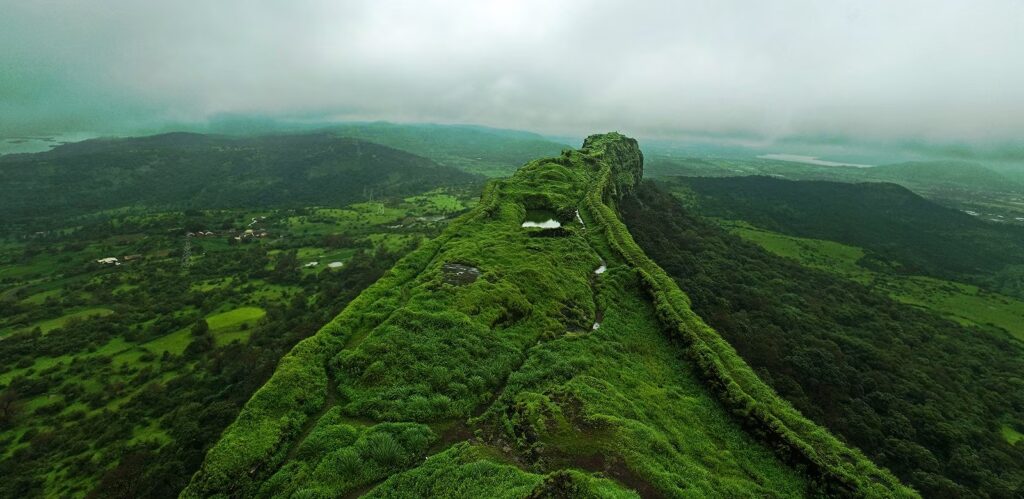
Pune: There is something deeply arresting about standing at the top of Lohagad on a monsoon morning. The fort disappears into clouds. The walls, dark and moss-covered, seem to grow out of the hill itself. Far below, Pawna Lake glitters through gaps in the mist. Most people who make this climb know Lohagad as a popular weekend trek near Lonavala. Far fewer know that this same fort has been captured, surrendered, fought over, and used as a royal treasury by some of the most powerful rulers in India’s history. That story is worth knowing before you set foot on the trail.

Iron Fort of the Sahyadris
Lohagad Fort, meaning Iron Fort in Marathi, is a hill fort near Lonavala in Pune district, Maharashtra, standing at 1,033 metres or 3,389 feet above sea level. The range divides the basins of the Indrayani river and Pavana lake, and Lohagad overlooks the Pavana reservoir to the south. Situated about 52 km northwest of Pune and around 100 km from Mumbai, the fort is close enough for a comfortable day trip from either city, yet high and remote enough to feel genuinely cut off from the world below.

A History That Runs Deeper Than Most Forts
The history of Lohagad does not begin in the Maratha era, though that is the chapter most people know. Lohagad has a long history with several dynasties occupying it at different periods of time: Satavahanas, Chalukyas, Rashtrakutas, Yadavas, Bahamanis, Nizams, Mughals and Marathas. The fort’s origins stretch back roughly 2,000 years, making it one of the oldest continuously occupied strategic sites in western India.
In 1648, the legendary Chhatrapati Shivaji Maharaj seized Lohagad, recognising its defensive and strategic importance. However, due to the Treaty of Purandar in 1665, he was forced to relinquish it to the Mughals. Undeterred, he recaptured the fort in 1670 and used it as a treasury vault to store the riches from his successful Surat campaign. The wealth looted during the Surat expedition, one of Shivaji’s most celebrated raids, was brought here for safekeeping, turning Lohagad into not just a military post but a financial stronghold of the Maratha empire.
The fort’s role did not end with Shivaji. In the Peshwa period, Nana Phadnavis used the fort and built several structures including a stepwell and the Laxmi Kothi, where his treasury was kept. In 1789, Nana Phadnavis ordered reconstruction of the fort, leading to the construction of a step well and numerous water tanks. The British eventually took control, and the fort was abandoned by the colonial administration in 1845, after which it passed into the care of the Archaeological Survey of India.
In September 2019, a group of trekkers from Pune discovered an ancient inscription in a cave on the fort’s southern face. Written in Jain Brahmi script and dating back to the 2nd or 1st century BC, the inscription suggests the cave was once a Jain rock-cut sanctuary, adding yet another layer to Lohagad’s fascinating history.
Four Gates That Still Stand
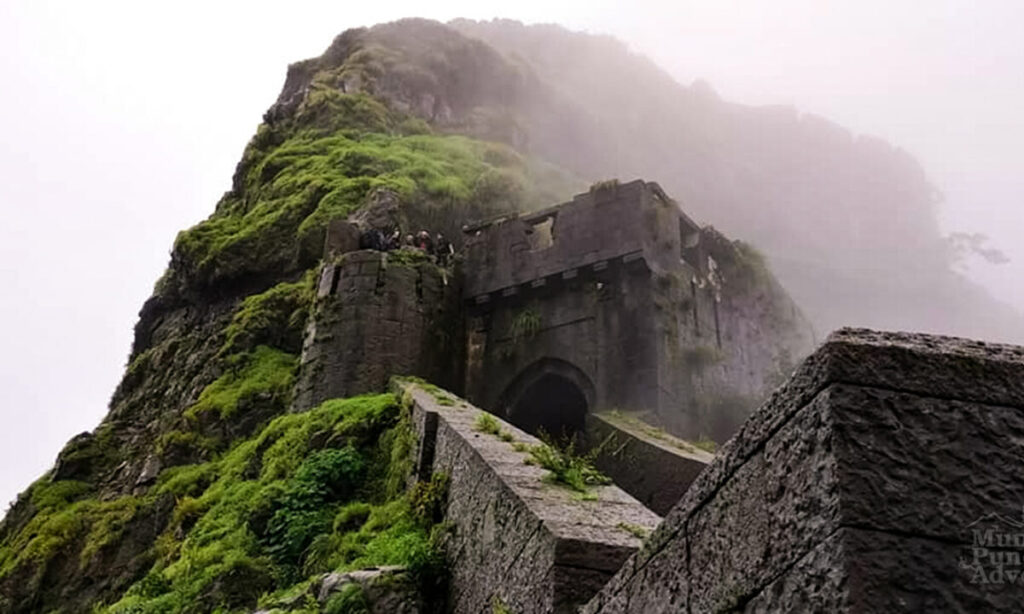
Ganesh Darwaja, Narayan Darwaja, Hanuman Darwaja and Maha Darwaja are the four doors to Lohagad from the nearby village. All four remain in remarkably good condition for their age. Each gate was designed as a defensive checkpoint, forcing attackers to navigate a series of turns and barriers before reaching the fort’s heart. This layered entry system was a hallmark of Maratha fort architecture and is one reason Lohagad held its ground through so many sieges.
Vinchukada: The Scorpion’s Tail
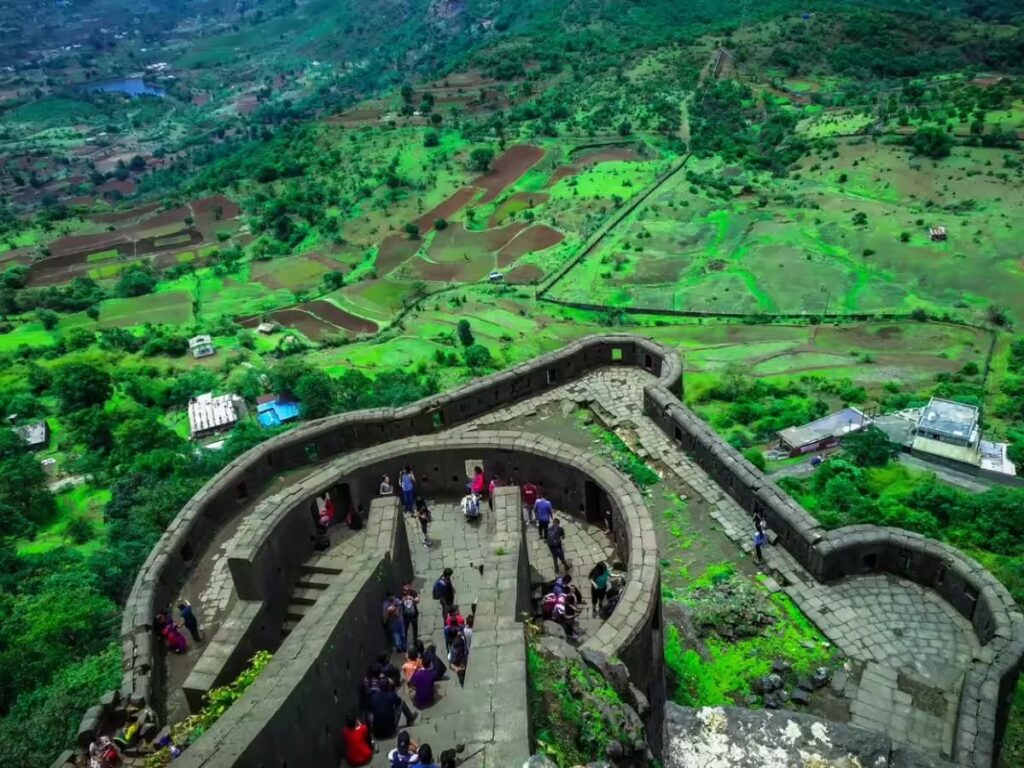
If there is one feature that makes Lohagad instantly recognisable in photographs, it is the Vinchukada. One of Lohagad’s most breathtaking features is the Vinchukada, or Scorpion’s Tail, a long, narrow, fortified spur extending from the fort’s main structure. This naturally sculpted rock formation resembles a scorpion’s sting and offers panoramic views of the surrounding Sahyadri landscapes.
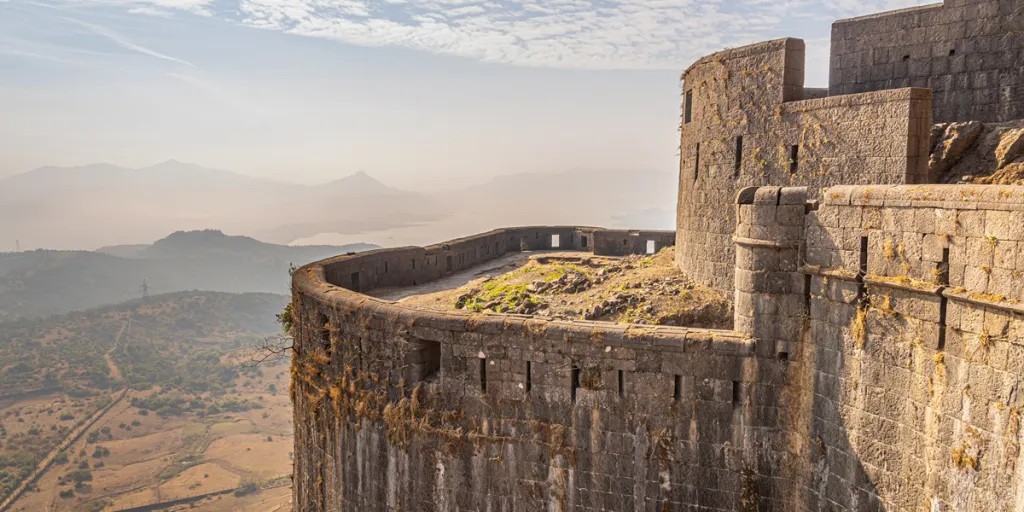
The Vinchu Kata is a 1,500-metre-long, 30-metre-wide fortified ridge that once served as a watchpost over the surrounding region. In its active military life, this spur gave defenders a sweeping line of sight over the valley approaches, making surprise attacks almost impossible. Today it is a favourite spot for photographers and trekkers who walk its narrow path with the valley dropping steeply on both sides.
Inside the Fort
Inside, visitors find the Laxmi Kothi which held Nana Phadnavis’s treasury, old cannons, and water cisterns. The fort also contains a small temple, the ruins of several residential structures, and the stepwell built during the Peshwa period which still holds water during the monsoon. From the top, on a clear day, it is possible to see the neighbouring Visapur Fort, Tikona Fort, Tung Fort, and the expanse of Pawna Lake stretching into the distance.
Why Monsoon Is the Best Time to Visit
Lohagad in the dry months is a fort. Lohagad in the monsoon is something else entirely. During the monsoon, the top of the fort is covered with mist and clouds and becomes particularly wet with growing moss. The hillside, barren and brown in summer, turns into an intense, almost neon green. Small waterfalls appear along the trail. The Vinchukada, shrouded in low cloud, looks as if it is floating above the valley.
For adventure enthusiasts, the most popular trail begins at Malavli Railway Station, approximately 10 kilometres away. This trek takes 2 to 3 hours and winds through stunning landscapes, even passing the ancient Bhaja Caves, adding a rich cultural dimension to the journey. The trail is rated easy to moderate, making it accessible for beginners and families, not just seasoned trekkers. However, the monsoon does bring slippery stone steps and muddy paths, so proper trekking footwear with grip is not optional.
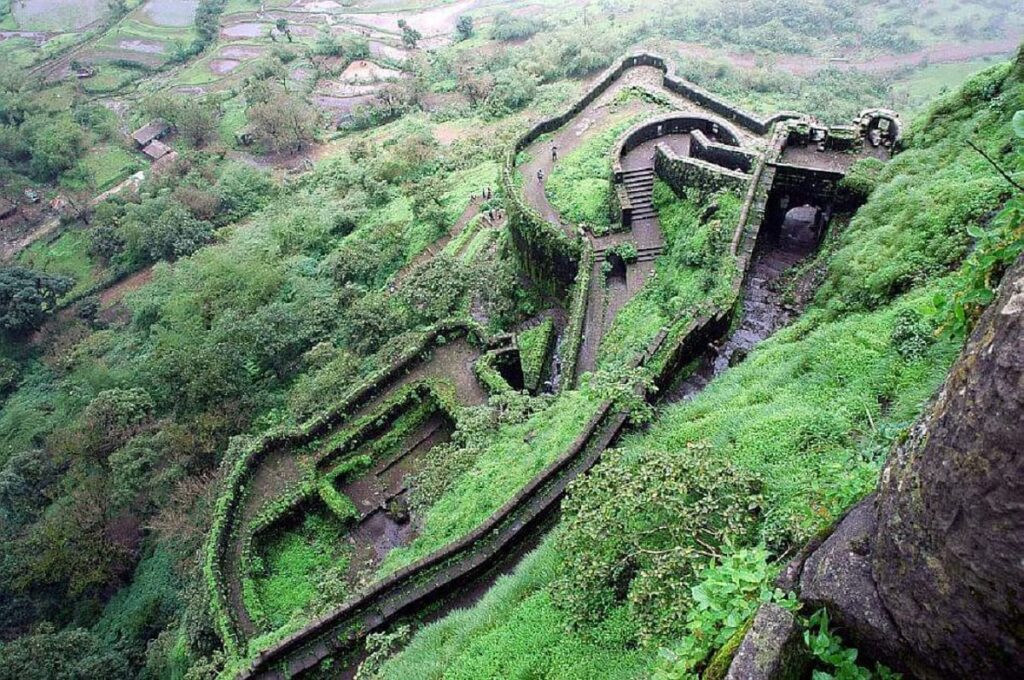
For those who prefer a shorter approach, a motorable road from Lohagadwadi village leads to the base of the fort, making it accessible year-round.
Nearby Places Worth Combining
Bhaja Caves, located 2 km from Malavli, were once home to Buddhist monks and can easily be added to the same trip with a short detour from the main trail. Lohagad and Visapur are twin forts on the same range, and fit trekkers often combine both on a single day. Pawna Lake, visible from the summit, is a popular camping destination and can round out the trip with an overnight stay.
Getting There
Lohagad is about 60 km from Pune and around 100 km from Mumbai. The most scenic way to arrive is by train to Malavli station on the Mumbai-Pune railway line, followed by the trail through the forest and past the Bhaja Caves. By road, the fort can be reached via the Mumbai-Pune Expressway to Lonavala, then onward to Lohagadwadi village.
Frequently Asked Questions
How difficult is the Lohagad trek? The trek from Malavli station is rated easy to moderate, takes 2 to 3 hours at a comfortable pace, and is suitable for beginners. The trail from Lohagadwadi village is shorter and less demanding. Both trails become slippery during the monsoon and require proper footwear.
What is the significance of Lohagad in Maratha history? Chhatrapati Shivaji Maharaj captured the fort in 1648, lost it to the Mughals under the Treaty of Purandar in 1665, and recaptured it in 1670. He used it to store the treasury from his Surat campaign, making it one of the most strategically important forts in the early Maratha empire.
What is Vinchukada at Lohagad? Vinchukada, meaning Scorpion’s Tail in Marathi, is a 1,500-metre-long fortified ridge that extends from the main fort. Its shape resembles a scorpion’s sting from above and was used historically as a watchpost. It is now the most photographed feature of the fort.
Can Lohagad and Visapur be visited together? Yes. Both forts sit on the same hill range and can be combined on a single day by fit trekkers. Bhaja Caves can also be included, making for a full day of history and trekking in the same area.