At Least Seven Killed After Cargo Plane Crashes at Kentucky Airport, Fire Spreads to Nearby Businesses
At Least Seven Killed After Cargo Plane Crashes at Kentucky Airport, Fire Spreads to Nearby Businesses
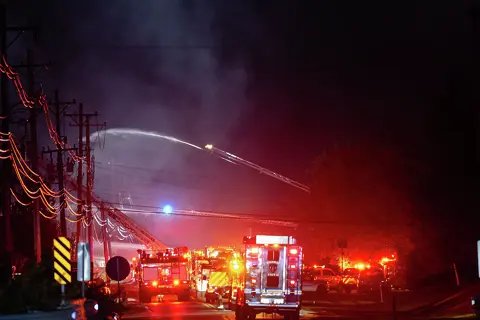
Chaos and heartbreak swept through Louisville, Kentucky, on Tuesday evening when a UPS cargo plane burst into flames moments after takeoff, sending shockwaves across the city that serves as the global heart of the shipping giant. The fiery crash, which occurred just after 5 p.m. near Louisville Muhammad Ali International Airport, claimed at least seven lives and left eleven others injured, including several with severe burns and trauma.
The McDonnell Douglas MD-11 aircraft, built in 1991 and bound for Honolulu, appeared to struggle shortly after liftoff from UPS’s Worldport facility. Witnesses reported seeing flames shooting from the left wing, followed by a thick trail of black smoke. Within seconds, the plane dipped, clipped part of a nearby structure, and exploded into a massive fireball that lit up the evening sky.

Video footage showed pieces of the plane scattering across the tarmac as the inferno consumed nearby buildings. One large structure near the runway — its roof ripped apart — bore the brunt of the explosion.

Officials confirmed that four of the victims were not aboard the aircraft, but were instead in surrounding industrial buildings struck by the debris and blast. Kentucky Governor Andy Beshear called the crash one of the most violent aviation disasters the state has witnessed.
At least three people are dead and 11 are injured after the UPS plane crash, Kentucky Gov. Andy Beshear says.pic.twitter.com/qIkXHHyveI
— Sri Lanka Tweet 🇱🇰 (@SriLankaTweet) November 5, 2025
A McDonnell Douglas MD11F cargo plane operated by United Parcel Service crashed during takeoff at Louisville International Airport in the US…
“Anyone who’s seen the videos or images can tell just how devastating this was,” Beshear said. He added that among the injured, some were suffering from “very serious, life-altering injuries.”
At the time of the accident, the UPS MD-11 was fully fueled for its long-haul route to Hawaii — a detail aviation experts say may have contributed to the scale of the explosion. “The plane itself becomes a bomb in situations like this because of the sheer volume of jet fuel it’s carrying,” explained aviation attorney Pablo Rojas, noting that early footage suggested a catastrophic engine or wing fire on the aircraft’s left side.
The crash site lies just beyond the southern perimeter of the airport, where several industrial facilities operate. One business, Kentucky Petroleum Recycling, was “hit directly,” authorities confirmed, while a nearby auto parts company also suffered significant damage.
Residents miles away could see plumes of smoke towering into the sky. Winds carried the dark cloud northward, across the Ohio River into Indiana. Although most EPA AirNow monitors recorded “Good” air quality levels near the airport, one station in Jeffersonville, Indiana registered a brief spike into “Moderate” territory roughly four hours later. Experts believe the smoke plume likely dispersed higher in the atmosphere, making ground-level detection more difficult.
At least three killed and 11 injured after a UPS UPS.N wide-body cargo plane crashed in Louisville, #Kentucky, erupting into a massive fireball shortly after takeoff, says the governor. pic.twitter.com/W9wGCah4B5
— DD News (@DDNewslive) November 5, 2025
The tragedy unfolded at the heart of UPS’s Worldport — the largest air logistics hub on Earth. The Louisville facility typically handles around 300 flights daily and processes over 400,000 packages every hour, employing thousands of local workers.
In the wake of the crash, UPS suspended all package sorting operations at the hub, halting both domestic and international shipments. Company officials did not immediately announce when work would resume.
“We all know someone who works at UPS,” said Louisville Metro Council member Betsy Ruhe, emphasizing the personal toll of the disaster. “Everyone’s calling and texting loved ones to make sure they’re safe — and sadly, not all those messages are being answered.” Mayor Craig Greenberg confirmed that the National Transportation Safety Board (NTSB) has taken charge of the investigation, deploying a 28-member team to the scene.
For those nearby, the crash sounded like an explosion from a war zone. Eric Richardson spent the night outside a police training center, desperately seeking news about his girlfriend, who had been working at a metal recycling facility near the crash site. Her phone’s live location still showed her inside the impacted area. His friend Bobby Whelan, who had left the site just minutes before the explosion, recalled the terrifying noise. “It was like a bomb went off,” he said quietly. “We’re just hoping for a miracle.”
Tom Brooks Jr., who operates another metal recycling business nearby, said the sheer force of the blast “rocked the entire place.”

Several miles away, Destyn Mitchell, working as a host at an Outback restaurant, remembered the unsettling moment the shockwave reached her. “We heard this loud boom that shook the building,” she said. “The whole mood changed instantly — people packed up their meals and left. Everyone just wanted to get home and check on their families.”
Police Chief Paul Humphrey said the airport remains shut down, with emergency crews working to secure hazardous debris and spilled fuel. “We don’t yet know how long it’ll take to make the area safe,” he said. The NTSB is now focusing on what caused the fire in the left wing. Preliminary evidence points to a possible engine malfunction or fuel system failure, but investigators cautioned that it could take months to confirm.
Governor Beshear promised full cooperation between state, local, and federal agencies as recovery and identification efforts continue.
Louisville is a community deeply connected to UPS — the company’s economic and social influence runs through nearly every neighborhood. Tuesday night’s crash left many residents anxiously refreshing their phones, hoping for news of loved ones.
The sight of burning wreckage so close to home has rattled even those accustomed to the city’s bustling air traffic. For now, grief overshadows commerce. As one resident put it, watching smoke rise beyond the skyline, “It felt like time stopped — everything went silent except for the sirens.”