Chandra Grahan On Holi 2026: Timings, Sutak Kaal And Visibility Details During Blood Moon
Chandra Grahan On Holi 2026: Timings, Sutak Kaal And Visibility Details During Blood Moon
Pune, March 3, 2026: The first lunar eclipse of 2026 will be witnessed across most parts of India today, coinciding with Holika Dahan and Holi celebrations. The celestial event is occurring on the full moon day of 12 Phalguna, 1947 Saka Era. According to official sources, the eclipse will be visible in a majority of Indian cities, barring some extreme western regions. Apart from India, it will also be seen in parts of eastern Asia, Australia, the Pacific Ocean and the Americas.
Chandra Grahan 2026: Date and Timings
The lunar eclipse will begin at 3:20 PM IST and conclude at 6:48 PM IST. The total phase is expected between 6:33 PM and 6:40 PM IST. The eclipse magnitude is reported to be 1.155.
Sutak Kaal
The Sutak Kaal commenced at 6:23 AM on March 3 and will end with the conclusion of the eclipse.

Visibility In India
As per the Ministry of Earth Sciences, most places in India will witness the concluding phase of the eclipse at moonrise. However, parts of North-East India and the Andaman and Nicobar Islands may also observe the end of the totality phase.
Cities including Agartala, Bhagalpur, Cooch Behar, Darjeeling, Dibrugarh, Gangtok, Guwahati, Imphal, Itanagar, Kohima, Kolkata, Midnapore, Murshidabad, Port Blair, Shillong, Sibsagar, Silchar, Siliguri and Tamenglong are likely to experience visibility for more than an hour. In contrast, cities such as Mumbai, Delhi, Bengaluru, Varanasi, Vadodara, Ujjain, Udaipur, Thrissur, Thiruvananthapuram, Thanjavur, Srinagar, Ranchi, Rajkot, Raipur, Pune, Patna, Panaji, Puducherry, Lucknow, Mangaluru, Jammu and Hyderabad may witness the eclipse for a shorter duration.
Traditional Do’s And Don’ts
Several cultural beliefs are associated with Chandra Grahan. Many people prefer staying indoors during the eclipse and avoid conducting auspicious ceremonies. Chanting mantras, meditation and prayer are encouraged. Some individuals refrain from eating food during the eclipse, while others place Tulasi leaves in stored food and water. Bathing before and after the eclipse is considered spiritually purifying in many traditions.
What Is A Lunar Eclipse?
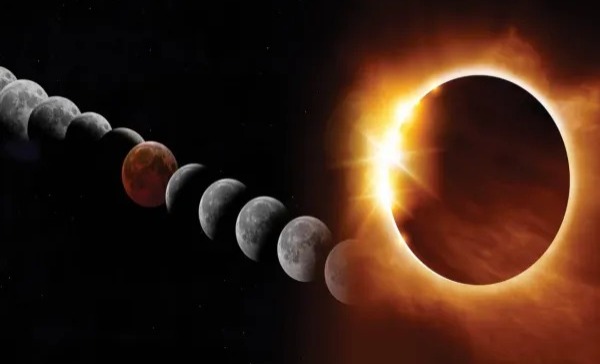
A lunar eclipse occurs on a full moon day when the Earth comes between the Sun and the Moon, casting its shadow on the Moon. A total lunar eclipse happens when the entire Moon passes through the Earth’s umbral shadow, while a partial eclipse occurs when only a part of the Moon is covered.
The next lunar eclipse visible from India is scheduled for July 6, 2028, and it will be a partial lunar eclipse.
Disclaimer:
The do’s and don’ts mentioned above are based on traditional beliefs and cultural practices. There is no scientific evidence that a lunar eclipse causes harm to health or affects food and daily activities. Readers are advised to rely on verified scientific information.