Could This Be the Strangest Place on Earth for Science?
Could This Be the Strangest Place on Earth for Science?
Imagine a place on Earth where the Sun feels closer, shadows vanish at noon, and water refuses to spin the way it normally does. A place where walking in a straight line suddenly becomes a challenge, and the ordinary rules of physics seem to bend in subtle but fascinating ways. It may sound like a trick, but it is very real—and it all happens because of a single invisible line that divides the planet into two equal halves.
Welcome to a country in South America that is full of adventure, natural wonders, and people who make life as vibrant as the landscapes around them. Here, standing on the Equator—the very line that separates the Northern and Southern Hemispheres—creates phenomena that leave both scientists and travelers astonished.
Step carefully along this line, and you might find yourself wobbling while trying to walk straight. Drop water into a sink at the right spot, and it refuses to spin the way you expect. At the exact moment when the Sun reaches its zenith, your shadow can disappear completely—you won’t even need a watch to tell the time. These curious occurrences are not illusions; they are all natural results of standing at Earth’s equatorial zone.

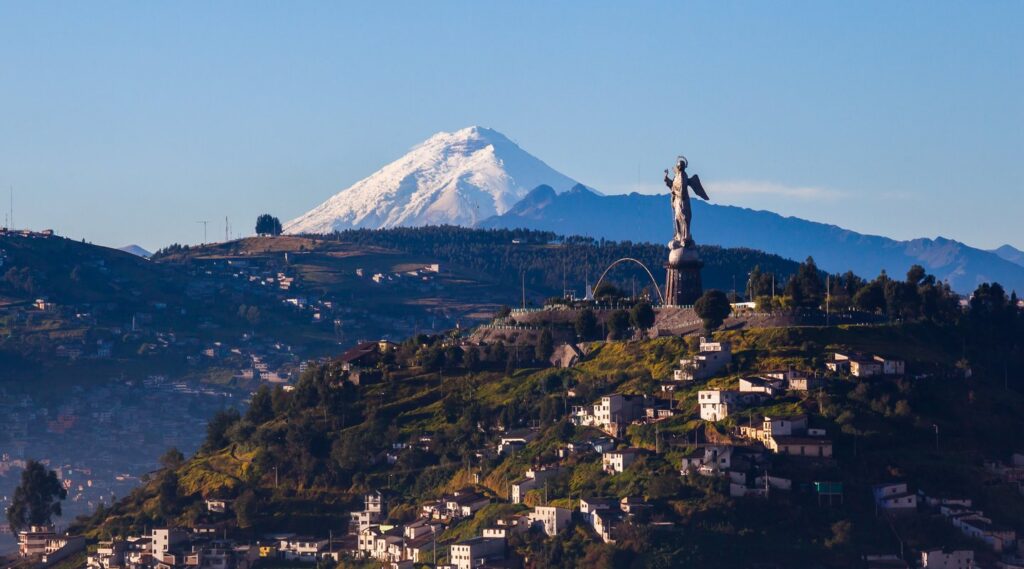
The effects of the equator extend far beyond small experiments. Mount Chimborazo, for instance, may not be the tallest peak above sea level, but because of its location near the equator, it is the point on Earth that is farthest from the planet’s center. In other words, standing atop Chimborazo brings you closer to space than anywhere else on land. Quito, the nation’s capital, also rises at an incredible altitude, making it the second-highest capital city in the world. Life here is challenging—thin air, lower oxygen levels, and strong sunlight make daily activities more demanding, and even engines and batteries work harder.
Beyond mountains and highlands, this country extends into the Pacific Ocean with the remarkable Galápagos Islands. These islands are among the most untouched places on the planet, home to more than 9,000 species of animals, including giant tortoises, marine iguanas, playful sea lions, and even penguins. Many of these creatures exist nowhere else in the world. The Galápagos Islands were the first-ever UNESCO World Heritage site, and their extraordinary wildlife inspired some of the most important scientific discoveries in history.
From the extraordinary physical phenomena along the equator to the heights of Chimborazo and the unique wildlife of the Galápagos, this country offers a blend of adventure, science, and natural beauty that is hard to find anywhere else. It is a place where the Earth’s quirks are on full display, waiting for those curious enough to explore them.
A land that surprises, educates, and astonishes—this is a destination where science, nature, and adventure come together. The next time you want to experience physics in action, explore remarkable wildlife, or simply witness the wonders of our planet, skip the textbooks and visit this extraordinary country. Here, the Earth itself becomes your classroom.