Delhi High Court: Absence Of Saptapadi Alone Cannot Invalidate A Hindu Marriage
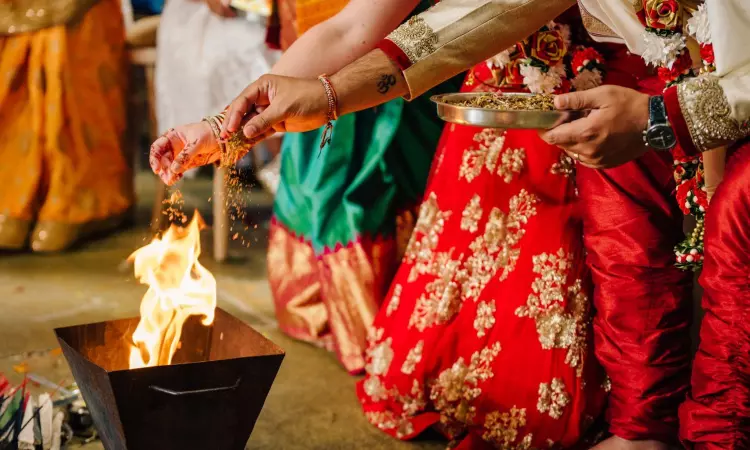
Delhi High Court: Absence Of Saptapadi Alone Cannot Invalidate A Hindu Marriage
The court said Hindu marriage validity depends on overall customary solemnisation, not only proof of the seven-step ritual.
The Delhi High Court has reaffirmed a key legal principle: the absence of direct evidence showing performance of Saptapadi, the traditional seven steps taken around the sacred fire does not by itself make a Hindu marriage invalid.
Restating the presumption in favour of marriage legitimacy, the court held that when circumstances indicate that the parties underwent marriage rituals and lived together as husband and wife, the marriage is presumed valid, especially when a child has been born from the union.
A Division Bench of Justice Anil Kshetrapal and Justice Harish Vaidyanathan Shankar delivered the ruling on August 27, 2025, while dismissing a husband’s appeal challenging a Family Court decision. The husband had sought a declaration that his marriage was null and void on the ground that Saptapadi had allegedly not been performed.

The High Court examined Section 7 of the Hindu Marriage Act, 1955, which governs ceremonies required for solemnisation. The Bench noted that the law does not mandate one uniform ritual for every Hindu marriage. Instead, it recognises that marriages may be solemnised according to the customs and ceremonies of either party.
The court observed:
“Sub-section (1) of Section 7 confers discretion on the parties to solemnise marriage as per the customs and ceremonies of either party, without mandating any particular ceremony.”
Clarifying the role of Saptapadi, the Bench added:
“Thus, performance of Saptapadi is not an indispensable requirement in every case to establish a valid marriage.”
The court also criticised the appellant’s weak approach to evidence. While claiming essential rites were missing, he failed to examine priests, guests, or elders who attended the ceremony. The Bench held that such omissions significantly weakened his plea.

The judges emphasised that long cohabitation and social recognition strengthen the presumption of lawful marriage. In this case, it was admitted that the couple lived together, the marriage was consummated, and a daughter was born, making the presumption of legitimacy even stronger.
The court concluded that the husband failed to discharge the burden of proof required to invalidate the marriage. Upholding the Family Court’s findings, the Bench ruled:
“We do not find any reason to interfere with the impugned judgement because the conclusion of the Family Court is plausible and possible.”
The appeal was dismissed, reinforcing that Hindu marriage validity must be assessed through surrounding circumstances, customary practices, and evidence not solely through the absence of proof of one specific ritual.