Driving Without a License in Metro Cities: What Changes Across States?
Driving Without a License in Metro Cities: What Changes Across States?
Operating a motor vehicle in India is not just a matter of convenience but a legal responsibility governed by strict regulations. One of the most basic requirements is carrying a valid driving license at all times. Under the Motor Vehicles (Amendment) Act, penalties for violations have become significantly stricter, making it essential for motorists to understand the driver without license fine applicable in their state. In major urban centres, enforcement tends to be more stringent, and the consequences of driving without license in Mumbai can include substantial fines along with additional legal complications due to advanced traffic surveillance systems.
The move toward digital monitoring and e-challans has made it nearly impossible to avoid detection. High definition cameras and integrated databases allow authorities to verify driver credentials in real time. Understanding how these rules change as you cross state borders is essential for anyone who travels between metro cities.
The Uniform Base Penalty Under Central Law
The Motor Vehicles Act serves as the primary legislation for road safety in India. Before the latest amendments, the penalty for driving without a license was relatively small. Today, the base fine has been increased to five thousand rupees. This change was made to discourage unlicensed drivers from taking to the roads and risking the lives of others.

In addition to the monetary fine, the law also allows for imprisonment for a term of up to three months. While physical arrest is rare for a first-time offence, it becomes a real possibility for repeat offenders or in cases where the unlicensed driver causes an accident. The vehicle can also be impounded on the spot, leading to additional towing and storage charges.
Variations in Enforcement Across Metro Cities
While the fine amount is largely standardised, the way traffic police handle the offence differs between cities like Delhi, Mumbai, and Bangalore. Each metro city has its own level of digital integration and roadside checking frequency.
Strict Digital Monitoring in Delhi
In the national capital, the traffic police rely heavily on an automated system. If you are caught driving without a valid license, the challan is issued against the vehicle registration number. Delhi also has a strict policy regarding the owner of the vehicle. If you allow someone without a license to drive your car, you as the owner can also be fined five thousand rupees. This double penalty system makes it very expensive for families who are not careful about who uses their car.
Focus on Road Safety in Mumbai
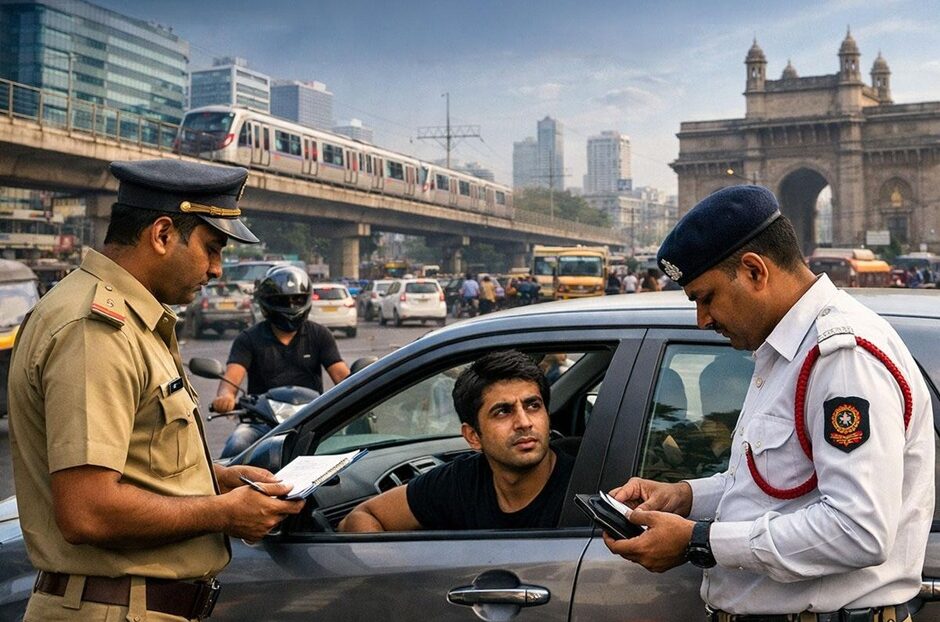
Mumbai traffic authorities focus heavily on the physical verification of documents. While digital copies on official apps are accepted, the lack of a license leads to immediate action. In Mumbai, the police often conduct special drives during late hours or festive seasons. If a driver is caught without a license during these drives, the vehicle is almost always impounded until a licensed driver comes to claim it.
The Role of E-Challans and Digital Records
The introduction of e-challans has changed the landscape of traffic enforcement. In the past, a driver might have escaped a fine by claiming they forgot their license at home. Now, the police use handheld devices to check the central Sarathi database using your name or vehicle number.
If the database shows that no license has ever been issued to you, the fine is applied immediately. These digital records are linked to your vehicle insurance and future license applications. Having a history of driving without a license can make it very difficult for you to get a legitimate license later or to renew your vehicle insurance at standard rates.
Penalties for Different Categories of Licenses
It is a common mistake to think that any license is sufficient for any vehicle. However, driving a transport vehicle with a non transport license or a four wheeler with only a two wheeler license is legally treated as driving without a valid license.
Mismatched Vehicle Classes
If you hold a license for a geared motorcycle but are caught driving a car, you will face the same five thousand rupee fine. Each class of vehicle requires a specific test of skill. The law treats an unqualified driver as a major safety risk. Always ensure that your license covers the specific category of the vehicle you are operating.
Expired and Lapsed Licenses
An expired license is legally equivalent to having no license at all. Most states provide a grace period for renewal, but once that period ends, you are liable for the full penalty. In many metros, the police check the expiry date on the digital portal during routine stops. It is wise to set a reminder for your license renewal at least six months before it expires to avoid legal trouble.
Impact on Insurance Claims
One of the most expensive surprises of driving without a license occurs when you try to file an insurance claim. If your vehicle is involved in an accident and the person behind the wheel does not have a valid license, the insurance company will reject the claim entirely.
This means you will have to pay for all damages to your own car and any third party property out of your own pocket. In cases of major accidents involving injuries, the financial liability can run into lakhs of rupees. The legal protection provided by your insurance policy is completely void without a valid driving license.
Conclusion
Driving without a license is a serious offence that carries heavy financial and legal consequences across all Indian states. While the five thousand rupee fine is a significant burden, the risk of vehicle impoundment and the loss of insurance protection are even greater. As metro cities move toward more automated enforcement, the chances of being caught are higher than ever. Always ensure your documents are valid and updated to enjoy a stress free and safe journey on Indian roads.