Fixed Electricity Charges May Rise Sharply As CEA Proposes Nationwide Tariff Overhaul
Fixed Electricity Charges May Rise Sharply As CEA Proposes Nationwide Tariff Overhaul
The Central Electricity Authority (CEA) has proposed major changes to India’s electricity billing system, including a sharp increase in fixed monthly charges for consumers. The move aims to help power distribution companies recover rising infrastructure and grid maintenance costs.
The Central Electricity Authority (CEA) has proposed a nationwide restructuring of electricity tariffs that could significantly increase the fixed monthly charges paid by consumers, even if actual power usage remains low.
According to the proposal, power distribution companies, commonly known as DISCOMs, are struggling to recover fixed operational costs as more affluent households and industries shift toward rooftop solar systems, open-access power and captive energy generation.

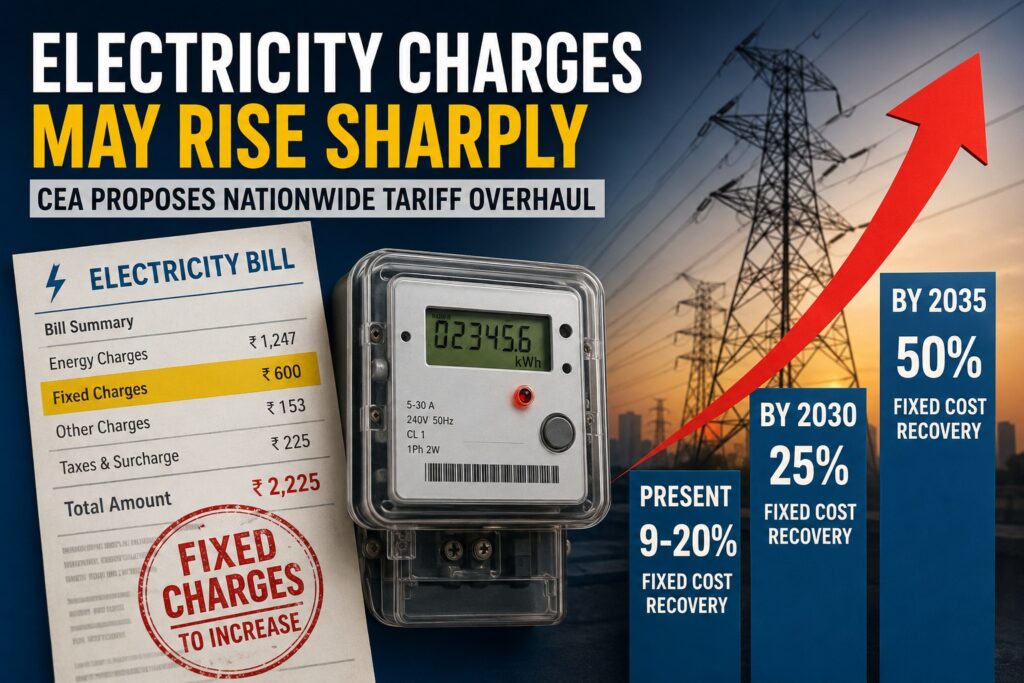
At present, a large portion of DISCOM revenue comes from per-unit electricity consumption charges. However, the CEA noted that while fixed expenses such as transmission infrastructure, salaries, maintenance, load dispatch operations and payments to power generators account for nearly 38% to 56% of utility costs, fixed monthly charges currently contribute only around 9% to 20% of tariff revenue.
The authority has therefore recommended a “calibrated and phased approach” to gradually increase fixed-cost recovery over the coming years.
Under the proposal, fixed-cost recovery from domestic and agricultural consumers could rise to 25% by 2030 and eventually 50% by 2035. For industrial, commercial and institutional consumers, the target recovery level has been proposed at 100%.
The report also suggested separate tariff structures for rooftop solar and net-metering consumers. Officials believe consumers using rooftop solar continue relying on the grid for backup supply while purchasing lower volumes of electricity from DISCOMs, creating financial pressure on utility companies.
The proposal further recommends standardising billing demand calculations across states to improve transparency and reduce tariff distortions. For larger consumers above specified thresholds, the report has also proposed shifting toward kVAh billing, which reflects power factor inefficiencies more directly.
Energy experts say the recommendations, if implemented by state regulators, could gradually change the structure of electricity bills across India. Consumers may end up paying a larger compulsory monthly charge irrespective of actual electricity consumption.
The proposal will now be placed before the Forum of Regulators for discussion and possible implementation. Since electricity tariff decisions are regulated state-wise, the final impact may vary across different states.
The recommendations come at a time when households and businesses are already facing pressure from rising fuel prices, commercial LPG costs and increasing food inflation.
Disclaimer: The proposed tariff changes are currently recommendations and have not yet been implemented. Final electricity charges may vary depending on decisions taken by individual state electricity regulators.