India Launches Its First Hydrogen-Powered Train: Route, Speed, Capacity and Key Features Explained
India Launches Its First Hydrogen-Powered Train: Route, Speed, Capacity and Key Features Explained
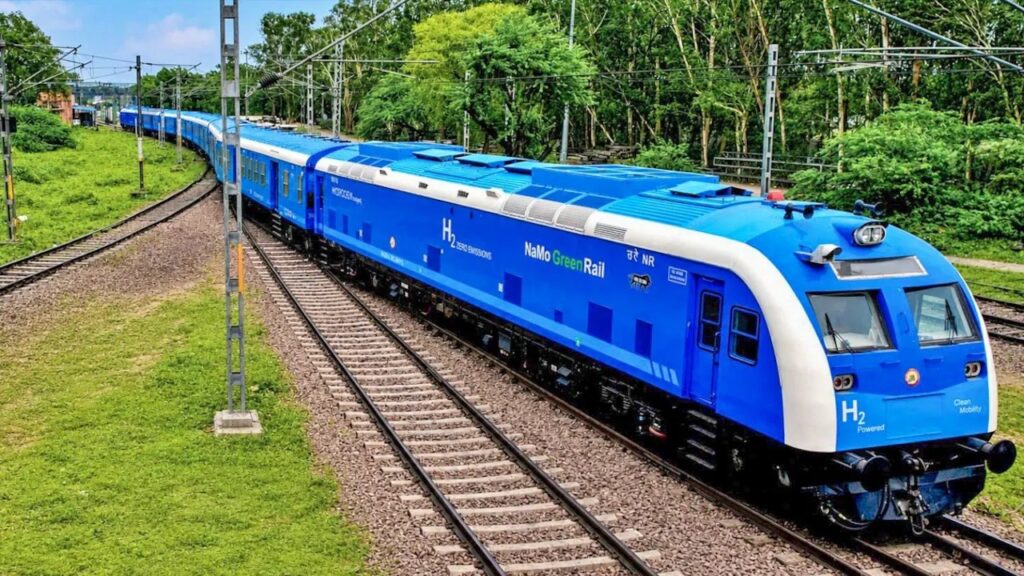
July 17: India has taken a significant step towards cleaner and sustainable rail transportation with the launch of its first hydrogen-powered train. Prime Minister Narendra Modi flagged off the train in Haryana on July 17, marking a milestone in the country’s efforts to adopt green mobility solutions.
Unlike conventional trains, the new hydrogen-powered train does not rely on diesel or overhead electric wires. Instead, it uses hydrogen fuel cell technology to generate electricity, producing only water vapour as a by-product and significantly reducing emissions.

Designed and Built in India
The train has been designed and developed in India and is among the most powerful hydrogen-powered passenger trains globally.

It comprises 10 coaches, including:
- 2 hydrogen-powered driving power cars
- 8 passenger coaches
The train can accommodate approximately 2,600 passengers and is powered by a 3,200-horsepower engine. In comparison, most hydrogen trains operating in other countries typically consist of only two to four coaches.
Route and Timings
The hydrogen train will initially operate on the Jind–Sonipat route in Haryana, covering a distance of 89 kilometres.
According to the Railway Ministry:
- The train departs Jind at 7:40 am and arrives in Sonipat at 9:40 am.
- The return journey begins from Sonipat at 10:40 am, reaching Jind at 1:00 pm.
The train has a maximum operational speed of 75 kmph on the route.
Railway authorities selected the Jind–Sonipat corridor to evaluate the train’s safety, operational efficiency and performance under regular service conditions.
How Hydrogen Fuel Cell Technology Works
Instead of using diesel engines or drawing power from overhead electric lines, the train is equipped with hydrogen fuel cells.
These fuel cells generate electricity by combining hydrogen stored onboard with oxygen from the atmosphere. The electricity powers the train’s motors, while the only emission produced is water vapour, making the technology environmentally friendly.
The train also features Lithium Iron Phosphate (LFP) batteries, which provide additional power when required and improve operational efficiency.
Advanced Safety Systems
Indian Railways has incorporated multiple safety mechanisms into the hydrogen train, including:
- Hydrogen leak detection systems
- Fire and smoke detection sensors
- Temperature monitoring systems
- Continuous ventilation systems
- Automatic hydrogen supply shut-off in case of emergencies
- Real-time monitoring of the train from the driver’s cabin
These systems are designed to ensure safe operation while handling hydrogen fuel.
Extensive Testing Before Launch
Before entering service, the train underwent several rounds of testing, including:
- Stability trials
- Communication and radio system checks
- Emergency braking tests
- Performance validation under operational conditions
The Railway Ministry said the project represents another major step towards modernising India’s railway network following the rapid electrification of broad-gauge routes.
The launch also marks the establishment of India’s first integrated hydrogen railway ecosystem, covering hydrogen production, storage, refuelling infrastructure and train operations.
A Step Towards Green Mobility
The hydrogen-powered train is part of Indian Railways’ broader push to reduce carbon emissions and adopt cleaner technologies. If successful, the technology could pave the way for the introduction of more hydrogen-powered trains on non-electrified routes across the country, supporting India’s long-term sustainability and net-zero goals.