Mega Clean-Up: Over 100 Tonnes of Waste Cleared After Maratha Protest at Mumbai’s Azad Maidan

Mega Clean-Up: Over 100 Tonnes of Waste Cleared After Maratha Protest at Mumbai’s Azad Maidan
In the aftermath of the large-scale Maratha reservation protest at Mumbai’s iconic Azad Maidan, the Brihanmumbai Municipal Corporation (BMC) undertook a massive clean-up mission, clearing an astounding 1.01 lakh kilograms (101 metric tonnes) of waste from the area and its surroundings between August 29 and September 2. Over five days, Azad Maidan—a focal point of central Mumbai—was packed with protestors demanding quota for the Maratha community. But as the crowds dispersed, they left behind mountains of garbage ranging from food wrappers and plastic bottles to torn footwear, posters, and flyers strewn across the grounds.
To tackle this overwhelming mess, BMC pressed into action 54 compactor dumpers, each capable of carrying 1,850 kg of solid waste. These vehicles worked round-the-clock alongside hundreds of sanitation workers, restoring cleanliness to one of Mumbai’s busiest public spaces. The clean-up began on August 29, when the BMC collected 4,000 kg of waste. The next day, it rose to 7,000 kg, and then ballooned to 30,000 kg per day from August 31 through the morning of September 2.
🧹आझाद मैदान आणि परिसरात बृहन्मुंबई महानगरपालिकेने रात्र सत्रात केली रस्ते स्वच्छता व स्वच्छतेची इतर कार्यवाही
— माझी Mumbai, आपली BMC (@mybmc) September 2, 2025
👷🏻♂️एकूण १ हजारांहून अधिक स्वच्छता कर्मचारी तीन सत्रांमध्ये कार्यरत. काल रात्र सत्रात म्हणजेच रात्री १० ते सकाळी ६ या कालावधीत ४०० हून अधिक कर्मचारी अविरतपणे कार्यरत… https://t.co/AwSdhZzdIO pic.twitter.com/31sRXwlJm0
According to official figures, 466 sanitation workers—including sweepers and waste pickers—were deployed in shifts to keep operations running. The team was supported by 13 small compactor trucks (1,850 kg capacity) and 3 large compactors (12,000 kg capacity). The smaller vehicles were crucial in navigating the congested and crowded protest areas with greater ease. Once loaded, the waste was taken to refuse transfer stations (RTS) in Mahalaxmi, and from there to Deonar or Kanjurmarg processing facilities.

Beyond just waste removal, the BMC also undertook sanitation measures. Using 26 tankers, each holding 1,000 litres, they sprayed a total of 26,000 litres of water on roads and open spaces to clean up the grime and leftovers. To sanitize the area, the civic team used 1,050 kg of bleaching powder and 100 kg of Izol, a disinfectant powder. Still, authorities noted that crowd density posed a serious challenge. A BMC official told The Indian Express that the clean-up was often disrupted because many areas were overcrowded or completely inaccessible, making it difficult to carry out consistent operations.
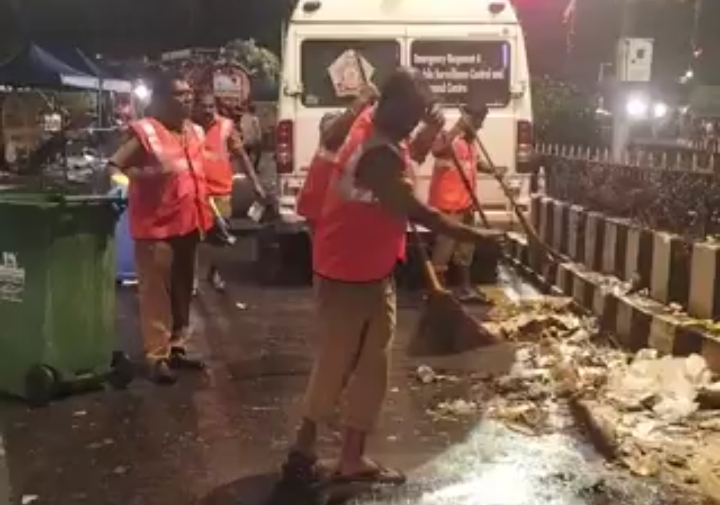
The biggest momentum in the clean-up came after the Bombay High Court ordered the protestors to vacate public spaces on Monday. As people began to leave Azad Maidan, the BMC launched a night-long clean-up blitz.
To support these efforts, the Mumbai Fire Brigade set up 40 high-intensity floodlights, allowing teams to work overnight. The civic body also scaled up its workforce, adding another 1,000 sanitation workers across the city during this phase. Workers were provided with 500 kg of plastic bags to help with waste collection and segregation. Teams operated in rotation—2 to 3 mini dumpers at a time—loading waste and transferring it into larger compactors for transport.
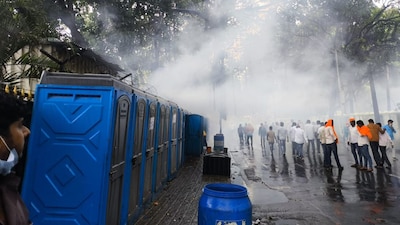
Additionally, the BMC deployed four advanced waste suction and jetting machines to tackle more stubborn grime and leftover debris stuck to roads and pavements. While the protest was ongoing, the BMC had made proactive arrangements for hygiene. 140 toilet seats were made available—81 were mobile toilets, and 59 were pre-existing permanent units at Azad Maidan.
To meet the sanitation demands of the large gathering, mobile toilets were strategically placed, including:
15 at MG Road
10 near the High Court
12 around DN Road
These facilities were aimed at minimizing open defecation and keeping basic hygiene accessible to protestors.