Pune Porsche Crash Case: Supreme Court Grants Bail to Three Accused, Stresses Parental Accountability
Pune Porsche Crash Case: Court Defers Hearing On Plea To Cancel Juvenile Accused’s Father’s Bail Till July 8
Fresh developments emerged on Monday in the high-profile Pune Porsche crash case as the Supreme Court granted bail to three men accused of manipulating evidence during the investigation into the deadly 2024 accident. While ordering their release, the apex court also made strong remarks on the role of parents in incidents involving juveniles, underlining that lack of supervision and communication often lies at the root of such tragedies.
The order was passed by a bench of Justices BV Nagarathna and Ujjal Bhuyan, which took note of the fact that the accused had remained in custody for nearly 18 months. The court directed that they be released on bail subject to conditions that would be fixed by the trial court.
The three accused had challenged a December 16, 2025, order of the Bombay High Court, which had rejected bail pleas of eight individuals linked to the case. The High Court had earlier held that the allegations pointed to a deliberate and coordinated attempt to tamper with crucial medical evidence in order to derail the investigation.

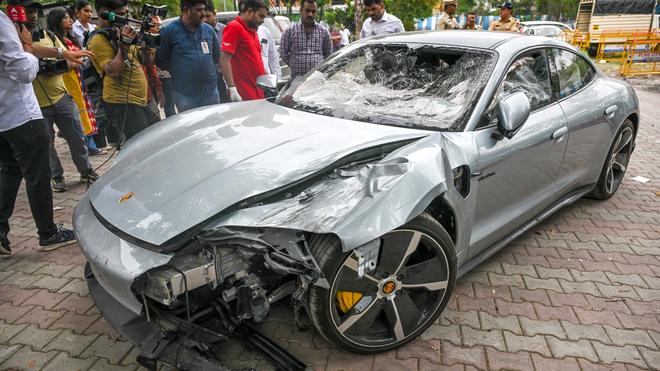
The case stems from a fatal accident that took place on May 19, 2024, at Pune’s Kalyani Nagar junction. Two young software engineers, Aneesh Awadhiya and Ashwini Koshta, were killed when a speeding Porsche Taycan allegedly driven by a 17-year-old rammed into their motorcycle. The teenager, reportedly from a well-known realtor’s family, was said to be under the influence of alcohol at the time. The car was allegedly being driven without number plates, after the minor and his friends had gone out to celebrate their Class 12 examination results at a pub.
What initially appeared to be a case of rash and negligent driving soon expanded into a much wider investigation. Police uncovered allegations of bribery, misuse of influence, and deliberate tampering of blood samples at the government-run Sassoon General Hospital. Investigators claimed that efforts were made to conceal the minor’s intoxication by swapping his blood sample with another.
Apart from the juvenile driver, police chargesheeted 10 other accused in the case. The minor’s parents were also booked for criminal conspiracy, with allegations that they had orchestrated the replacement of their son’s blood sample with that of his mother to obstruct the course of justice.
While granting bail, Justice Nagarathna made pointed observations on parental responsibility, though she clarified that the court had to exercise restraint to avoid prejudicing the trial. She remarked that, in many such cases, “both father and mother are at fault for failing to exercise adequate control over their children,” adding that the court was cautious about elaborating further on this aspect.
She went on to observe that celebrations driven by substance use, followed by reckless high-speed driving, often end in the loss of innocent lives on the road, including pedestrians and commuters who have nothing to do with such behaviour. Emphasising accountability, she said that the law must respond firmly to such actions.
According to the court, a key issue lies in parents handing over powerful vehicles and unrestricted funds to children, enabling late-night parties and dangerous behaviour. Justice Nagarathna observed that when parents do not spend time talking to their children or maintaining open dialogue, money and access to luxury become substitutes, with serious consequences.
Earlier, the Bombay High Court had taken a strict view while refusing bail to the accused. It had observed that the collective intention of the applicants appeared to be the falsification of medical records in a government hospital, allegedly carried out through a pre-planned conspiracy.
The High Court relied on investigation material, including chemical analysis and DNA reports, which indicated that an entirely different and improper method of collecting blood samples was used, allegedly in exchange for bribe money. It also noted that even when fresh blood samples were drawn at Aundh Hospital, attempts were made to interfere with the process.
Expressing concern, the High Court had stated that releasing the accused on bail could lead to further tampering with evidence or influencing of witnesses, given their alleged financial power and social dominance. It pointed out unusual delays in the medical examination of the juvenile and the belated recording of statements, which, according to the prosecution, indicated early attempts to undermine the investigation.
The High Court concluded that the apprehension of the prosecution regarding witness intimidation and evidence manipulation was well founded. It held that granting bail before the examination of key and vulnerable witnesses could seriously damage the case and therefore declined to exercise discretion in favour of the accused at that stage.
Among those who approached the Supreme Court was Amar Santosh Gaikwad, alleged to be a middleman who paid ₹3 lakh to the assistant of a doctor to facilitate the blood sample swap. The top court had earlier sought responses from the Maharashtra government on his bail plea, as well as on petitions filed by Aditya Avinash Sood (52) and Ashish Satish Mittal (37). Sood and Mittal were arrested in August 2024 after investigators found that their blood samples were used for tests linked to the minors present in the car at the time of the accident.
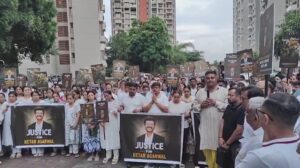
The case had also triggered widespread public outrage after the Juvenile Justice Board initially granted bail to the minor driver on lenient conditions, including writing a 300-word essay on road safety. Following sharp criticism, Pune police sought a review of the order, after which the juvenile was sent to an observation home. He was later released following a High Court order in June.
While the juvenile was eventually released, several others—including his parents, doctors, hospital staff, alleged middlemen, and other accused—were sent to jail in connection with the blood sample manipulation case.