Supreme Court Directs Indian Railways to Stop Calling Travellers ‘Second-Class’ Passengers
Supreme Court Directs Indian Railways to Stop Calling Travellers 'Second-Class' Passengers
Court says the expression is against the spirit of the Constitution and compensation cannot be denied merely because a train ticket is missing.
By Vidhi Lalla
The Supreme Court has urged the Indian Railways to stop referring to travellers as “second-class passengers”, saying the term carries an inappropriate social connotation and is inconsistent with the spirit of the Constitution. The court suggested that the classification should apply only to railway coaches and not to people.

The observation came while the apex court was hearing the case of Chandrakant Thakkar, who died after falling from a moving train in 2015. His wife had sought compensation under the Railway Act, but her claim was rejected by the Railway Claims Tribunal and later upheld by the Madhya Pradesh High Court because no valid ticket was recovered from the deceased after the accident.

Setting aside both decisions, a bench of Justice Sanjay Karol and Justice N. Kotiswar Singh ruled that the absence of a ticket cannot by itself prove that a person was travelling without one.
“There is a statement by the appellant that the deceased had a ticket in his bag for the journey. There is no other way to prove this. There is no denial of the deceased travelling in the train and the occurrence of the incident… We are of the view that the courts below have erred in not awarding compensation to the appellant,” the court observed.
Supreme Court Urges Railways To Prevent Overcrowding In Trains, Suggests Dropping 'Second Class Passenger' Term#SupremeCourt #Railways https://t.co/X6MIXjxuWH
— Live Law (@LiveLawIndia) July 18, 2026
The bench directed the Railways to pay ₹8 lakh as compensation to the deceased’s wife within four weeks. It also ordered that if the amount is not paid within the stipulated period, it will carry 8 per cent annual interest from the date the claim was filed.
The judges also objected to the terminology used in railway manuals.
“One aspect that caught our attention while perusing the manual and other related documents was the use of the term ‘second class passenger’. While it is ostensibly linked to the expenditure incurred by the passenger to travel, we may suggest that the class connotation be attached to the coach and not to the passenger, in recognition of the history of class divisions in our country and the same being offensive to the spirit of the Constitution of India,” the bench said.
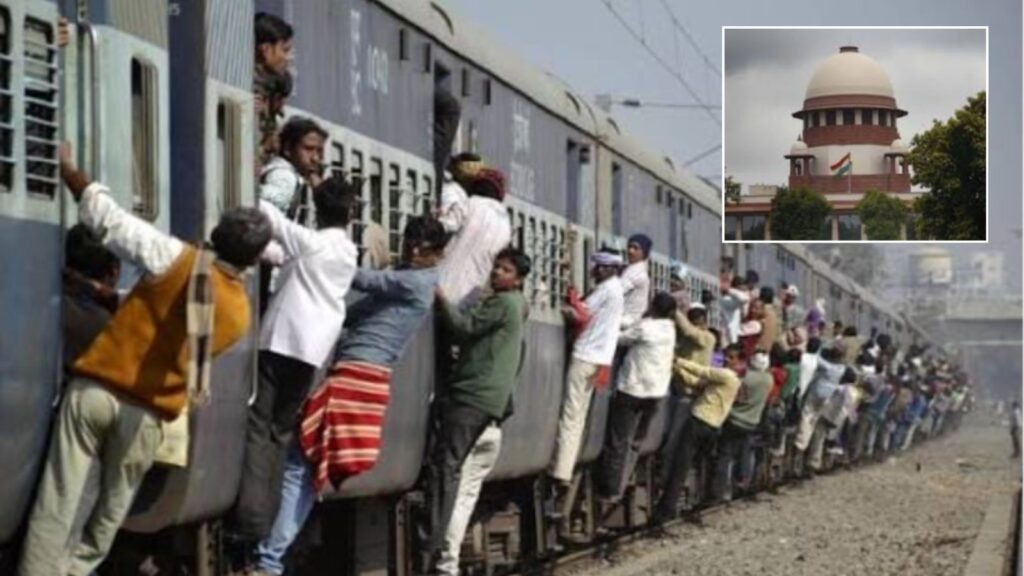
The court further noted that deaths caused by overcrowding on trains can no longer be treated as isolated incidents. Referring to recent railway accidents, including fatalities linked to overcrowding, the judges stressed the need for stronger safety measures and better implementation of existing railway guidelines.
The bench observed that while the Railways already have detailed rules for crowd management, including distributing passengers across coaches, alerting upcoming stations and adding extra coaches when necessary, implementation remains inadequate.
At the same time, the Supreme Court said passengers also have a responsibility to ensure their own safety.
“We may observe one more thing. It would be entirely unfair to cast sole responsibility upon the Railways. The passengers themselves have an equal responsibility… Sometimes, then, practical considerations must give way to the preservation of life,” the court observed, cautioning against risky practices such as attempting to board overcrowded or moving trains.
The court also suggested that improving passenger safety would require additional manpower and encouraged the Railways to create more employment opportunities to strengthen safety and crowd management across the network.