The Secret Behind the ‘V’: Why Birds Fly in Formation and Take Turns Leading the Sky
The Secret Behind the ‘V’: Why Birds Fly in Formation and Take Turns Leading the Sky
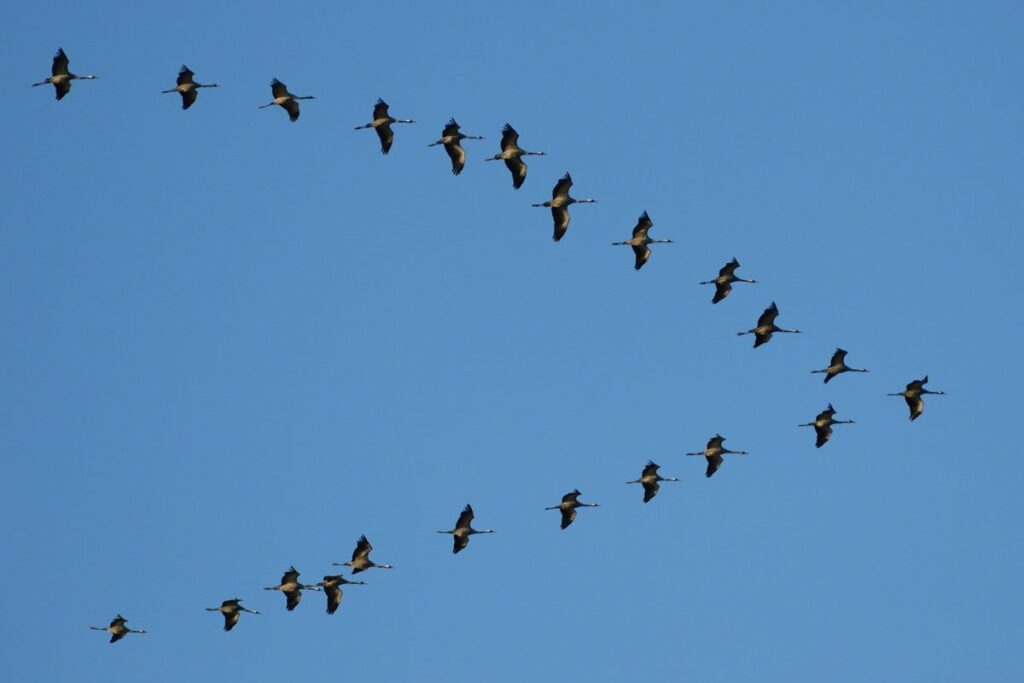
A recent study has shed light on one of nature’s most mesmerizing spectacles — the sight of large migratory birds flying together in a perfect “V”-shaped formation. While this display may seem purely aesthetic, scientists have now confirmed that it serves a critical aerodynamic and energy-saving function, showcasing nature’s remarkable engineering.
How the “V” Formation Works
When a bird flaps its wings, it generates air vortices — swirling air currents consisting of two main components: downwash, the air pushed downward directly behind the bird, and upwash, the air lifted upward and outward to the sides of the wings.
Birds flying just behind and slightly to the side of the leader position themselves strategically within this upwash zone. This allows them to gain extra lift from the rising air currents generated by the bird ahead, effectively giving them a “free ride” that reduces the amount of energy needed to stay airborne.

The coordinated movement results in energy conservation and smoother flight across the flock. Studies show that birds flying in a “V” can expend up to 20–30% less energy than if they were flying solo, making the formation essential for long migratory journeys that span thousands of kilometers.

Teamwork in the Sky
In this aerial strategy, the lead bird faces the greatest challenge — breaking through undisturbed air and facing the strongest resistance. As a result, leaders often tire faster than the others.
To counter this, birds rotate leadership positions throughout the journey, taking turns at the front of the “V.” This rotation allows the flock to maintain a steady pace without exhausting any single member.
Moreover, the “V” shape enhances visibility, communication, and coordination among flock members. Each bird can see the others, stay synchronized with wingbeats, and react quickly to directional changes, ensuring the group remains cohesive and avoids collisions.
Why Large Birds Use the ‘V’ Formation
The aerodynamic advantages of the “V” pattern are most effective for large birds with long wingspans, such as geese, cranes, pelicans, and swans. The wider wings create stronger air vortices, which amplify the upwash effect.
In contrast, smaller birds — such as sparrows or starlings — rarely adopt this formation because their short wings generate less consistent air currents, making the benefits minimal. Instead, they often fly in irregular clusters or swarms for protection and agility.
Scientific Backing and Observations
Research published in the journal Nature highlighted how birds in a “V” formation synchronize their wingbeats with remarkable precision. Each bird times its flapping to maximize the lift from the bird ahead, maintaining an exact position to harness optimal aerodynamic gain.
Scientists studying northern bald ibises equipped with GPS and motion sensors found that every bird maintained a consistent spatial and temporal pattern, suggesting conscious coordination rather than instinctive clustering.
Dr. Steven Portugal, an animal flight expert from the Royal Veterinary College, explained,
“The precision with which these birds position themselves shows a deep understanding of the aerodynamic principles involved — this is teamwork at its finest in nature.”
Beyond Birds: Lessons for Aviation and Technology
The “V” formation is now being studied by aerospace engineers and roboticists as a model for improving fuel efficiency and formation flying in aircraft and drones. By mimicking these natural patterns, airplanes could potentially save fuel by exploiting aerodynamic uplift from other planes in formation.
NASA has already tested this principle with fighter jets, finding fuel savings of up to 15% when flying in bird-like formations.
Why It Matters
This elegant natural behavior is more than a marvel of the skies — it is a symbol of cooperation, intelligence, and adaptation. Birds don’t just fly together for companionship; they work together for survival, demonstrating nature’s ability to combine physics and instinct seamlessly.
The next time a flock of geese glides across the horizon in that perfect “V,” it’s worth remembering — behind the beauty lies a masterclass in aerodynamics, teamwork, and evolutionary genius.