Scientists Identify the Only Naturally Vivid-Blue Fruit on Earth—And It Contains Zero Blue Pigment
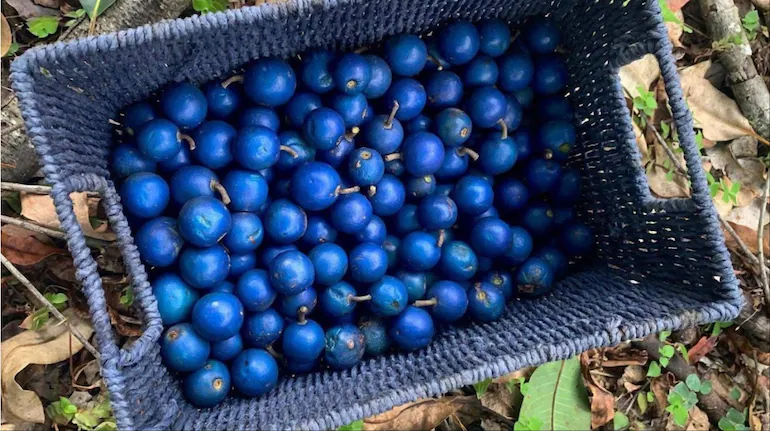
Scientists Identify the Only Naturally Vivid-Blue Fruit on Earth—And It Contains Zero Blue Pigment
For generations, the idea of a naturally bright-blue fruit sounded more like myth than science. After all, even the foods we casually call “blue”—such as blueberries or blue corn—lean heavily toward purple. But tucked away in the rainforests of Australia and Southeast Asia grows a remarkable exception, a tree whose fruit appears so electrically blue that many people assume it’s been edited or artificially dyed. This extraordinary species, Elaeocarpus angustifolius—popularly known as the blue quandong, blue fig, or blue marble tree—has now captured global scientific attention for a very unusual reason: its colour isn’t created by pigments at all.
The glossy, marble-like fruit of the blue quandong shines with a metallic, jewel-tone blue unlike anything else found in nature. Only about 1–2 centimetres wide, each fruit reflects a shade so intensely saturated that it often looks unreal in photographs. Yet researchers have confirmed that the effect is completely natural and—perhaps even more fascinating—not caused by chemical pigments.
For years, scientists believed truly blue fruits simply didn’t exist. But recent studies published in Nature and PNAS revealed the secret behind the quandong’s striking appearance. When the fruit’s skin was ground down in an attempt to extract its colour, it didn’t produce any blue substance at all. Instead, the powder turned a plain grey, offering definitive proof: the fruit contains no blue pigment.

The Optical Trick Behind Its Brilliant Hue
So how does a fruit glow with such vivid colour if no pigment is involved?
The answer lies in structural coloration, a rare natural phenomenon more commonly seen in animals like peacocks, beetles, and butterflies. Under powerful microscopes, scientists discovered that the fruit’s skin is built from ultra-thin layers of cellulose arranged in precise nanoscale formations. These microscopic structures bounce and bend light in a very specific way, reflecting only blue wavelengths while cancelling the others.
This same principle creates the shimmering feathers of a peacock—but in plants, this kind of optical engineering is exceptionally rare. In fact, the blue marble tree is one of only six known fruit-bearing plants that use structural coloration to appear blue.
Where This Remarkable Tree Grows
The blue quandong is native to the lush tropical forests of:
Northern and eastern Australia
Papua New Guinea
Parts of Indonesia
It grows into a tall, broad-canopied tree, producing clusters of its distinctive blue fruits that gleam even under dense rainforest shade. This eye-catching visibility isn’t just for show—it plays a vital role in the tree’s survival.
Why Evolution Chose This Radiant Blue
Researchers believe the species evolved this unusual visual strategy to appeal to birds. Many bird species see blue and ultraviolet wavelengths far more vividly than humans do. In the dim, filtered light of the jungle, the fruit’s metallic colour becomes a beacon, guiding birds to it from surprising distances. Once eaten, the seeds are dispersed widely, giving the tree an effective method for spreading through the forest.
The revelation that plants can create intense, durable colour using physical structure rather than chemicals is sparking new interest in biomimicry. Scientists are exploring how this natural design could inspire eco-friendly dyes, long-lasting colourants, and sustainable alternatives to pigment-based colouring systems.
The blue quandong may appear small and unassuming at first glance, but its existence challenges long-held assumptions about colour in the natural world. By relying on physics instead of pigments, this rare rainforest tree has created something truly spectacular—a fruit so vividly blue that it borders on surreal.