Tragedy Unfolds: Eight Elephants Killed As Rajdhani Express Derails In Assam After Night-Time Collision
Tragedy Unfolds: Eight Elephants Killed As Rajdhani Express Derails In Assam After Night-Time Collision
The New Delhi–bound Rajdhani hit a herd crossing the tracks in Assam’s Hojai district, derailing the engine and five coaches; no passengers were injured.
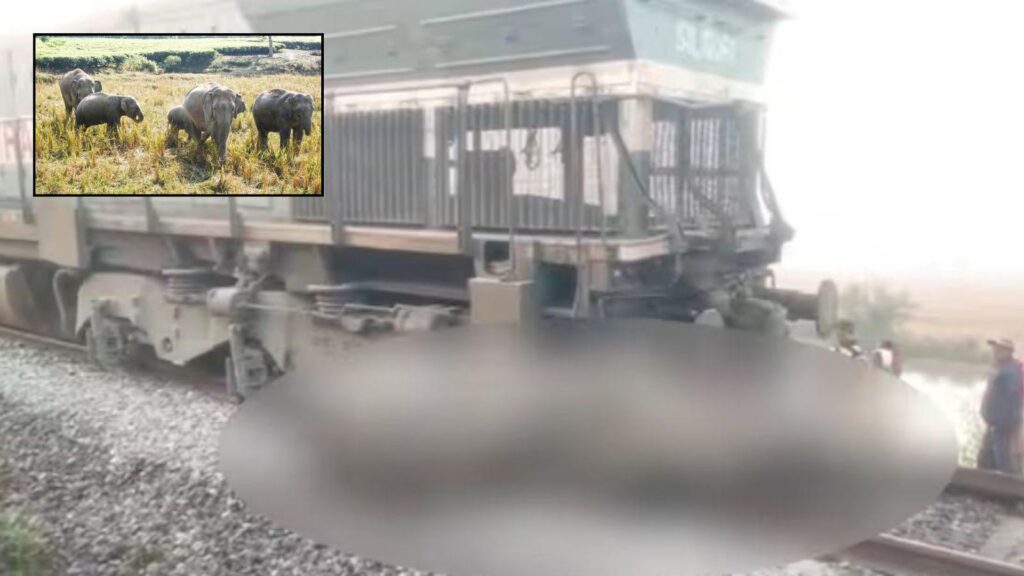
A tragic accident unfolded in Assam in the early hours of Saturday when the New Delhi–bound Anand Vihar–Sairang Rajdhani Express collided with a herd of elephants, killing at least eight animals and injuring one more. The impact caused the locomotive and five passenger coaches to derail, leading to disruption of rail services in the region.
The incident occurred at around 2.17 am near Changjurai village in Hojai district, on the Jamunamukh–Kampur section under the Lumding Division of the Northeast Frontier Railway. According to forest officials, the herd was attempting to cross the railway tracks when it was struck by the high-speed train.
Despite the severity of the collision, no passengers or railway staff were injured. Officials said the loco pilot applied emergency brakes after spotting the herd on the tracks, which helped reduce the scale of human casualties. However, several elephants could not escape in time and were hit by the train.

Railway authorities said that around 600 passengers were onboard the Rajdhani Express at the time of the accident. Of these, nearly 200 passengers travelling in the affected coaches were safely shifted to other coaches. After preliminary restoration work, the train later resumed its journey.
Train movement on the affected section was temporarily suspended as forest and railway officials jointly worked at the site to clear the tracks and manage the situation. Officials confirmed that trains scheduled to pass through the stretch were diverted to alternative routes while restoration work continued, as only a single line is operational in the area.
#WATCH | Maligaon, Assam | Loco pilot applied emergency brakes and stopped the train. Restoration work completed and no injuries have occurred: Kapinjal Kishore Sharma, Chief Public Relations Officer of the Northeast Frontier Railway.
— ANI (@ANI) December 20, 2025
(Visuals from the spot)
(Source: Northeast… https://t.co/n9mzFHUKZM pic.twitter.com/jvhTNmgl3F
The incident has once again highlighted the persistent challenge of human–wildlife conflict along railway corridors in elephant habitats across the Northeast. Assam, in particular, has witnessed several such incidents over the years, especially during night-time hours when herds move across traditional migration paths that intersect railway lines.
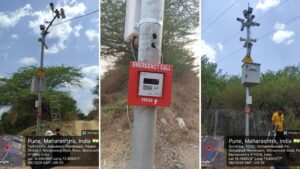
Railway authorities said efforts are underway to strengthen preventive measures. Indian Railways has been deploying technology-driven solutions, including Artificial Intelligence-based systems, to reduce such accidents. An AI-enabled Intrusion Detection System using Distributed Acoustic Sensors has already been implemented across 141 route kilometres in the Northeast Frontier Railway to detect elephant movement near tracks. Tenders have also been awarded to expand the system across an additional 981 route kilometres.
The system is designed to alert loco pilots, station masters and control rooms in real time about the presence of elephants near railway tracks, allowing trains to slow down or halt to prevent collisions.
Forest officials said they are monitoring the injured elephant and assessing the situation in the area. The deaths of the animals have sparked concern among wildlife conservationists, who continue to call for stricter speed restrictions, better fencing, and improved coordination between railway and forest departments in sensitive wildlife zones.
The derailment and loss of wildlife have cast a shadow over rail operations in the region, serving as a stark reminder of the fragile balance between infrastructure expansion and wildlife conservation.