Kavach 4.0 Marks Record Expansion on Indian Railways, Covering 472 km Under Advanced Safety System
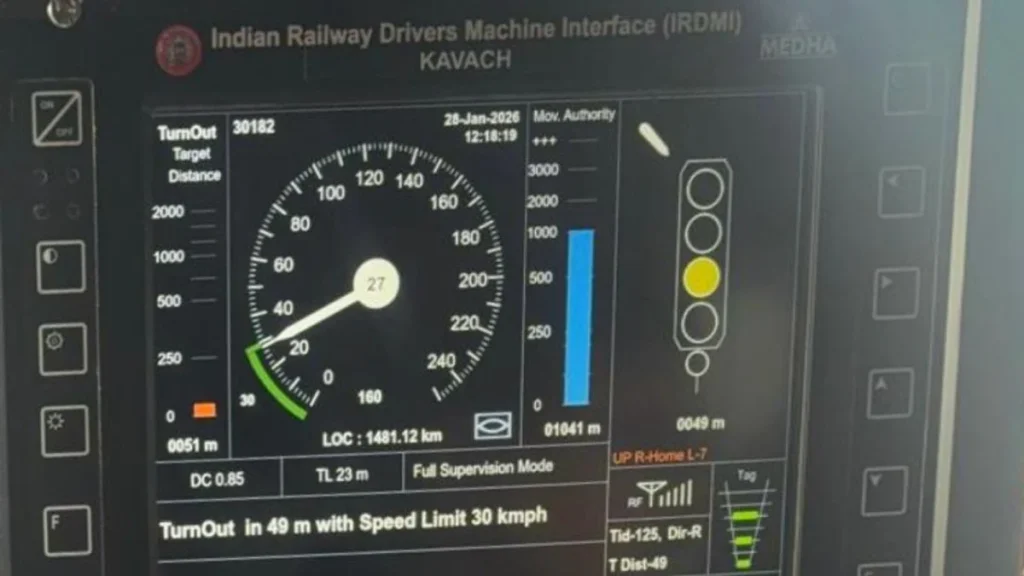
Kavach 4.0 Marks Record Expansion on Indian Railways, Covering 472 km Under Advanced Safety System
Rail safety received a major push as Indian Railways commissioned Kavach Version 4.0, the indigenous Automatic Train Protection (ATP) system, across 472.3 route kilometres (RKm) in one of the largest single-day rollouts to date. This achievement marks the highest number of route kilometres brought under Kavach both in a single day and within a month, highlighting the rapid pace at which the system is being deployed on high-density rail corridors.
The Ministry of Railways stated that the newly commissioned stretches span Western Railway, Northern Railway and East Central Railway, significantly strengthening protection against train collisions, signal violations and over-speeding while improving overall operational reliability.
Kavach 4.0: Newly Commissioned Routes

The latest phase of Kavach commissioning covers the following sections:
• Vadodara–Virar (344 km) on Western Railway
• Tughlakabad Junction Cabin–Palwal (35 km) on Northern Railway
• Manpur–Sarmatanr (93.3 km) on East Central Railway
With this addition, Kavach Version 4.0 is now operational across five zones of Indian Railways. According to the Railways Ministry, the earlier highest commissioning stood at 324 route kilometres on the Kota–Mathura section of West Central Railway.
Western Railway: Kavach Activated on Virar–Surat Section
Western Railway has successfully commissioned Kavach on the Virar–Surat stretch, a crucial segment of the Delhi–Mumbai rail route. The section includes 28 stations and 28 block sections, bringing enhanced safety coverage to one of the country’s busiest rail corridors.
Infrastructure installed as part of the project includes:
• 33 S-Kavach units in relay rooms and relay huts
• 64 Radio Interface Units (RIUs) at auto huts and operating control locations
• 33 tubular lattice towers, each with a height of 40 metres
• 412 km of optical fibre cable (OFC) laid in dual paths
Work on this section began in January 2023, and Kavach was successfully commissioned on 30 January 2026. The first Kavach-equipped service from Mumbai was Train No. 20907, Dadar–Bhuj Sayajinagri Express.
Further expansion is underway, with the Vadodara–Nagda section expected to be commissioned by March 2026, and the Virar–Mumbai Central section targeted for completion by September 2026. Kavach installation on locomotives is also progressing, with 364 locomotives already fitted in the Western Railway zone.
Northern Railway: Coverage on Tughlakabad Junction Cabin–Palwal Section
On Northern Railway, Kavach 4.0 has been commissioned on the 35-km Tughlakabad Junction Cabin–Palwal section, a strategically important four-line corridor in the Delhi region.
Despite the route length being 35 km, the corridor accounts for 152 main-line track kilometres, including major station yards. Kavach has been installed across:
Two main lines with automatic signalling
- Two lines operating under the absolute block signalling system
- This ensures uniform safety coverage across all lines and operating conditions on the section.
East Central Railway: Manpur–Sarmatanr Section Goes Live
East Central Railway has commissioned Kavach on the 93.3-km Manpur–Sarmatanr section of the DDU–Pradhankhanta rail line, a key part of the Delhi–Howrah trunk route. The section passes through Uttar Pradesh, Bihar and Jharkhand and handles heavy mixed traffic.
Operational features of this stretch include:
- 77 stations, including 8 junction stations
- 79 level crossing gates
- 7 intermediate block signals
Train operations with Kavach 4.0 have already begun. The first Kavach-enabled service, Train No. 13305 Sasaram Intercity Express, departed Sone Nagar at 07:42 am and arrived at Manpur at 09:35 am. During this run, a head-on collision test was conducted, and the train automatically stopped, validating the system’s effectiveness.
The ministry further noted that Kavach installation is planned over 4,235 route kilometres of East Central Railway, including 417 route kilometres on the Pt. Deen Dayal Upadhyaya Junction–Manpur section.
How Kavach 4.0 Improves Train Safety
Kavach is designed to automatically intervene during unsafe operating conditions by applying brakes when required. The system:
- Prevents Signal Passing at Danger (SPAD).
- Protects against head-on and rear-end collisions.
- Continuously monitors and controls train speed.
- Maintains safety during low visibility and adverse weather conditions.
- The system meets SIL-4 safety standards, the highest level of safety integrity globally. Being indigenously developed, Kavach is cost-effective and supports the growth of India’s railway signalling ecosystem.
Overall Progress of Kavach 4.0 Across Indian Railways
Following the latest commissioning, Kavach Version 4.0 is now operational over 1,306.3 route kilometres across the Indian Railways network. Prior to this expansion, 834 route kilometres had already been commissioned, including:
• 633 RKm on the Palwal–Mathura–Nagda section of the Delhi–Mumbai route.
• 105 RKm on the Howrah–Bardhaman section of the Delhi–Howrah route.
• 96 RKm on Gujarat’s first Kavach-enabled Bajwa (Vadodara)–Ahmedabad section.