Mysuru’s Mirror Strategy to Curb Public Urination Goes Viral, Sparks Debate on Sanitation Gaps
Mysuru’s Mirror Strategy to Curb Public Urination Goes Viral, Sparks Debate on Sanitation Gaps
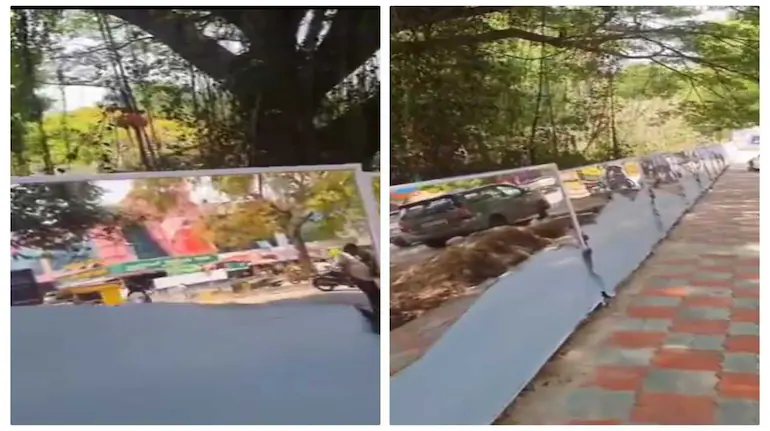
Authorities in Karnataka’s Mysuru have taken a creative approach to tackle open urination by installing reflective steel mirrors along a roadside near the Suburban Bus Stand. The initiative, aimed at discouraging people from using the area as an open toilet, has quickly gone viral on social media and triggered widespread discussion on civic habits and urban sanitation.
The mirrors have been fixed on a wall that had long been a hotspot for public urination, despite repeated warnings from officials. By introducing reflective surfaces, authorities are relying on a psychological effect—people may hesitate to engage in the act when confronted with their own reflection. The once neglected and unsanitary corner has now been transformed into a visually striking installation.

Videos of the setup circulating online have drawn mixed reactions. Many users praised the idea as innovative and practical, noting that it could effectively discourage such behavior without heavy enforcement. The concept of “self-awareness through reflection” has been seen as a simple yet clever solution.

At the same time, the initiative has sparked a broader conversation about infrastructure shortcomings. Critics argue that addressing open urination requires more than deterrence tactics, especially when many cities still lack sufficient clean and accessible public toilets. Several users pointed out that without proper facilities, such measures may only offer a temporary fix.
Concerns were also raised about the condition of existing public restrooms. Some questioned why people are often required to pay for poorly maintained toilets, emphasizing that sanitation is a basic necessity. Suggestions included increasing the number of hygienic washrooms, ensuring regular maintenance, and deploying marshals to monitor and penalize offenders.
Whoever came up with this idea deserves nothing less than a Nobel… Genius 🙏🙏🙏 pic.twitter.com/hI7cTkcKH8
— Akki Rotti (@Theshashank_p) May 6, 2026
Others highlighted practical challenges with the mirror installation itself. Doubts were expressed about its durability, with some predicting that the reflective sheets could soon become dirty, damaged, or vandalized. There were also worries about potential safety risks if the installation deteriorates over time.
While the mirror experiment has succeeded in grabbing attention and sparking dialogue, it has also underscored a deeper issue—India’s ongoing struggle to balance behavioral change with adequate public sanitation infrastructure.