Baramati Tragic Plane Crash: What Went Wrong in the Final Minutes, Questions Still Unanswered
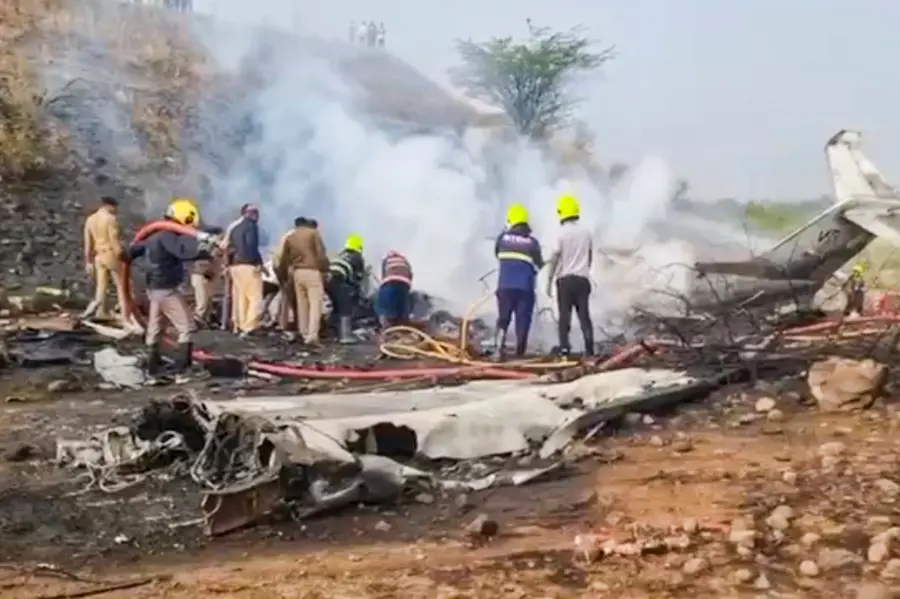
Pune: CID Summons VSR Company Owner R K Singh For Questioning In Ajit Pawar Plane Crash Probe
As investigators reconstruct the last approach, five key gaps remain in understanding how the tragedy unfolded
The tragic plane crash in Baramati that claimed the life of Maharashtra Deputy Chief Minister Ajit Pawar and five others has left the nation in shock. As the Aircraft Accident Investigation Bureau (AAIB) takes over the probe, attention has now shifted to the final minutes before impact and the critical questions that remain unanswered.
The chartered aircraft was carrying Ajit Pawar along with his security personnel and crew members. According to official information, the aircraft attempted to land at Baramati airstrip but failed on the first attempt. It then took off for a go-around and tried to land again. During the second attempt, the aircraft crashed near the runway, killing all six people onboard.
Eyewitness accounts suggest that the plane was seen circling in the sky before descending again. The crash occurred shortly after the second landing attempt, indicating that something went seriously wrong in the final moments of the approach.

One of the primary questions investigators are examining is what exactly happened after the aircraft received its final landing clearance. Reports indicate that air traffic authorities did not receive any response from the cockpit after clearance was given. Flames were observed soon after, suggesting a sudden and catastrophic failure. Whether this was due to a technical malfunction, engine failure, loss of control, or cockpit emergency remains unclear.

The second major concern is why the aircraft attempted to land in poor visibility conditions at an uncontrolled airfield. Baramati is a small airstrip that does not have an Instrument Landing System (ILS), which means pilots must rely on visual cues for alignment and descent. Preliminary information suggests that visibility was poor at the time of landing. The crew had initially reported difficulty in spotting the runway before making a go-around. This raises the question of whether conditions were suitable for a safe landing or whether diversion to another airport should have been considered.
Another puzzling aspect is the sudden radio silence after clearance. Until that point, communication between the aircraft and ground authorities was reportedly normal. The abrupt loss of contact suggests either a severe communication failure, pilot incapacitation, electrical malfunction, or overwhelming workload inside the cockpit during a critical phase of flight.
Investigators are also looking closely at whether the aircraft suffered any mechanical or engine failure during the go-around or final approach. The aircraft reportedly burst into flames near the runway edge. This opens up several possibilities, including fuel leakage, electrical fire, engine malfunction, bird strike, or a hard landing that caused ignition.
The fifth key question revolves around whether standard landing procedures were followed and whether the approach was stable. In aviation, a stable approach is crucial for a safe landing. The aircraft was operating under visual meteorological conditions, and the crew had earlier indicated difficulty in sighting the runway. The fact that the runway was sighted only shortly before clearance raises doubts about whether the aircraft had sufficient time and alignment to complete a safe landing.
Experts point out that small airstrips like Baramati, without advanced landing guidance systems, require high precision and favorable weather conditions. The large loop or arc reportedly observed in the aircraft’s flight path suggests that the pilots were attempting to realign visually with the runway after aborting the first landing attempt. Such manoeuvres are not unusual, but they carry higher risk, especially in poor visibility.
Authorities have confirmed that the aircraft had valid certifications and had undergone recent airworthiness checks. This means maintenance lapses cannot be assumed at this stage. Only a detailed analysis of cockpit voice recordings, flight data recorders, maintenance logs, and weather reports will provide a clearer picture.
As of now, no official conclusion has been drawn on whether the crash was caused by technical failure, human error, environmental factors, or a combination of these elements. Speculation and conspiracy theories have been dismissed, with agencies stating that there is no evidence of sabotage or foul play.
The AAIB will reconstruct the final 26 minutes of the flight to understand the chain of events that led to the disaster. Until then, the exact cause of the crash remains unknown, leaving several crucial questions open and the public awaiting clarity on what went wrong in the final moments of the flight.