Pune’s Rising Heat Linked To Rapid Urbanisation, Shrinking Green Cover And Concretisation
Pune’s Rising Heat Linked To Rapid Urbanisation, Shrinking Green Cover And Concretisation
Saakshi Pandhare
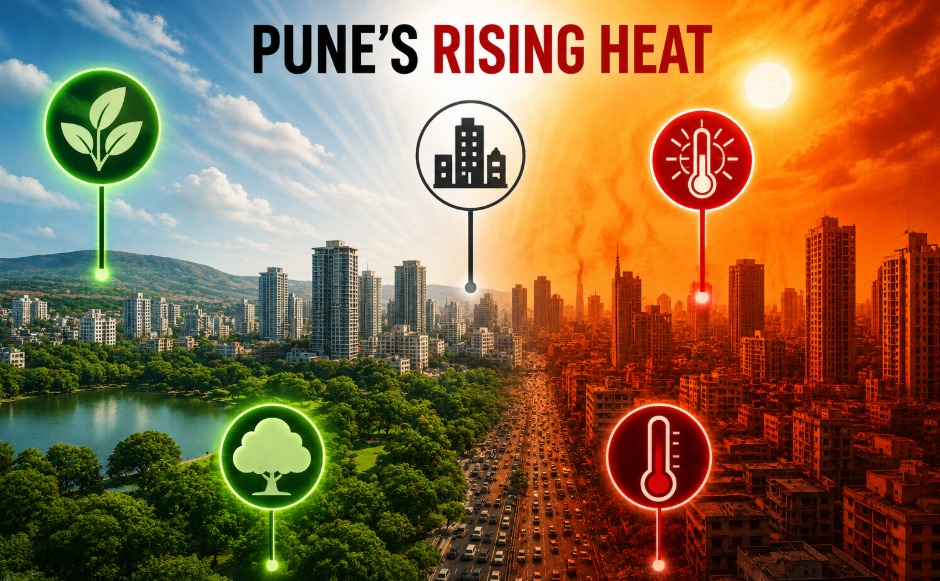
Pune, May 12, 2026: Pune is now facing rising temperatures, shrinking tree cover, and worsening heat conditions. Residents across areas such as Hinjawadi, Kharadi, and Senapati Bapat Road say the city no longer feels as cool and comfortable as it once did.
According to Dr Gurudas Nulkar, Pune’s changing urban landscape has intensified this problem over time. “Urban Heat Islands are essentially patches within cities that record much higher temperatures compared to surrounding regions,” he explained.


Dr Nulkar also pointed to the loss of roadside trees as a major reason behind rising heat. Referring to Senapati Bapat Road, he said the stretch was once heavily shaded, but much of the greenery disappeared due to urban development and road expansion.
Studies support these concerns. A report by World Resources Institute India found that Pune lost nearly 620 hectares of tree cover between 2016–17 and 2019–20 within PMC limits, while built-up land increased by more than 839 hectares during the same period.
A 2025 study further revealed that urbanisation within PMC areas increased from 44.8% in 2012 to 55.17% in 2022, with some areas recording heat island intensity between 2°C and 8°C.
For older residents, the rising temperatures are clearly noticeable.
Seventy-year-old resident Kaivan Bodhanwala recalled Pune’s cooler climate from decades ago. “When I first came to Pune, I was surprised to see places without fans because the climate was naturally pleasant,” he recalled.
He also expressed concern about the impact of extreme heat on labourers and stray animals. “Construction labourers and stray animals suffer tremendously in this weather. People rarely stop to think about what they endure through the day,” he said.
Urban planners say greenery should be treated as essential infrastructure rather than decoration.
Dr Swati Sahastrabudhe, Professor at Dr Bhanuben Nanavati College of Architecture for Women, stressed the importance of ecological planning. “Green infrastructure should form the foundation of city planning rather than being considered later as decoration,” she said.
She noted that older peth areas remain comparatively more livable because of shaded streets and open public spaces, unlike many newly developed commercial zones.
Long-time resident Jyoti Amale said Pune’s environmental decline has happened gradually over several decades. “Most of the greenery that once defined Pune has disappeared,” she said. “The city has never experienced such intense heat before.”
Environmental activist Dr Sushma Date criticised the city’s development model and lack of sustainable planning. “Development without sustainability is fundamentally flawed,” she said. She also raised concerns over excessive concretisation, riverbed construction, and poor tree protection measures.
Experts warn that tree loss not only increases temperatures but also affects biodiversity, groundwater absorption, soil quality, and flood risks. Research suggests that maintaining at least 16% tree cover could help reduce urban temperatures significantly.