West Bengal Election Battle 5 Key Factors That Reshaped the Political Equation
West Bengal Election Battle 5 Key Factors That Reshaped the Political Equation
The political atmosphere in West Bengal has once again turned intense as counting trends for the 294 assembly seats begin to paint a tightly contested picture. Early indications suggest the BJP moving ahead in around 160 seats, while the Trinamool Congress (TMC) is shown leading in approximately 177 seats. At the same time, Bhabanipur constituency is witnessing Mamata Banerjee maintaining an edge over Suvendu Adhikari, keeping the spotlight firmly on one of the most closely watched seats in the state.
Behind this shifting electoral landscape, BJP’s campaign strategy appears to have played a decisive role. Party leaders, including Union Home Minister Amit Shah, reportedly spent nearly 15 days in Bengal, directly shaping ground-level planning and execution. This election, according to political observers, has been driven by a mix of cultural messaging, welfare promises, voter targeting, and deep organizational work.

Cultural Identity and Food Politics Take Center Stage

One of the most discussed narratives in the campaign was the debate around Bengal’s food and identity. Mamata Banerjee had earlier accused the BJP of targeting the state’s traditional fish and rice culture, suggesting an attempt to impose a different food ideology. In response, BJP positioned itself as being aligned with Bengal’s cultural roots, especially the Shakti tradition where fish is considered symbolic and even sacred in some practices. Public appearances by leaders eating fish and rice were used to reinforce the message that cultural habits would not be interfered with regardless of political outcomes.
Religious Symbolism and the Kaaba vs Maa Kali Debate
Another strong narrative that emerged was the contrast between religious symbols. After a video involving TMC leader Sayani Ghosh singing “Mere dil mein hai Kaaba…” circulated widely, BJP amplified the discussion into a larger cultural framing. Senior leaders like Amit Shah and Yogi Adityanath highlighted it as a symbolic contrast between “Kaaba and Maa Kali”, suggesting that Bengal’s identity is deeply rooted in devotion to Goddess Kali and Durga. The party also connected slogans like “Jai Shri Ram” with “Jai Maa Kali” in an attempt to align with regional sentiments.
Women-Centric Promises Intensify the Competition
Welfare schemes aimed at women became another major battleground. The TMC expanded its Lakshmi Bhandar scheme, increasing monthly assistance from ₹1,000 to ₹1,500. BJP responded with a significantly higher promise of ₹3,000 per month for eligible women. At the national level, the push for 33% women’s reservation through a special parliamentary session was highlighted as a major commitment. Prime Minister Narendra Modi also emphasized women’s safety, stating that they should be able to move freely even during late-night hours, countering earlier remarks by Mamata Banerjee advising caution at night.
Voter List Revision and Controversy Around Exclusions
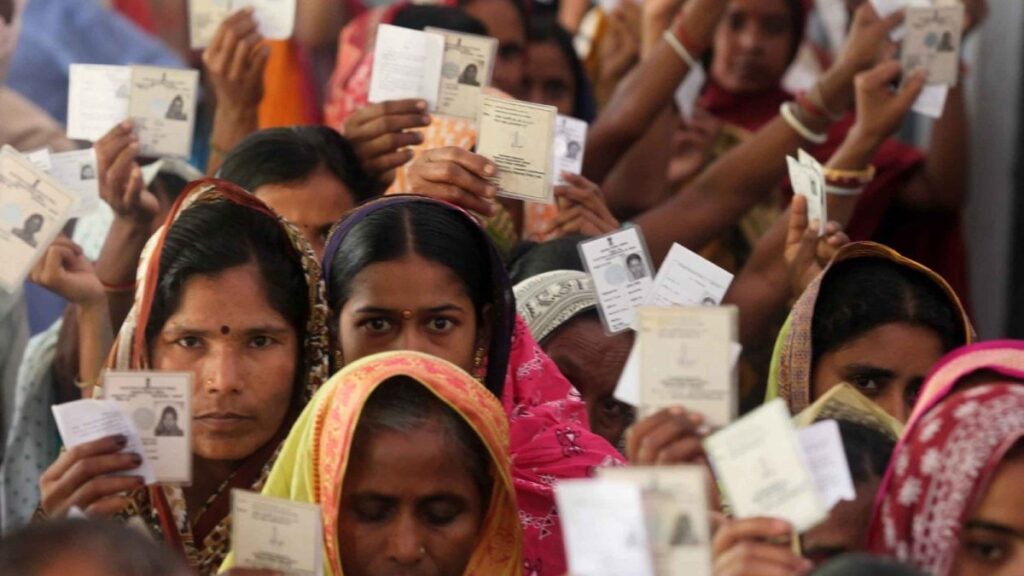
A major administrative development during the election period was the Special Intensive Revision (SIR) of electoral rolls. Around 9.1 million voter names were removed, reducing the total voter count by nearly 11.8%, from 7.66 crore to 6.75 crore. The highest impact was seen in districts such as Murshidabad, Malda, and North 24 Parganas, which have significant minority populations. The BJP described this exercise as a necessary step to remove alleged illegal entries and irregular votes, calling it a “clean-up of the voter list.”
Anti-Incumbency and Micro-Level Election Management
After 15 years of continuous governance by the TMC, anti-incumbency sentiment became a central factor in the campaign narrative. BJP focused heavily on issues like corruption allegations and “syndicate raj” to build its case. Learning from its earlier performance in 2021, the party strengthened its organizational structure at the booth level. Reports suggest that all 80,719 polling booths were studied in detail under Amit Shah’s guidance.
A key feature of this approach was the “Panna Pramukh” system, where each worker was assigned responsibility for 30 to 60 voters, ensuring direct outreach and mobilization. The party also reduced dependence on outside leadership by promoting local candidates, repeatedly emphasizing that Bengal’s leadership would emerge from within the state itself, not from external imposition.