Why Clear Non-Veg Labels Have Become Essential in Indian Dining Spaces
Why Clear Non-Veg Labels Have Become Essential in Indian Dining Spaces
In the age of social media outrage, restaurants are choosing radical transparency over reputation risk
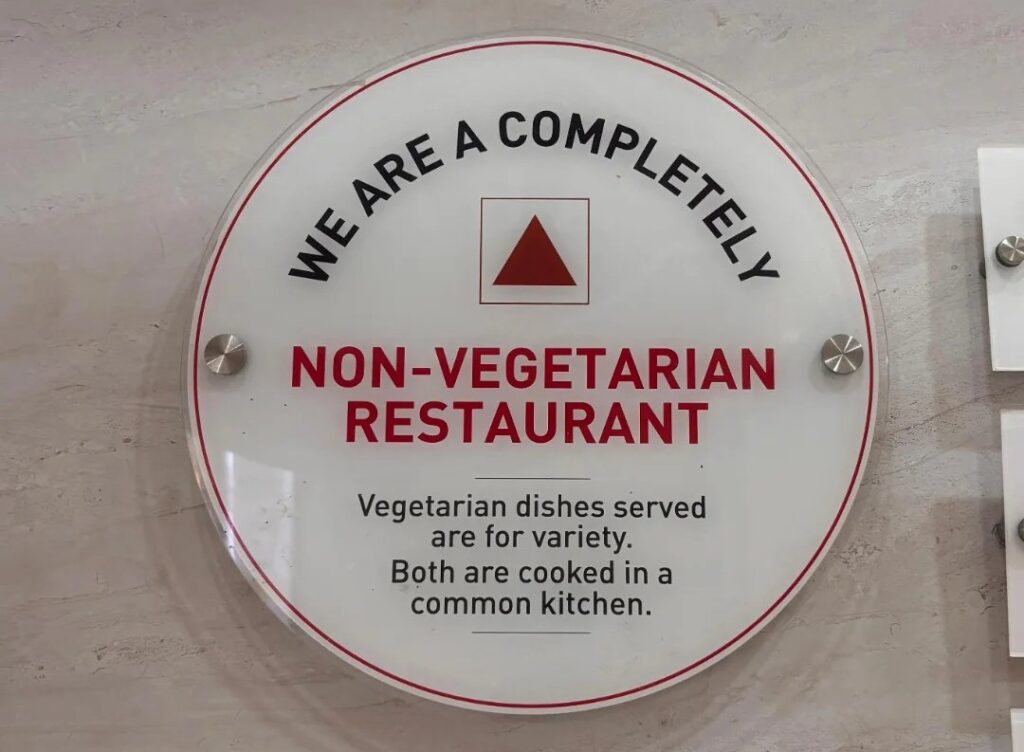
A simple circular sign mounted on a restaurant wall has become the unlikely symbol of a new era in India’s dining culture. The message is clear and unapologetic: “WE ARE A COMPLETELY NON-VEGETARIAN RESTAURANT.” Below it, a clarification that would have seemed unnecessary just a few years ago: “Vegetarian dishes served are for variety. Both are cooked in a common kitchen.”
This isn’t just signage. It’s survival strategy in an age where one misunderstood social media post can unravel decades of carefully built reputation in minutes.
Across Indian cities, an increasing number of restaurants have begun displaying prominent declarations of their non-vegetarian status at their entrances. The trend reflects a fundamental shift in how food businesses approach customer communication in the social media era. What was once considered obvious or understood through menu offerings now requires explicit, unambiguous declaration.
The reasoning is simple yet profound. In today’s hyperconnected world, a single viral video, one edited clip shared by an offended influencer, or a misrepresented dining experience can trigger waves of outrage that obliterate reputations built over generations. Restaurants have learned, often through painful experience, that assumptions are dangerous and ambiguity is a liability.

Mallu restaurants have begun displaying "Non-Vegetarian" signboards to avoid the reputational damage that comes from vegetarian engagement baiters on X. pic.twitter.com/wMLSrlO2WP
— Rishi | ഋഷി | 🌐🗽🥥🔰🏙 (@RishiJoeSanu) November 17, 2025
The circular sign represents more than regulatory compliance or customer service. It embodies a philosophy of radical transparency that acknowledges the volatile nature of public opinion in the digital age. When clarity is displayed upfront, customers make informed choices rather than stumbling into accidental experiences that breed resentment, regret, and ultimately, social media revenge.
The Cost of Confusion
The restaurant industry has witnessed numerous instances where lack of clear communication about food preparation practices led to public relations disasters. Vegetarian customers who unknowingly ate at establishments where meat and vegetarian dishes share kitchen space have taken to social media platforms to express their shock, disappointment, and often, anger.
These experiences, amplified through shares and retweets, have caused significant damage to restaurant brands. What might have been avoided through simple, upfront disclosure instead becomes a cautionary tale shared across communities. The emotional response from customers who feel deceived, even unintentionally, generates the kind of negative publicity that traditional marketing budgets cannot counteract.
For vegetarian patrons in India, where dietary choices often carry deep religious, cultural, and ethical significance, discovering after the fact that their meal was prepared in a kitchen handling meat products can feel like a violation of trust. The intensity of this sentiment cannot be understated. It’s not merely about preference but about values, identity, and sometimes, spiritual beliefs.
The Power of Informed Choice
The bold NON-VEG signboard eliminates confusion before it can breed drama. It serves as a filter that allows customers to make decisions aligned with their values before crossing the threshold. This upfront honesty benefits all parties involved.
Vegetarian customers appreciate knowing the full context of how their food is prepared. Those with strict dietary requirements can choose whether they’re comfortable with shared kitchen facilities. Non-vegetarian customers, meanwhile, understand exactly what kind of establishment they’re entering without any pretense or ambiguity.
Social Media: Judge, Jury, and Executioner
The rise of social media has fundamentally altered the power dynamics between businesses and consumers. A dissatisfied customer no longer merely walks away or shares their experience with friends over coffee. Today, they can broadcast their grievances to thousands or even millions of people within minutes.
The viral nature of outrage content means that negative experiences spread far more rapidly and widely than positive ones. A “veg influencer” discovering meat preparation in what they assumed was a pure vegetarian kitchen can create content that reaches audiences far beyond their immediate followers. The emotional authenticity of feeling deceived makes such content particularly shareable.
Restaurants have learned that defending themselves after such incidents proves nearly impossible. No amount of clarification, apology, or explanation can fully counteract the initial emotional impact of the accusation. The court of public opinion operates on immediate reactions rather than nuanced understanding. By the time a restaurant can mount a response, the damage has already been done.
The Bravest Display: Unfiltered Truth
There’s something counterintuitive yet powerful about restaurants choosing to potentially limit their customer base through such explicit declarations. In an industry where maximizing foot traffic typically drives decision-making, willingly displaying information that might discourage some customers seems commercially questionable.
Yet this approach reflects a deeper wisdom. The restaurants adopting these signboards understand that the customers they might lose through upfront honesty pale in comparison to those they would lose through perceived deception. They recognize that building a loyal customer base requires trust, and trust begins with transparency.
Beyond Binary Categories
The signboard in the image reveals another layer of complexity in India’s food culture. The note that “Vegetarian dishes served are for variety” acknowledges that many non-vegetarian restaurants offer vegetarian options to accommodate diverse dining groups and preferences. However, the critical detail follows: “Both are cooked in a common kitchen.”
This distinction matters enormously to many vegetarian diners in India. For some, eating vegetarian food prepared in utensils or spaces that have contact with meat products violates their dietary principles. Others might not have such strict requirements but still appreciate knowing the complete picture.
By explicitly stating this information, the restaurant navigates a middle ground. It can serve both vegetarian and non-vegetarian customers while ensuring that vegetarian patrons understand the full context of their meal preparation. This prevents the scenario where a vegetarian customer assumes they’re dining in a “pure vegetarian” environment simply because they ordered vegetarian dishes.
The Regulatory Landscape
Food safety authorities in various Indian states have increasingly emphasized the importance of clear disclosure about food preparation practices. These regulations reflect both consumer protection principles and the practical necessity of preventing food safety issues and customer complaints.
Cultural Context
Understanding the significance of these signboards requires appreciating the deep cultural importance of dietary choices in Indian society. Unlike many Western contexts where vegetarianism is primarily viewed as a personal choice or health decision, in India it’s often intertwined with religious identity, caste considerations, and cultural heritage.
For many Indians, their vegetarian or non-vegetarian status forms a core part of their identity. It influences not just what they eat but where they socialize, whom they dine with, and how they navigate public spaces. This cultural reality means that food-related misunderstandings carry weight far beyond the immediate transaction.
The non-vegetarian signboard thus serves as more than consumer information. It’s a cultural marker that helps people navigate social spaces in ways that align with their identity and values. It reduces the anxiety that vegetarian diners might otherwise experience about unknowingly violating their dietary principles.