‘Tesla Gets a Brain Freeze’: Viral Clip Captures Carmaker’s Tech Navigating Chaotic Indian Traffic
‘Tesla Gets a Brain Freeze’: Viral Clip Captures Carmaker’s Tech Navigating Chaotic Indian Traffic
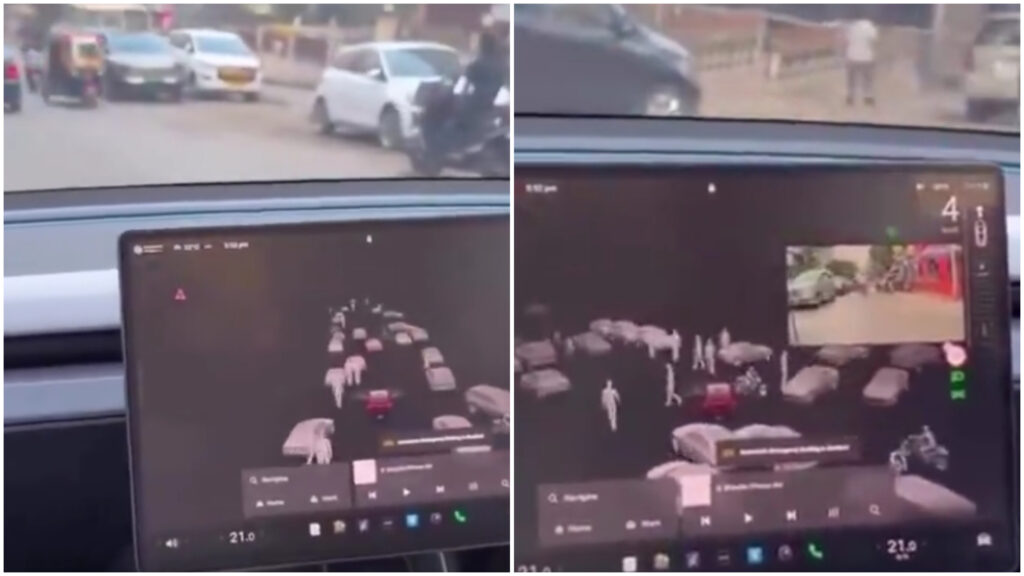
Viral footage showing a Tesla attempting to make sense of dense Indian traffic has set off a storm of reactions across social media platform X. Recorded from inside the vehicle, the clip clearly displays the car’s central touchscreen as it continuously maps nearby cars, scooters, auto-rickshaws and pedestrians moving in close quarters on a crowded road.
Within hours of being shared, the video attracted thousands of views and comments. Many viewers responded with humour, while others raised serious questions about whether advanced driver-assistance systems (ADAS) are truly equipped for India’s complex and often unpredictable road conditions.
The display in the clip appears to show Tesla Vision in action — the company’s camera-based system that operates without radar. Built to provide high-definition spatial awareness, it identifies lane markings, traffic flow and surrounding objects using cameras alone. In this instance, however, the system seems visibly strained as icons representing vehicles and pedestrians crowd the screen in a tightly packed, non-lane-driven traffic environment.

Online reactions ranged from playful to pointed. One user joked that the car had developed a “brain migraine,” while another remarked, “Tesla needs to go fully manual on Indian roads.” A third quipped, “Tesla thought it was smart. Indian roads said: ‘Hold my pothole.’”
Some users expressed deeper skepticism. “It will glitch and die. It was not manufactured to handle so much load,” one comment read, reflecting concerns about how such systems cope with heavy traffic density and unpredictable driving behaviour.
Others took a different view, suggesting the chaotic setting could serve as valuable training data. “That’s not a migraine, that’s FSD getting its PhD in absolute chaos navigation,” one user wrote, implying that mastering Indian roads could make the technology stronger elsewhere. Another comment emphasized the need for localisation, stating that the software may require updates tailored specifically to Indian road behaviour and infrastructure.
Infrastructure challenges also became part of the discussion. Several users questioned whether the system could reliably detect potholes, abrupt lane changes and informal traffic patterns that are common on Indian streets. The broader debate once again highlighted how road discipline, regulatory frameworks and infrastructure quality can significantly impact the performance of semi-autonomous systems.
The exact location of the footage remains unconfirmed, and the original post provided no additional details beyond the caption: “Tesla got brain migraine on Indian roads.”
Though Tesla’s ADAS features are designed to interpret surroundings with precision, experts have often pointed out that real-world performance can vary dramatically across regions. Highly dynamic traffic ecosystems like India’s present a distinct challenge for global autonomous-driving technologies developed primarily in more structured environments.
Humour may have driven the clip’s popularity, but the discussion it sparked touches on a much larger issue — whether cutting-edge automotive technology can seamlessly adapt to some of the most demanding road conditions in the world. For autonomous systems, India may prove to be the ultimate stress test.