Mira–Bhayander Flyover Narrows From Four Lanes To Two, Videos of the Structure Viral, Sparks Safety Fears

Mira–Bhayander Flyover Narrows From Four Lanes To Two, Videos of the Structure Viral, Sparks Safety Fears
MMRDA says lane drop is a planned engineering decision linked to future expansion, but critics warn of congestion and accident risks
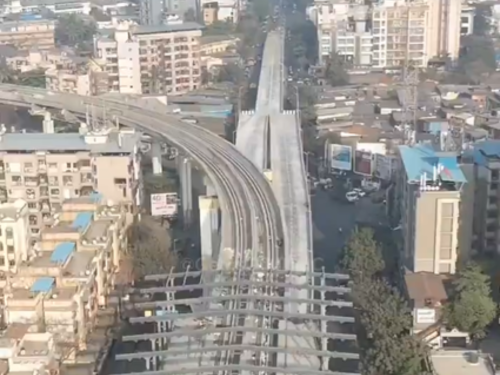
A newly opened flyover in Mira–Bhayander has come under sharp public scrutiny after social media users flagged an abrupt reduction from four lanes to two, raising concerns over traffic safety and congestion in the busy Mumbai Metropolitan Region. The controversy erupted after images and videos of the structure went viral, with many calling the sudden narrowing an “invitation to crashes.”
The flyover is part of the Metro Line 9 double-decker corridor being developed by the Mumbai Metropolitan Region Development Authority (MMRDA). According to officials, the lane reduction is not a design flaw but a planned engineering feature dictated by land availability, right-of-way constraints and future expansion plans.
A 4-lane flyover in Mira-Bhayandar suddenly narrows into just 2 lanes. This double-decker flyover is a part of the Metro Line 9 project by JKumar and is set to be inaugurated in February.
— Gems of Mira Bhayandar (@GemsOfMBMC) January 26, 2026
Is this how @MMRDAOfficial designs “infrastructure”?
How did this design get approved? 🤷🏻 pic.twitter.com/ZNfwi1Yf9W
The stretch at the centre of the debate is the 1.5-kilometre Deepak Hospital–Phatak Road section in Bhayander East. Commuters and local residents have questioned why a four-lane elevated road would suddenly funnel traffic into two lanes without a longer transition zone. Critics argue that such a design could lead to bottlenecks, confusion among drivers and a higher risk of accidents, particularly during peak hours.

The flyover does not “suddenly narrow.” The transition from 4 lanes to 2 lanes is not a design flaw, but is based on available road width constraints, and future network planning.
— MMRDA (@MMRDAOfficial) January 27, 2026
As per planning, the flyover has been designed with two lanes for Bhayander East and future… https://t.co/hZrsBl9SAR
Responding to the criticism, MMRDA maintained that the configuration is intentional. Officials said the flyover has currently been designed with two lanes towards Bhayander East, while provision has been kept for two additional lanes towards Bhayander West in the future. The authority stated that the present layout aligns with long-term traffic planning and anticipated expansion across the Western Railway line once approvals and coordination with the Mira–Bhayander Municipal Corporation are completed.
Very true. People must not make fun of MMRDA and the team that designed this masterpiece.
— Aaditya Thackeray (@AUThackeray) January 27, 2026
Next year, another MoU on teaching this design to other countries. The bride will be complete by the timeline of everything else that was promised- 2047.
What stupidity can lead to this… https://t.co/E1Pzn0ZBXT
MMRDA also pointed out that other sections of the Metro Line 9 double-decker corridor are at different stages of completion. Portions such as the 1.1-kilometre SK Stone Circle–Shivar Garden stretch and the 754-metre Kashigaon Metro Station–Saibaba Hospital stretch have already been opened to traffic. Officials said the corridor is being developed in phases, and interim arrangements are unavoidable in complex urban infrastructure projects.
To address safety concerns, the authority said the flyover has been equipped with standard traffic management features, including proper signage, rumble strips and crash barriers. Inputs from the traffic police were incorporated into the design before opening the stretch to vehicular movement. MMRDA emphasised that the primary objective of the structure is traffic dispersal and congestion reduction, not merely increasing lane count.
The issue has also drawn political reactions. Shiv Sena (UBT) leader Aaditya Thackeray took a dig at the project on social media, questioning the logic behind a sudden lane reduction and warning that such designs could create chaos rather than ease traffic. His remarks added fuel to an already heated online debate, with users divided between those accepting MMRDA’s explanation and those demanding design changes.
Urban planners note that sudden lane drops are not uncommon in cities where infrastructure is built in stages, but stress that clear advance warnings, adequate taper lengths and strict enforcement are essential to minimise risks. In high-density corridors like Mira–Bhayander, even minor design miscalculations can have outsized consequences for daily commuters.
For now, MMRDA has ruled out any immediate redesign, reiterating that the flyover’s current form is temporary and aligned with future expansion plans. Whether this assurance is enough to calm public concern remains to be seen, as traffic volumes increase and real-world usage puts the design to the test.