Mumbai–Pune in Just 90 Minutes: How Budget 2026’s High-Speed Rail Will Transform Connectivity
Mumbai–Pune in Just 90 Minutes: How Budget 2026’s High-Speed Rail Will Transform Connectivity
Mumbai Pune Travel Time | Budget 2026 High-Speed Rail Corridor
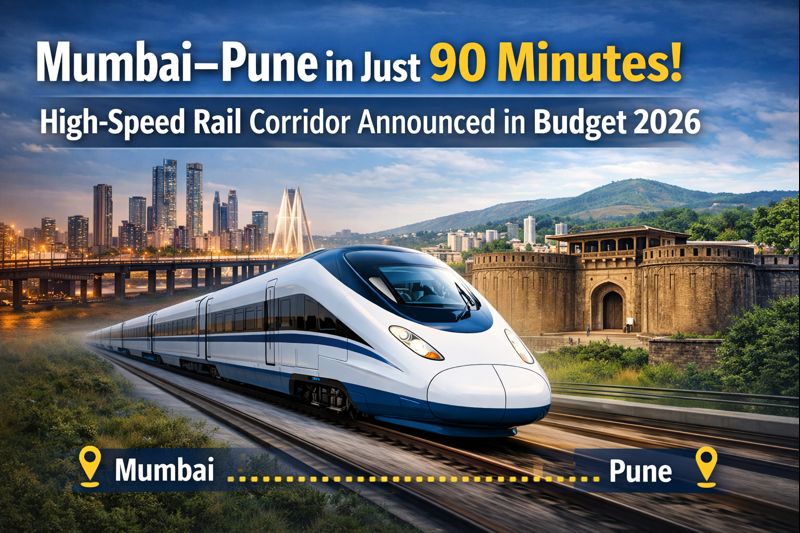
Mumbai and Pune could soon be just 90 minutes apart, as the government’s Union Budget 2026 announces a major push towards high-speed rail connectivity. One of the most significant infrastructure announcements in the budget is the launch of seven new high-speed rail (HSR) corridors, aimed at drastically reducing travel time between India’s key economic and cultural hubs.
Budget 2026: A Major Boost to High-Speed Rail Connectivity
Finance Minister Nirmala Sitharaman, while presenting the Union Budget 2026, unveiled plans to develop seven “growth connector” high-speed rail corridors across the country. These corridors are expected to reshape passenger travel, boost economic activity, and enhance inter-city connectivity.

The proposed high-speed rail routes include:
- Mumbai – Pune
- Pune – Hyderabad
- Hyderabad – Bengaluru
- Hyderabad – Chennai
- Chennai – Bengaluru
- Delhi – Varanasi
- Varanasi – Siliguri
Once operational, these corridors will significantly reduce travel durations compared to existing road and conventional rail networks.
Mumbai–Pune Travel Time to Drop to 60–90 Minutes
At present, travelling between Mumbai and Pune takes three to four hours by road or train, depending on traffic, ghat sections, and toll congestion. With the proposed high-speed rail corridor, the journey time is expected to reduce to just 60 to 90 minutes, offering a faster, smoother, and more reliable alternative for daily commuters and business travellers.
Similarly, the Pune–Hyderabad journey, which currently takes eight to ten hours, could be completed in three to four hours once the corridor becomes operational.
What Is a High-Speed Rail (HSR) Corridor?
A high-speed rail corridor is a dedicated railway line designed exclusively for very high-speed trains, commonly referred to as bullet trains.
- Track Design: These corridors use standard gauge tracks, separate from conventional rail lines. Routes are often elevated or underground to eliminate crossings and obstacles.
- Technology: The project is expected to use advanced Japanese Shinkansen or European rail technology. India’s first high-speed rail project, the Mumbai–Ahmedabad corridor, is already being developed with Japanese assistance.
Speed, Safety and Advanced Infrastructure
- Operating Speed: Trains on these corridors are expected to run at 250–320 kmph, with a potential maximum speed of up to 350 kmph.
- Signalling Systems: Advanced safety systems such as Kavach or Automatic Train Control (ATC) will be deployed to ensure accident-free operations.
- World-Class Stations: Stations will be developed on the lines of modern airports, offering passengers enhanced comfort and facilities.
Economic, Environmental and Urban Benefits
The high-speed rail initiative is expected to deliver wide-ranging benefits:
- Economic Growth: Improved connectivity between major IT, industrial, and commercial centres like Mumbai, Pune, and Hyderabad will accelerate trade, investments, and job creation.
- Sustainable Transport: High-speed trains generate significantly lower carbon emissions compared to air travel and private vehicles, supporting India’s sustainability goals.
- Balanced Urban Development: Faster travel will encourage the growth of satellite cities, reducing population pressure on major metros.
Implementation and Next Steps
The high-speed rail projects will be implemented by the National High-Speed Rail Corporation Limited (NHSRCL). Land acquisition and technical processes are expected to begin soon, marking a major step forward in India’s infrastructure development journey.
With Budget 2026 placing strong emphasis on speed, safety, and connectivity, the Mumbai–Pune high-speed rail corridor could redefine how millions travel between the two cities in the coming years.